Research & Development World

  • R&D World Home
  • Topics
    • Aerospace
    • Automotive
    • Biotech
    • Careers
    • Chemistry
    • Environment
    • Energy
    • Life Science
    • Material Science
    • R&D Management
    • Physics
  • Technology
    • 3D Printing
    • A.I./Robotics
    • Software
    • Battery Technology
    • Controlled Environments
      • Cleanrooms
      • Graphene
      • Lasers
      • Regulations/Standards
      • Sensors
    • Imaging
    • Nanotechnology
    • Scientific Computing
      • Big Data
      • HPC/Supercomputing
      • Informatics
      • Security
    • Semiconductors
  • R&D Market Pulse
  • R&D 100
    • 2025 R&D 100 Award Winners
    • 2025 Professional Award Winners
    • 2025 Special Recognition Winners
    • R&D 100 Awards Event
    • R&D 100 Submissions
    • Winner Archive
  • Resources
    • Research Reports
    • Digital Issues
    • Educational Assets
    • R&D Index
    • Subscribe
    • Video
    • Webinars
    • Content submission guidelines for R&D World
  • Global Funding Forecast
  • Top Labs
  • Advertise
  • SUBSCRIBE

3D Graphene Demonstrates that Optical Properties are Tunable

By Hemholtz Zentrum Berlin | May 31, 2017

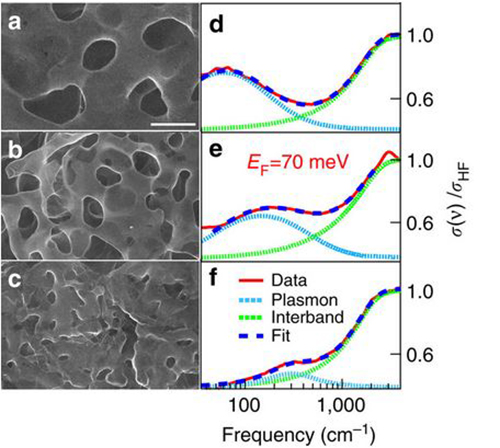
SEM-images of 3D graphene with different pore size (a,b,c, scale = 1μm). Optical properties (d,e,f) change with pore size. Image: 10.1038/ncomms14885

An international research team has for the first time investigated the optical properties of three-dimensional nanoporous graphene at the IRIS infrared beamline of the BESSY II electron storage ring. The experiments show that the plasmonic excitations (oscillations of the charge density) in this new material can be precisely controlled by the pore size and by introducing atomic impurities. This could facilitate the manufacture of highly sensitive chemical sensors.

Carbon is a very versatile element. It not only forms diamonds, graphite, and coal, but can also take a planar form as a hexagonal matrix – graphene. This material, consisting of only a single atomic layer, possesses many extreme properties. It is highly conductive, optically transparent, and is mechanically flexible as well as able to withstand loads. André Geim and Konstantin Novoselov received the 2010 Nobel Prize in Physics for the discovery of this exotic form of carbon. And just recently, a Japanese team has been successful in stacking two-dimensional graphene layers in a three-dimensional architecture with nanometer-sized pores.

A research team operated by a group at Sapienza University in Rome has now for the first time made a detailed investigation of the optical properties of 3D graphene at BESSY II. The team was able to ascertain from the data how charge density oscillations, known as plasmons, propagate in three-dimensional graphene. In doing so, they determined that these plasmons follow the same physical laws as 2D graphene. However, the frequency of the plasmons in 3D graphene can be very precisely controlled, either by introducing atomic impurities (doping), by the size of the nanopores, or by attaching specific molecules in certain ways to the graphene. In this way, the novel material might also lend itself to manufacturing specific chemical sensors, as the authors write in Nature Communications. In addition, the new material is interesting as an electrode material for employment in solar cells. 

The researchers used the IRIS beamline at the BESSY II synchrotron source in Berlin to their advantage for their investigations. Broad-band infrared is available there, which especially facilitates spectroscopic analysis of novel materials using terahertz radiation. “A special operating mode of the BESSY II storage ring called low-alpha allowed us to measure the optical conductivity of three-dimensional graphene with a particularly high signal-to-noise ratio. This is hardly possible with standard methods, especially in the terahertz region. However, it is exactly this region that is important for observing critical physical properties,” says Dr. Ulrich Schade, head of the group at the infrared beamline.

Source: Hemholtz Zentrum Berlin
Related Articles Read More >

The emerging materials shaping next-generation semiconductor electronics
24 R&D trends that redefined 2024
Graphene-based flowmeter sensor measures nano-rate fluid flows, Part 3: The sensor
Graphene-based flowmeter sensor measures nano-rate fluid flows, Part 2: The graphene context
rd newsletter
EXPAND YOUR KNOWLEDGE AND STAY CONNECTED
Get the latest info on technologies, trends, and strategies in Research & Development.
RD 25 Power Index

R&D World Digital Issues

Fall 2025 issue

Browse the most current issue of R&D World and back issues in an easy to use high quality format. Clip, share and download with the leading R&D magazine today.

R&D 100 Awards
Research & Development World
  • Subscribe to R&D World Magazine
  • Sign up for R&D World’s newsletter
  • Contact Us
  • About Us
  • Drug Discovery & Development
  • Pharmaceutical Processing
  • Global Funding Forecast

Copyright © 2026 WTWH Media LLC. All Rights Reserved. The material on this site may not be reproduced, distributed, transmitted, cached or otherwise used, except with the prior written permission of WTWH Media
Privacy Policy | Advertising | About Us

Search R&D World

  • R&D World Home
  • Topics
    • Aerospace
    • Automotive
    • Biotech
    • Careers
    • Chemistry
    • Environment
    • Energy
    • Life Science
    • Material Science
    • R&D Management
    • Physics
  • Technology
    • 3D Printing
    • A.I./Robotics
    • Software
    • Battery Technology
    • Controlled Environments
      • Cleanrooms
      • Graphene
      • Lasers
      • Regulations/Standards
      • Sensors
    • Imaging
    • Nanotechnology
    • Scientific Computing
      • Big Data
      • HPC/Supercomputing
      • Informatics
      • Security
    • Semiconductors
  • R&D Market Pulse
  • R&D 100
    • 2025 R&D 100 Award Winners
    • 2025 Professional Award Winners
    • 2025 Special Recognition Winners
    • R&D 100 Awards Event
    • R&D 100 Submissions
    • Winner Archive
  • Resources
    • Research Reports
    • Digital Issues
    • Educational Assets
    • R&D Index
    • Subscribe
    • Video
    • Webinars
    • Content submission guidelines for R&D World
  • Global Funding Forecast
  • Top Labs
  • Advertise
  • SUBSCRIBE