
-A team of international researchers has found that a strain of anthrax-causing bacterium thought to have been viable 80 years after a thwarted World War I espionage attack, was, in reality, a much younger standard laboratory strain. The team speculates that the mix-up was due to commonplace laboratory contamination.
The study, published this week in mBio®, an open-access journal of the American Society for Microbiology, highlights the advances in genomic sequencing that now enable precise tracking of bacterial strains used in biological warfare and terrorist attacks around the world.
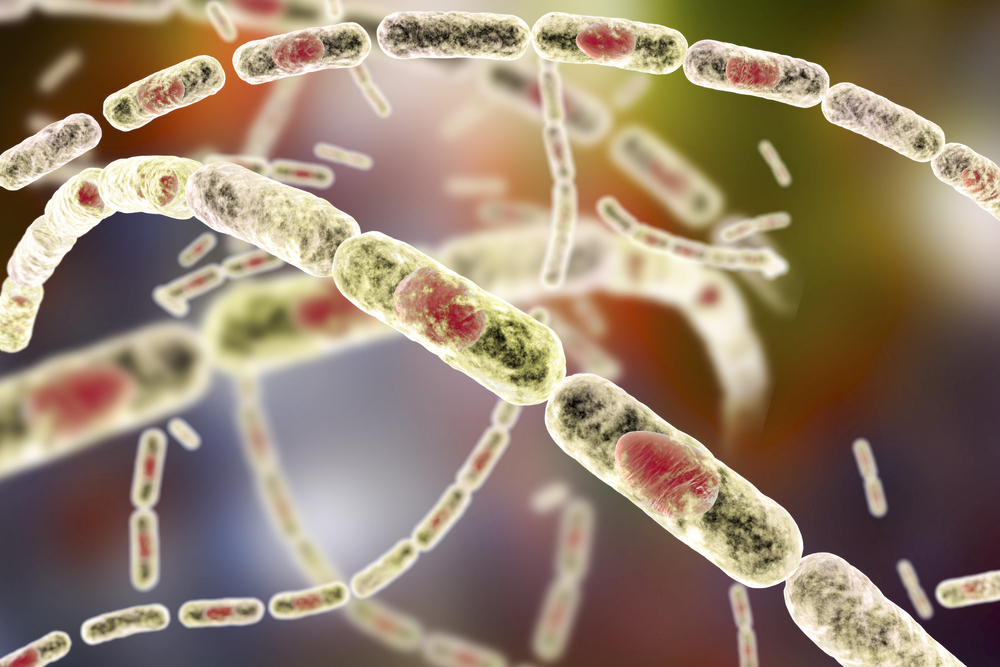
“Historically, there have always been bacterial strain mix-ups in the course of doing research,” says Paul Keim, executive director of The Pathogen and Microbiome Institute at Northern Arizona University in Flagstaff and senior author on the current study. “But now that we have the molecular tools, we can do the quality control on strain collections to figure out exactly what they contain.” (image: Bacillus anthracis bacteria using Gram-stain technique. credit: CDC)
The current study helps debunk the claim that a World War I biological weapon containing anthrax-causing spores was still viable 80 years later. In 1917, German spy Baron Otto von Rosen was caught in Norway possessing lumps of sugar embedded with glass capillaries filled with a liquid holding spores of Bacillus anthracis, the bacterium that causes anthrax. He was suspected of plotting to feed the sugar lumps, which contained the oldest known isolates of B. anthracis, to the reindeer that pulled transports of munitions and foods across the frozen Arctic tundra for the Allied forces.
The poison-laced sugar remained in a Norwegian police museum until 1997, when it was sent to what is now known as the Defence Science and Technology Laboratory in Porton Down, United Kingdom. Researchers there used DNA amplification to determine that the agent inside the tiny glass tubes was indeed B. anthracis. After some extensive laboratory coaxing, they next cultured and isolated four colonies grown from the liquid inside the tubes. In a 1998 Nature paper, they declared that they had revived the anthrax bacterial strain that had spent 8 decades as spores (Ref 1).
However, DNA sequencing of entire organism’s genome was in its infancy at this time, so the exact genetic identity of the strain was never defined. In 2001, Keim was tapped to help investigate the anthrax-containing letters mailed by a terrorist across the US. At the request of the FBI, Keim’s team categorized all known anthrax-causing strains, which included the Porton Down ‘sugar’ samples and other samples from around the world.
At that time, Keim noted a very close genetic similarity between the Porton Down strains and what had become the standard laboratory reference strain used in experiments and vaccine development, known as the Ames Ancestor strain. Amidst the urgency of pinning down which strain was used in the letters–it turned out to be the Ames strain–he forgot about the strange similarity.
“As we learned more and more about the Ames strain, it became obvious that it had to be a contaminant,” in the Porton Down samples, says Keim. Then, at a 2013 conference, he was approached by German biodefense researchers, who had sequenced what they thought was the original German spy’s strain. They too had noticed its genetic resemblance to the Ames strain.
Working in tandem, Keim’s Arizona team and Herman Meyer and Markus Antwerpen at the Bundeswehr Institute of Microbiology in Munich, sequenced the strains using next-generation sequencing (NGS), a technique that allowed them to analyze every genetic difference at the level of single letter changes to the genetic code. It also allows them to sequence a strain’s entire genome, not just a handful of times, like the previous technology used in 2001, but 100 times over. The new technology also costs about 10,000 times less per genome sequenced.
Both labs confirmed that the Porton Down ‘sugar’ strains differed by only two genetic letters from the Ames Ancestor strain–a near identical matching. The researchers speculate that during the intense culturing attempts of the sugar samples in 1997, spores from the Ames Ancestor strain, which were likely to be abundant in the Porton Down military defense laboratory facilities, fell into the culture media and grew.
Two of the original Porton Down researchers, Martin Pearce and Caroline Redmond, collaborated on this new study to confirm that indeed, a likely contamination event threw off their results. “That work has been cited many times as evidence that spores can survive in liquid for 80 years–and now that’s clearly not true,” says Keim, leaving it an open question of just how long B. anthracis spores can survive and still cause disease.
“But their first finding that the capillary tube did include B. anthracis DNA was a solid result,” says Keim. Unfortunately, none of the 1917 sample remains to be completely sequenced using today’s technology.
But how do the new study’s authors know their work is not suffering from contamination, as well? “It was independently verified by two different labs, working on two different continents,” says Keim, a strong argument against contamination.
The work also showcases the important role that NGS can play in the quality control monitoring of bacterial strain repositories around the world–to ensure that strains being used in experiments are truly what researchers think they are and to catch strain contamination when it happens.