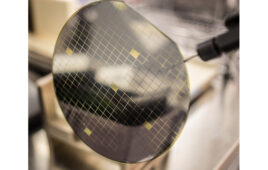
One of the most recent semiconductor fabrication facilities added to Texas Instruments’ lineup of 12 worldwide wafer fabs is located in Richardson, Texas. Aptly named RFAB for short, the fab’s list of industry firsts and achievements in next-generation cleanroom design are much longer. RFAB is the world’s first LEED-Certified semiconductor manufacturing facility, featuring several designed-in technologies that allow for more sustainable cleanroom operation and low cost environmental control.
CONFERENCE AGENDA ANNOUNCED:
The highly-anticipated educational tracks for the 2015 R&D 100 Awards & Technology Conference feature 28 sessions, plus keynote speakers Dean Kamen and Oak Ridge National Laboratory Director Thom Mason. Learn more.
The fab’s features include:
- Well-insulated and airtight construction to maximize energy efficiency at the building envelope;
- High-efficiency fan filter units (FFUs) to recirculate and remove particles from the cleanroom air stream;
- Run-around coils on the make-up air systems, which allow more efficient use of heat exchange systems to minimize the reheating requirement when dehumidifying outdoor air;
- Extensive use of larger and straighter pipe and ductwork to reduce inherent pressure loss/restriction, thereby enabling installation of smaller, lower cost, more efficient pumps and fans; and
- Gravity-driven waste streams achieved through proper layout and upfront planning. These eliminate the need for lift stations and reduce potential impact from airborne molecular contamination (AMC).
The inception of RFAB and construction of the LEED-Certified semiconductor manufacturing facility began in 2004. Not only was focus on sustainability paramount, the design team was tasked with building a factory at 30 percent lower cost than a similar 300mm wafer fab located just six miles away. Though construction was completed in 2006, the first wafer was produced from the site in 2010.
 At a high-level, the fab consists of two-level fab construction; an open-floor, flow-through ballroom design (minimal columns, waffle slab, common plenums) spanning 284,000 sq. ft.; and cleanroom environmental control equipment including fan filter HEPA units at 25% coverage, mini-environment for all tools and sealed wafer carriers (FOUPs), makeup air systems to control dewpoint and pressure, cleanroom sensible cooling coils to control temperature, ionizers to mitigate static electricity in stockers, incoming, and wet chemical areas, UV sleeves for cleanroom lights in photolithography to filter wavelengths below 520nm, real-time airborne molecular contamination systems.
Environmental control technologies and techniques
It is easier to list the parameters and conditions that have no impact on the semiconductor manufacturing process than it is to detail those that do. However, all of these parameters fall into two general categories for cleanroom environmental control. The first are parameters with absolute control requirements such as cleanroom differential pressure, particle counts, static electricity, and exposure to UV light. The second are parameters with both absolute and rate-of-change/stability control requirements such as cleanroom temperature, dewpoint, and AMC.
Sustainability and cost efficiency were the fundamental design criteria for RFAB; therefore, the basic configuration chosen was a ballroom concept to maximize space utilization. When it came to choosing the required cleanroom classification, the predominant trend at the time had paced toward cleaner and cleaner classifications for the main cleanroom area. RFAB cleanroom design departed from that scheme, opting for a fully automated factory, sealed wafer carriers, and tool mini-environments. If the wafers are only exposed to an air stream inside the manufacturing tools, there is no need to operate a cleanroom at Class 1 levels. Instead, each tool has a HEPA filtration system allowing it to achieve Class 1 capability while the ballroom can operate at Class 100 or higher. This change significantly reduced the recirculation air flow rate and number of FFU’s required to maintain cleanroom particle spec. The benefits do not stop there; reducing recirculation air flow rate reduces motor power, which in turn reduces sensible heat load, which significantly reduces the requirement for heat rejection equipment such as cooling towers and chillers. Furthermore, the ballroom design concept, coupled with FFUs, generates a negative plenum that further minimizes risk of particle contamination caused by ceiling penetrations and leaks in exterior seals. Particle contamination is arguably the largest concern in maintaining a controlled cleanroom environment; however, the choice does not have to be between improved control and reduced operating cost or equipment.
 In addition to these technologies and techniques, several unique solutions were employed at RFAB to achieve improved environmental control and low-cost sustainable operation:
- Split chiller plant concept where a smaller portion of the chillers are designed for the cleanroom dehumidification load, operating at a nominal 42 degrees F. The remaining chillers operate at higher discharge temperature better suited for sensible cooling and in a heat recovery configuration, significantly reducing the requirement for natural gas fired boilers and water consumption at cooling towers.
- Adiabatic humidification systems eliminate the need for steam boilers or electric humidifiers, resulting in a simple, well controlled cleanroom humidification system that reduces water consumption and sensible cooling demand year-round.
- Full utilization of variable speed drives (VFDs) on all cleanroom control systems provides the ability to match demand as efficiently as possible while maintaining installed system capacity. VFDs are the primary means of controls for cleanroom pressure and air recirculation flow rate.
- Real-time AMC detection equipment allows fab personnel to pinpoint components, systems, or outdoor conditions generating chemical vapors that can cause significant impact and corrosion to wafers being processed. Though it was not by design, allowing RFAB to remain empty for several years after construction permitted all the materials within the factory to offgas completely and achieve the fastest initial product qualification period of any factory at TI. It is similar to a “new car smell” that is given the time to fade away.
- An extensive network of sensors integrated into a real-time data acquisition system with historical trending allows both the Facilities and Fab personnel to receive alerts on any adverse conditions so they can be corrected immediately. In addition, this system provides immediate feedback for setpoint changes and optimization opportunities, enabling validation of expected results and data driven decisions for sustaining operations and environmental control.
Outlook for future cleanroom design
Based on the advances at RFAB and progression in cleanroom design, concepts that will likely be pursued in future cleanroom designs include:
- Further reduction in smocking requirements, which would allow for more relaxed temperature, humidity, and particle specifications, thereby generating opportunities for further utility reduction via recirculated air reduction and seasonal cleanroom temperature and dewpoint adjustments.
- Large-scale general exhaust or heat exhaust recovery either directly for fresh air makeup, or through technologies such as desiccant systems or enthalpy wheels.
- Full scale implementation of adiabatic humidification system offsetting sensible cooling load and providing improved humidification control.
- Lighting upgrades to longer life, reliable LED products, and responsive lighting systems. More automation results in fewer personnel required to perform manual tasks on the cleanroom floor, which reduces the need for active lighting in many areas.
- Continued use of ballroom cleanrooms for long term operational flexibility and better space utilization.
- Adoption of inexpensive wireless sensors that could allow for better monitoring, control, and system optimization.
- Continued improvement in AMC control through continuously purged FOUPs (inert gas), further automation, and overall focus on wafer environment instead of cleanroom environment.
Summary

Ben Winsett is the Facilities Engineering Manager of Texas Instruments, headquartered in Dallas. www.ti.com
This article appeared in the July/August 2015 issue of Controlled Environments.