Whip together an industrial waste product and a bit of plastic and you might have the recipe for the next revolution in battery technology. Scientists from NIST, the Univ. of Arizona in Tucson and Seoul National Univ. in Korea have combined common ingredients to make an inexpensive, high-capacity lithium-sulfur battery that can be cycled hundreds of times without losing function.
The new battery’s performance would be competitive in today’s marketplace, says NIST materials scientist Christopher Soles. “Five hundred cycles with the capacity we’ve shown is definitely better than what’s in your laptop today.”
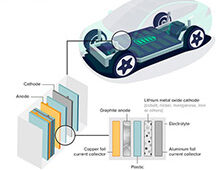
Batteries deliver power by shuttling positive ions between two electrodes—an anode and a cathode—while electrons travel around a circuit and do useful work. In the past decade, compact batteries using tiny lithium ions have achieved ever larger energy densities, packing more power in smaller volumes and helping to make smart phones and other mobile technologies ubiquitous. But lithium-ion batteries require bulky cathodes, typically made from ceramic oxides like cobalt oxide, to house the ions, which limits the battery’s energy density. This means that for more power-intensive applications like long-range electric vehicles, even lithium-ion technology does not cut it.
Enter lithium-ion’s slimmer cousin, lithium-sulfur. These batteries’ cathodes are made mainly of sulfur, a cheap waste product of petroleum processing. Sulfur weighs barely half as much as cobalt, atom for atom, and can pack more than twice as many lithium ions into a given volume as can cobalt oxide; thus, lithium-sulfur batteries have several times the energy density of lithium-ion batteries. But sulfur cathodes have two major weaknesses. Sulfur easily combines with lithium to form compounds that crystallize and gum up the battery’s insides, and it tends to crack under the stress of repeated cycling. As a result, a typical lithium-sulfur battery becomes useless within a few dozen cycles—far too few for a laptop or car battery that may get cycled once a day for years.
To create a more stable cathode, the research team heated sulfur to 185 C, melting the element’s eight-atom rings into long chains. They then mixed the sulfur chains with DIB, a carbon-based plastic precursor that links the sulfur chains together, creating what is known as a co-polymer. The team dubbed their manufacturing process “inverse vulcanization” because it resembles the process used to make rubber tires, with one crucial difference: In tires, carbon-containing material makes up the bulk, and sulfur is just sprinkled in.
Adding DIB to the cathodes prevents them from cracking as easily and keeps lithium-sulfur compounds from crystallizing. The scientists tested different mixtures of sulfur and DIB and found that the optimum mix contained between 10 and 20% DIB by mass: Less DIB did not provide the cathode-protecting properties while more of the electrochemically inactive DIB began to drag down the battery’s energy density.
The researchers ran their optimized battery through 500 cycles and found that it retained more than half its initial capacity. Other experimental lithium-sulfur batteries have performed similarly, but their cathodes require more complex manufacturing processes that would be expensive to scale up, says Jeffrey Pyun, a chemist at the University of Arizona and Seoul National University. By contrast, the team’s polymer cathode requires only easily available materials and moderate heat. “We take it, we melt it in one step and pow, we get this plastic,” Pyun says. “If you were to come to our lab, we could do this in five minutes.”
Even so, we aren’t likely to see lithium-sulfur batteries in stores right away. Soles notes that a commercial battery technology has to do more than just meet performance specs. For example, lithium can combust if exposed to air, so any commercial lithium-sulfur battery will need to undergo rigorous safety testing before it hits the market.
Source: NIST