Research & Development World

  • R&D World Home
  • Topics
    • Aerospace
    • Automotive
    • Biotech
    • Careers
    • Chemistry
    • Environment
    • Energy
    • Life Science
    • Material Science
    • R&D Management
    • Physics
  • Technology
    • 3D Printing
    • A.I./Robotics
    • Software
    • Battery Technology
    • Controlled Environments
      • Cleanrooms
      • Graphene
      • Lasers
      • Regulations/Standards
      • Sensors
    • Imaging
    • Nanotechnology
    • Scientific Computing
      • Big Data
      • HPC/Supercomputing
      • Informatics
      • Security
    • Semiconductors
  • R&D Market Pulse
  • R&D 100
    • 2025 R&D 100 Award Winners
    • 2025 Professional Award Winners
    • 2025 Special Recognition Winners
    • R&D 100 Awards Event
    • R&D 100 Submissions
    • Winner Archive
  • Resources
    • Research Reports
    • Digital Issues
    • Educational Assets
    • Subscribe
    • Video
    • Webinars
    • Content submission guidelines for R&D World
  • Global Funding Forecast
  • Top Labs
  • Advertise
  • SUBSCRIBE

A Computational Analysis Identifies a New Clinical Phenotype of Severe Malaria

By Barcelona Institute for Global Health | September 4, 2018

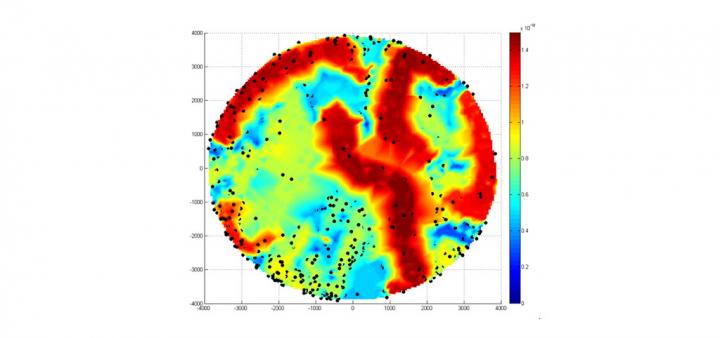
This density heatmap shows the distribution of patients in the 8-dimensional feature space. Higher density values (in red) indicate closer proximity of patients in this feature space. Black dots indicate SM patients who died. (Credit: Cominetti O et al, Figure 2)

There are more clinical phenotypes of severe malaria than those defined by the World Health Organization (WHO), according to a study led by ISGlobal, an institution supported by “la Caixa” Foundation. The results indicate that heart failure can be a pathogenic mechanism of disease, which has implications in the clinical management of these patients.

Despite the progress achieved over the last decades, malaria is estimated to have caused almost half a million deaths in 2016, mostly among children. The definition of severe malaria was established to identify those children at risk of dying, but in reality it is a complex and heterogeneous disease that not always responds to the recommended treatments.

The team led by Climent Casals-Pascual, researcher at ISGlobal and at Oxford University, applied a computational analysis based on networks in order to identify biologically relevant phenotypes apart from those currently defined by the WHO (cerebral malaria, respiratory distress, and severe malarial anaemia). For this, they performed a ‘network-based clustering analysis’ with data from almost 3,000 Gambian children hospitalized with malaria. They found that the mortality was higher in those clusters with higher phenotypic heterogeneity. The analysis revealed four clusters of patients with both respiratory distress and severe anaemia, in which an increase in liver size was associated with higher mortality. By analysing plasma proteins of these patients, they showed that this is likely due to heart failure.

“Our results indicate that heart failure should be reconsidered as a pathogenic mechanism in severe malaria,” explains Casals-Pascual, “and that therefore the standard clinical management may not be appropriate for these patients.” This type of “systems approach” can be a very valuable tool to identify new phenotypes and mechanisms as well as therapeutic options for complex diseases,” he adds.

Related Articles Read More >

Who has access to Claude Mythos-tier models (and beyond) will redefine cybersecurity, including in R&D
Abstract of modern high tech internet data center room with rows of racks with network and server hardware. 3d rendering
A startup says it found hidden memory behavior in NVIDIA GPUs and is building a security layer around it
Ex-Google founders bet quantum-compressed chemistry can crack covalent drug design
NTT Research launches Scale Academy with SaltGrain, a zero-trust data security suite
rd newsletter
EXPAND YOUR KNOWLEDGE AND STAY CONNECTED
Get the latest info on technologies, trends, and strategies in Research & Development.

R&D World Digital Issues

Fall 2025 issue

Browse the most current issue of R&D World and back issues in an easy to use high quality format. Clip, share and download with the leading R&D magazine today.

R&D 100 Awards
Research & Development World
  • Subscribe to R&D World Magazine
  • Sign up for R&D World’s newsletter
  • Contact Us
  • About Us
  • Drug Discovery & Development
  • Pharmaceutical Processing
  • Global Funding Forecast

Copyright © 2026 WTWH Media LLC. All Rights Reserved. The material on this site may not be reproduced, distributed, transmitted, cached or otherwise used, except with the prior written permission of WTWH Media
Privacy Policy | Advertising | About Us

Search R&D World

  • R&D World Home
  • Topics
    • Aerospace
    • Automotive
    • Biotech
    • Careers
    • Chemistry
    • Environment
    • Energy
    • Life Science
    • Material Science
    • R&D Management
    • Physics
  • Technology
    • 3D Printing
    • A.I./Robotics
    • Software
    • Battery Technology
    • Controlled Environments
      • Cleanrooms
      • Graphene
      • Lasers
      • Regulations/Standards
      • Sensors
    • Imaging
    • Nanotechnology
    • Scientific Computing
      • Big Data
      • HPC/Supercomputing
      • Informatics
      • Security
    • Semiconductors
  • R&D Market Pulse
  • R&D 100
    • 2025 R&D 100 Award Winners
    • 2025 Professional Award Winners
    • 2025 Special Recognition Winners
    • R&D 100 Awards Event
    • R&D 100 Submissions
    • Winner Archive
  • Resources
    • Research Reports
    • Digital Issues
    • Educational Assets
    • Subscribe
    • Video
    • Webinars
    • Content submission guidelines for R&D World
  • Global Funding Forecast
  • Top Labs
  • Advertise
  • SUBSCRIBE