Research & Development World

  • R&D World Home
  • Topics
    • Aerospace
    • Automotive
    • Biotech
    • Careers
    • Chemistry
    • Environment
    • Energy
    • Life Science
    • Material Science
    • R&D Management
    • Physics
  • Technology
    • 3D Printing
    • A.I./Robotics
    • Software
    • Battery Technology
    • Controlled Environments
      • Cleanrooms
      • Graphene
      • Lasers
      • Regulations/Standards
      • Sensors
    • Imaging
    • Nanotechnology
    • Scientific Computing
      • Big Data
      • HPC/Supercomputing
      • Informatics
      • Security
    • Semiconductors
  • R&D Market Pulse
  • R&D 100
    • 2025 R&D 100 Award Winners
    • 2025 Professional Award Winners
    • 2025 Special Recognition Winners
    • R&D 100 Awards Event
    • R&D 100 Submissions
    • Winner Archive
  • Resources
    • Research Reports
    • Digital Issues
    • Educational Assets
    • R&D Index
    • Subscribe
    • Video
    • Webinars
    • Content submission guidelines for R&D World
  • Global Funding Forecast
  • Top Labs
  • Advertise
  • SUBSCRIBE

A Firefly’s Flash Inspires New Nanolaser Light

By R&D Editors | July 17, 2017

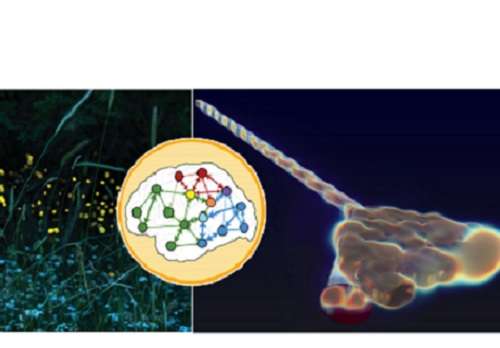
The complex flashing patterns of fireflies (left) led KAUST researchers to develop anapole lasers that use interactions between energy-storing nanodisks (center) to generate high-speed pulses of light on microchips (right). (Credit: Reproduced with permission from ref 1.© 2017 Gongora et al.)

A reinvented, low-cost laser source that stores light energy inside nanoscale disks could underpin the development of optically powered neurocomputers, reveals a simulation study led by KAUST researchers.

Photonic devices that use controlled laser pulses to manipulate data switches, biomedical implants and solar cells are sought-after because they are lightning quick compared to traditional electronics; however, current prototypes have not been commercialized because of the difficulty in making lasers small enough to fit onto computer circuit boards, while also retaining pulse-shaping capabilities.

“The challenge of reducing an optical source down to the nanoscale is that it starts to emit energy strongly in all directions,” explained Andrea Fratalocchi, an Associate Professor of Electrical Engineering. “This makes it almost impossible to control.”

A partnership with Yuri Kivshar’s group at the Australian National University revealed paths to beat optical diffraction limits with unconventional anapole lasers. Being made from semiconductors shaped into precisely sized nanodisks, anapoles respond to light stimulation by producing electromagnetic waves that either radiate or rotate in donut-shaped toroid distributions.

At specific excitation frequencies, interference between the two fields produces a state—the anapole—which does not emit energy in any direction and traps light inside the nanodisk.

“You can think of this laser as an energy tank—once the laser is on, it stores light and doesn’t let it go until you want to collect it,” said Fratalocchi.

To unlock the potential of this new light source, the KAUST team simulated various engineering architectures using quantum-based algorithms.

These calculations, along with improved microchip integration and thousand-fold enhancements in coupling to optical routers, predict that anapole nanolasers can generate ultrafast light pulses that are uniquely suited for studying natural patterns of signaling and neural connections.

Fratalocchi notes that the nanolasers would appear invisible to an observer until perturbed by a nearby object. Consequently, arranging the cylindrical light sources into a loop could be used to produce a chain reaction of light emissions, tunable down to as small as femtosecond pulse times.

“It’s really like a population of fireflies, where the individuals synchronize their emissions into beautiful patterns,” he explained “When we place the nanolasers close together, we can get similar control over the pulses.”

The team’s models suggest that integrating different loops of anapole nanolasers may produce oscillating, dynamic patterns useful for reproducing brain-like activities, such as machine learning and memory retrieval at low cost because the platform needs only inexpensive silicon wafers to work.


Related Articles Read More >

The 2025 R&D 100 Finalists are here
New nanotechnology method increases microalgae biofuel yield by 300%
New nanopore sensor paves the way for fast, accurate, low-cost DNA sequencing
Floating solar mats clean polluted water — and generate power
rd newsletter
EXPAND YOUR KNOWLEDGE AND STAY CONNECTED
Get the latest info on technologies, trends, and strategies in Research & Development.
RD 25 Power Index

R&D World Digital Issues

Fall 2025 issue

Browse the most current issue of R&D World and back issues in an easy to use high quality format. Clip, share and download with the leading R&D magazine today.

Research & Development World
  • Subscribe to R&D World Magazine
  • Sign up for R&D World’s newsletter
  • Contact Us
  • About Us
  • Drug Discovery & Development
  • Pharmaceutical Processing
  • Global Funding Forecast

Copyright © 2025 WTWH Media LLC. All Rights Reserved. The material on this site may not be reproduced, distributed, transmitted, cached or otherwise used, except with the prior written permission of WTWH Media
Privacy Policy | Advertising | About Us

Search R&D World

  • R&D World Home
  • Topics
    • Aerospace
    • Automotive
    • Biotech
    • Careers
    • Chemistry
    • Environment
    • Energy
    • Life Science
    • Material Science
    • R&D Management
    • Physics
  • Technology
    • 3D Printing
    • A.I./Robotics
    • Software
    • Battery Technology
    • Controlled Environments
      • Cleanrooms
      • Graphene
      • Lasers
      • Regulations/Standards
      • Sensors
    • Imaging
    • Nanotechnology
    • Scientific Computing
      • Big Data
      • HPC/Supercomputing
      • Informatics
      • Security
    • Semiconductors
  • R&D Market Pulse
  • R&D 100
    • 2025 R&D 100 Award Winners
    • 2025 Professional Award Winners
    • 2025 Special Recognition Winners
    • R&D 100 Awards Event
    • R&D 100 Submissions
    • Winner Archive
  • Resources
    • Research Reports
    • Digital Issues
    • Educational Assets
    • R&D Index
    • Subscribe
    • Video
    • Webinars
    • Content submission guidelines for R&D World
  • Global Funding Forecast
  • Top Labs
  • Advertise
  • SUBSCRIBE