Research & Development World

  • R&D World Home
  • Topics
    • Aerospace
    • Automotive
    • Biotech
    • Careers
    • Chemistry
    • Environment
    • Energy
    • Life Science
    • Material Science
    • R&D Management
    • Physics
  • Technology
    • 3D Printing
    • A.I./Robotics
    • Software
    • Battery Technology
    • Controlled Environments
      • Cleanrooms
      • Graphene
      • Lasers
      • Regulations/Standards
      • Sensors
    • Imaging
    • Nanotechnology
    • Scientific Computing
      • Big Data
      • HPC/Supercomputing
      • Informatics
      • Security
    • Semiconductors
  • R&D Market Pulse
  • R&D 100
    • 2025 R&D 100 Award Winners
    • 2025 Professional Award Winners
    • 2025 Special Recognition Winners
    • R&D 100 Awards Event
    • R&D 100 Submissions
    • Winner Archive
  • Resources
    • Research Reports
    • Digital Issues
    • Educational Assets
    • Subscribe
    • Video
    • Webinars
    • Content submission guidelines for R&D World
  • Global Funding Forecast
  • Top Labs
  • Advertise
  • SUBSCRIBE

A Major Step Forward in Organic Electronics

By Linkoping University | January 11, 2018

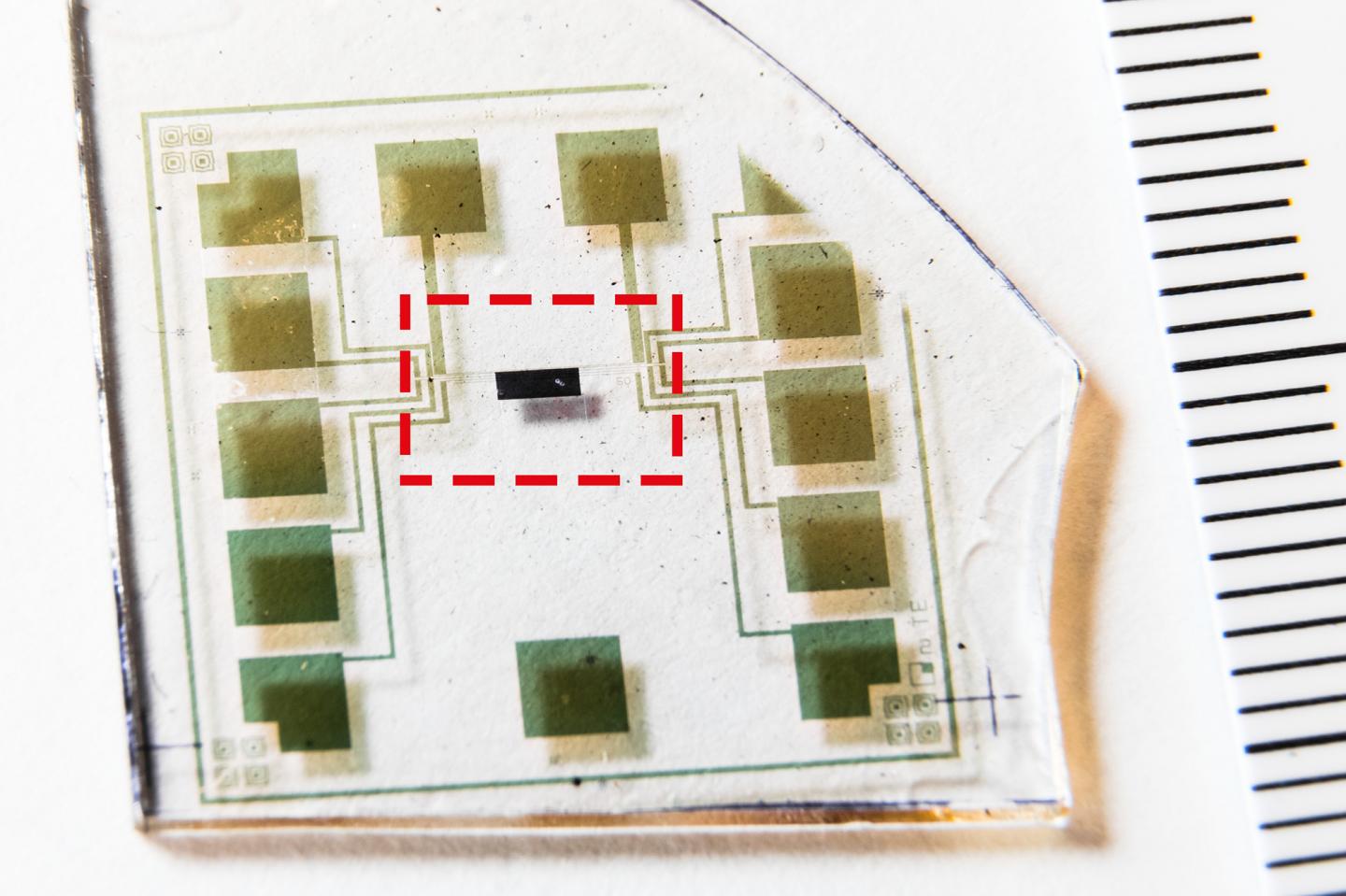
These are the worlds first complementary electrochemical logic circuits.

Researchers at the Laboratory of Organic Electronics, Linköping University, have developed the world’s first complementary electrochemical logic circuits that can function stably for long periods in water. This is a highly significant breakthrough in the development of bioelectronics.

The first printable organic electrochemical transistors were presented by researchers at LiU as early as 2002, and research since then has progressed rapidly. Several organic electronic components, such as light-emitting diodes and electrochromic displays, are already commercially available.

The dominating material used until now has been PEDOT:PSS, which is a p-type material, in which the charge carriers are holes. In order to construct effective electron components, a complementary material, n-type, is required, in which the charge carriers are electrons.

It has been difficult to find a sufficiently stable polymer material, one that can operate in water media and in which the long polymer chains can sustain high current when the material is doped.

In an article in the prestigious scientific journal Advanced Materials, Simone Fabiano, head of research in the Organic Nanoelectronics group at the Laboratory of Organic Electronics, presents, together with his colleagues, results from an n-type conducting material in which the ladder-type structure of the polymer backbone favours ambient stability and high current when doped. One example is BBL, poly(benzimidazobenzophenanthroline), a material often used in solar cell research.

Postdoctoral researcher Hengda Sun has found a method to create thick films of the material. The thicker the film, the greater the conductivity.

“We have used spray-coating to produce films up to 200 nm thick. These can reach extremely high conductivities,” says Simone Fabiano.

The method can also be successfully used together with printed electronics across large surfaces.

Hengda Sun has also shown that the circuits function for long periods, both in the presence of oxygen and water.

“This may appear at first glance to be a small advance in a specialised field, but what is great about it is that it has major consequences for many applications. We can now construct complementary logic circuits – inverters, sensors and other components – that function in moist surroundings,” says Simone Fabiano.

“Resistors are needed in logical circuits that are based solely on p-type electrochemical transistors. These are rather bulky, and this limits the applications that can be achieved. With an n-type material in our toolbox, we can produce complementary circuits that occupy the available space much more efficiently, since resistors are no longer required in the logical circuits,” says Magnus Berggren, professor of organic electronics and head of the Laboratory for Organic Electronics.

Applications of the organic components include logic circuits that can be printed on textile or paper, various types of cheap sensor, non-rigid and flexible displays, and – not least – the huge field of bioelectronics. Polymers that conduct both ions and electrons are the bridge needed between the ion-conducting systems in the body and the electronic components of, for example, sensors.

Related Articles Read More >

New video series: Travel for engineers
Advanced Manufacturing and Process Innovation Special Report: When you can’t hire, you automate
Pancreas or pancreatic cancer with organs and tumors or cancerous cells 3D rendering illustration with male body. Anatomy, oncology, disease, medical, biology, science, healthcare concepts.
AI tool used to detect pancreatic cancer in routine CT scans in China 
R&D 100 Red Carpet: DuPont’s triple win
rd newsletter
EXPAND YOUR KNOWLEDGE AND STAY CONNECTED
Get the latest info on technologies, trends, and strategies in Research & Development.

R&D World Digital Issues

Fall 2025 issue

Browse the most current issue of R&D World and back issues in an easy to use high quality format. Clip, share and download with the leading R&D magazine today.

R&D 100 Awards
Research & Development World
  • Subscribe to R&D World Magazine
  • Sign up for R&D World’s newsletter
  • Contact Us
  • About Us
  • Drug Discovery & Development
  • Pharmaceutical Processing
  • Global Funding Forecast

Copyright © 2026 WTWH Media LLC. All Rights Reserved. The material on this site may not be reproduced, distributed, transmitted, cached or otherwise used, except with the prior written permission of WTWH Media
Privacy Policy | Advertising | About Us

Search R&D World

  • R&D World Home
  • Topics
    • Aerospace
    • Automotive
    • Biotech
    • Careers
    • Chemistry
    • Environment
    • Energy
    • Life Science
    • Material Science
    • R&D Management
    • Physics
  • Technology
    • 3D Printing
    • A.I./Robotics
    • Software
    • Battery Technology
    • Controlled Environments
      • Cleanrooms
      • Graphene
      • Lasers
      • Regulations/Standards
      • Sensors
    • Imaging
    • Nanotechnology
    • Scientific Computing
      • Big Data
      • HPC/Supercomputing
      • Informatics
      • Security
    • Semiconductors
  • R&D Market Pulse
  • R&D 100
    • 2025 R&D 100 Award Winners
    • 2025 Professional Award Winners
    • 2025 Special Recognition Winners
    • R&D 100 Awards Event
    • R&D 100 Submissions
    • Winner Archive
  • Resources
    • Research Reports
    • Digital Issues
    • Educational Assets
    • Subscribe
    • Video
    • Webinars
    • Content submission guidelines for R&D World
  • Global Funding Forecast
  • Top Labs
  • Advertise
  • SUBSCRIBE