Research & Development World

  • R&D World Home
  • Topics
    • Aerospace
    • Automotive
    • Biotech
    • Careers
    • Chemistry
    • Environment
    • Energy
    • Life Science
    • Material Science
    • R&D Management
    • Physics
  • Technology
    • 3D Printing
    • A.I./Robotics
    • Software
    • Battery Technology
    • Controlled Environments
      • Cleanrooms
      • Graphene
      • Lasers
      • Regulations/Standards
      • Sensors
    • Imaging
    • Nanotechnology
    • Scientific Computing
      • Big Data
      • HPC/Supercomputing
      • Informatics
      • Security
    • Semiconductors
  • R&D Market Pulse
  • R&D 100
    • 2025 R&D 100 Award Winners
    • 2025 Professional Award Winners
    • 2025 Special Recognition Winners
    • R&D 100 Awards Event
    • R&D 100 Submissions
    • Winner Archive
  • Resources
    • Research Reports
    • Digital Issues
    • Educational Assets
    • R&D Index
    • Subscribe
    • Video
    • Webinars
    • Content submission guidelines for R&D World
  • Global Funding Forecast
  • Top Labs
  • Advertise
  • SUBSCRIBE

Anti-Reflective Coating Inspired by Insect “Cloaking Device”

By Kenny Walter | November 3, 2017

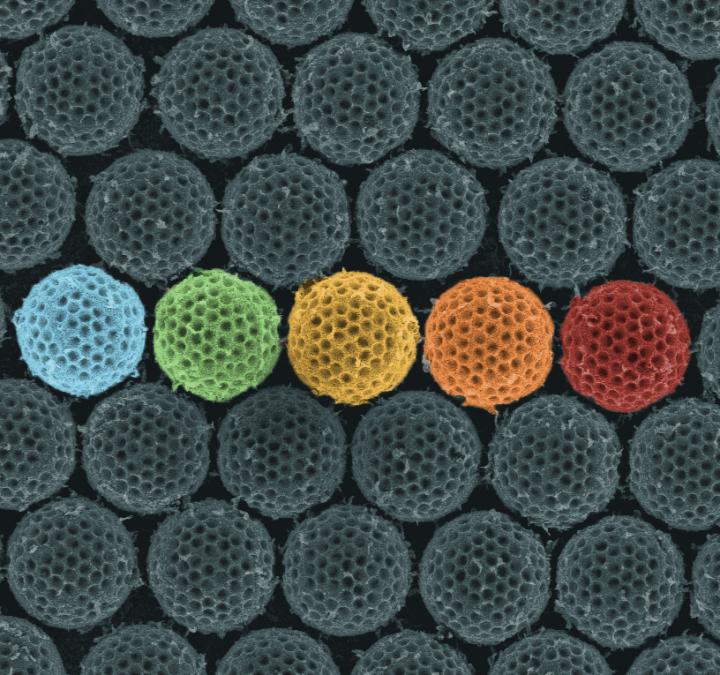
This is synthetic brochosomes (false colored). Credit Shikuan Yang, Birgitt Boschitsch

Researchers have turned to the leaf hopper insect as inspiration for a new synthetic material.

A team from Penn State University have created synthetic microspheres with nanoscale holes that can absorb light from all different directions across a wide range of frequencies, making it an ideal candidate for anti-reflective coatings.

The leaf hopper insect extruded microparticles called brochosomes and wipes them on their wings to hide from potential predators in the environment. The particles are superhydrophobic, enabling the insect’s wings to stay dry in wet conditions.

However, researchers recently discovered that the brochosomes also allows leaf hoppers and their eggs to blend in with their backgrounds at the wavelengths of light visible to their main predators.

“We knew our synthetic particles might be interesting optically because of their structure,” Tak-Sing Wong, assistant professor of mechanical engineering and the Wormely Family Early Career Professor in Engineering, said in a statement. “We didn’t know, until my former postdoc and lead author of the study Shikuan Yang brought it up in a group meeting, that the leaf hopper made these non-sticky coatings with a natural structure very similar to our synthetic ones.

“That led us to wonder how the leaf hopper used these particles in nature,” he added.

While there is very little information about the leaf-hopper brochosomes, the pit’s sizes in the synthetic microspheres are close to the wavelength of light and can capture up to 99 percent of light, ranging from ultraviolet through visible and into the near infrared.

“The problem is that in the field, these leaf hoppers produce very little of this product and it is very hard to collect,” Wong said. “But we had already produced large quantities of these structures in the lab, enough to put inside a machine to look at their optical properties.”

The researchers simulated insect vision and found that the brochosomes are very likely camouflage coatings against leaf hopper predators.

The synthetic microspheres are produced with a complex five-step process that uses electrochemical deposition.

The process can be scaled up with many different materials including gold, silver, manganese oxide or a conductive polymer could be used to make synthetic brochosomes.

“Different materials will have their own applications,” Wong said. “For example, manganese oxide is a very popular material used in supercapacitors and batteries.

“Because of its high surface area, this particle could make a good battery electrode and allow a higher rate of chemical reaction to take place.”

The material could potentially have applications in sensors and cameras, where capturing unwanted light reflection could increase the signal-to-noise ratio. It could also be useful in telescopes and solar cell applications.

“This paper is more of a fundamental study,” Wong said. “In the future, we may try to extend the structure to longer wavelengths.

“If we made the structure a little larger, could it absorb longer electromagnetic waves such as mid-infrared and open up further applications in sensing and energy harvesting?” he added.


 

Related Articles Read More >

Gadolyn names Jack Lifton advisory board chair, adds Gareth Hatch
Lead-free piezoelectric material converts motion to power without lead
R&D 100 Winners protecting nuclear materials
R&D Winners turn fruit waste into ‘leather’
rd newsletter
EXPAND YOUR KNOWLEDGE AND STAY CONNECTED
Get the latest info on technologies, trends, and strategies in Research & Development.
RD 25 Power Index

R&D World Digital Issues

Fall 2025 issue

Browse the most current issue of R&D World and back issues in an easy to use high quality format. Clip, share and download with the leading R&D magazine today.

R&D 100 Awards
Research & Development World
  • Subscribe to R&D World Magazine
  • Sign up for R&D World’s newsletter
  • Contact Us
  • About Us
  • Drug Discovery & Development
  • Pharmaceutical Processing
  • Global Funding Forecast

Copyright © 2025 WTWH Media LLC. All Rights Reserved. The material on this site may not be reproduced, distributed, transmitted, cached or otherwise used, except with the prior written permission of WTWH Media
Privacy Policy | Advertising | About Us

Search R&D World

  • R&D World Home
  • Topics
    • Aerospace
    • Automotive
    • Biotech
    • Careers
    • Chemistry
    • Environment
    • Energy
    • Life Science
    • Material Science
    • R&D Management
    • Physics
  • Technology
    • 3D Printing
    • A.I./Robotics
    • Software
    • Battery Technology
    • Controlled Environments
      • Cleanrooms
      • Graphene
      • Lasers
      • Regulations/Standards
      • Sensors
    • Imaging
    • Nanotechnology
    • Scientific Computing
      • Big Data
      • HPC/Supercomputing
      • Informatics
      • Security
    • Semiconductors
  • R&D Market Pulse
  • R&D 100
    • 2025 R&D 100 Award Winners
    • 2025 Professional Award Winners
    • 2025 Special Recognition Winners
    • R&D 100 Awards Event
    • R&D 100 Submissions
    • Winner Archive
  • Resources
    • Research Reports
    • Digital Issues
    • Educational Assets
    • R&D Index
    • Subscribe
    • Video
    • Webinars
    • Content submission guidelines for R&D World
  • Global Funding Forecast
  • Top Labs
  • Advertise
  • SUBSCRIBE