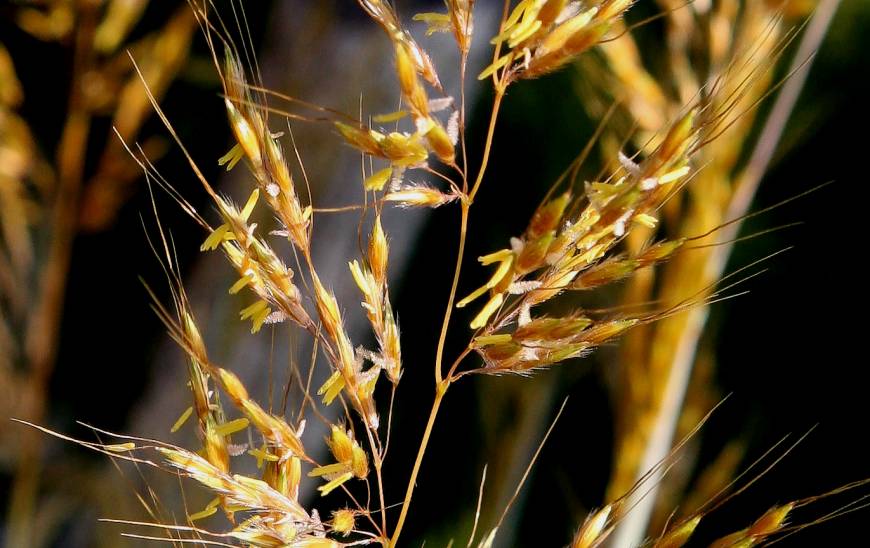
A closeup of grass stalks belonging to Gramineae, a family of flowering plants that produce the lipid isoarborinol. Image credit: Nomarcland
A fatty molecule thought to be unique to flowering plants has turned up in bacteria skimmed from the Adriatic Sea. The surprising finding solves a 20-year-old paleontological mystery and could affect how scientists interpret the presence of this molecule in the ecological record. Where once it suggested the presence of land and flowering plants, it could indicate marine or freshwater-dwelling bacteria instead.
The molecule in question, isoarborinol, is a fatty molecule, or lipid, whose only known biological sources were certain flowering plants, or angiosperms. For this reason, when geobiologists detect isoarborinol they assume flowering plants once flourished in that spot.
“Arborinol lipids can be preserved in sedimentary rocks for millions of years, so they can function as ‘molecular fossils’ that can inform us about the types of organisms and environments on early Earth,” said study co-author Paula Welander, a geobiologist at Stanford’s School of Earth, Energy & Environmental Sciences.
In the 1990s, however, scientists discovered fossil traces of isoarborinol in ancient sediments from Germany that dated back to the Permian and Triassic eras — about 100 million years before the first appearance of flowering plants. At the time, scientists speculated that an as-yet unknown microbial source of these lipids must also exist, but nobody had found evidence to support this hypothesis — until now.
In the new study, published Dec. 26 in Proceedings of the National Academy of Sciences, Welander and her team identified a modern-day marine bacterium (Eudoraea adriatica), previously isolated from the Adriatic Sea, that produces two lipids with chemical structures that are similar to isoarborinol.
“The lipids, which we dubbed eudoraenol and adriaticol, were completely new molecules that hadn’t been seen before,” Welander said. “They were the first new arborinol lipids to be discovered in 30 years, and the first to be identified outside of the plant kingdom.”
Because arborinol lipids are found in sediments from the early Earth, a better understanding of how they’re produced could change how paleontologists interpret the fossil record. “If these lipids are discovered in sediment cores from ancient lakes, the question is, do they represent terrestrial input from flowering plants or were there actually lake bacteria living in low-oxygen environments that were producing them?” Welander said.
The implications extend beyond geobiology, she added. Understanding the chemistry behind how certain lipids are produced could help scientists better synthesize similar structures in the lab. “Our study of the biochemistry of these proteins could contribute to our understandings of the synthesis of novel compounds that have clinical or biotechnological significance,” Welander said.
In addition to being produced by a completely different organism, the bacterial protein required to make the lipids also appears to be unique. “Angiosperms and bacteria developed phylogenetically distinct but remarkably similar enzymes to produce these lipids,” Welander said.
Experiments by Welander’s lab revealed that the protein that produces the bacterial lipid is unrelated in an evolutionary sense to the protein that produces isoarborinol in flowering plants. This matters because it demonstrates that the microbe did not acquire this protein from a plant — through horizontal gene transfer, for example — but rather evolved the ability to make arborinols independently. “It also adds credence to the idea that arborinols in the rock record — and modern environments, too — could come from a bacterial source,” Welander said.