Casting a New Light on “Supersolid” Effects in Helium-4
Does helium-4 become a “supersolid” near absolute zero? What previous researchers thought might be a supersolid transition is better explained by changes in the solid’s resistance to shearing, according to new research by J. C. Séamus Davis, the J.G. White Distinguished Professor in the Physical Sciences. The research is reported in Science.
Background
In 2004 Eunseong Kim and Moses Chan at Pennsylvania State University spun a cylinder of solid helium in a torsion oscillator, which twists rapidly back and forth like a washing machine agitator. They found that slightly below 0.2 K (Kelvins — degrees above absolute zero), the resonant frequency of rotation increased, as if some of the mass had come loose and was ignoring the attempt to push it around. This was interpreted as evidence for a “supersolid,” a material that moves without friction.
John Reppy, Cornell’s J.L. Wetherill Professor Emeritus of Physics, showed that slightly heating and then cooling the solid diminished the supposed supersolid effect. He suggested that the apparent changes in inertia were due to defects in the crystal, since heating and cooling anneals the solid to remove such defects. Reppy stopped short of saying there was no supersolid, suggesting that the defects themselves could be forming a “Bose-Einstein condensate” and moving as a single frictionless object.
But theorist Alexander Balatsky at Los Alamos National Laboratory (LANL), a co-author of the Science paper, suggested that the effects could simply result from slowing of the movements of microscopic defects in the crystal — places where the orderly crystal lattice is a little bit out of alignment. Imagine cutting a chessboard in half and sliding one half just a little bit out of phase with the other. These defects can lubricate the solid and make it easier to shear. Cooling reduces their ability to move and increases the solid’s “shear modulus” — its resistance to being pulled apart.
As Balatsky explained, if you spin a fresh egg back and forth it won’t resist with all its mass because all of the insides don’t move with the shell. But freeze the egg and it will resist more noticeably. “But there’s nothing supersolid about an egg,” Davis pointed out.
The new research

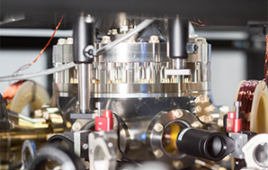
A torsion oscillator shakes a sample of frozen helium back and forth like a washing machine agitator. The Cornell version uses a SQUID, a supersensitive magnetic field detector, to achieve precision 10,000 times greater than instruments used in previous experiments with solid helium. The entire apparatus is about the diameter of a quarter. Courtesy of Davis Lab |
So Davis and colleagues repeated the Penn State experiment with a torsional oscillator 10,000 times more sensitive than previous instruments. Rather than measuring the resonant frequency they were able to directly measure the susceptibility of the sample to being rotated, and from this see how “loose” the defects in the crystal were. They found that varying the temperature while twisting the sample with a constant angular acceleration and varying the angular acceleration while at a constant temperature produced almost the same curves, suggesting an explanation in everyday physics, rather than exotic quantum behavior. Notably, they found no sharp change at a “critical temperature” where the helium might undergo a phase change to a supersolid. The results, they said, are more consistent with a gradual decrease in the freedom of movement of the defects in the crystal.
They compared their torsional oscillator measurements with data from solid helium-4 shearing experiments performed by John Beamish at the University of Alberta and found almost perfect agreement. “This demonstrates directly that the torsional oscillator responses previously attributed to supersolidity are actually due to generation of the same microscopic excitations as those produced by shearing the solid,” Davis said. “Our measurements of helium-4 produce exactly the same type of data as Kim and Chan, but our understanding of it is now quite different.”
The next steps, the researchers say, are to directly identify the type of microscopic crystal defect which is altering the shearing of the crystal, and to see if the presence of a superfluid component within the frozen disordered solid — a “superglass” state — is still possible.
Cornell co-authors of the paper include Ethan Pratt Ph.D. ’10, now at the National Institute of Standards and Technology, Ben Hunt Ph.D. ’09, now at the Massachusetts Institute of Technology, and graduate student Vikram Gadagkar. They collaborated with researchers Matthias Graf at LANL and Minoru Yamashita at Kyoto University. The work was funded by the Kavli Institute for Theoretical Physics and the National Science Foundation.