Research & Development World

  • R&D World Home
  • Topics
    • Aerospace
    • Automotive
    • Biotech
    • Careers
    • Chemistry
    • Environment
    • Energy
    • Life Science
    • Material Science
    • R&D Management
    • Physics
  • Technology
    • 3D Printing
    • A.I./Robotics
    • Software
    • Battery Technology
    • Controlled Environments
      • Cleanrooms
      • Graphene
      • Lasers
      • Regulations/Standards
      • Sensors
    • Imaging
    • Nanotechnology
    • Scientific Computing
      • Big Data
      • HPC/Supercomputing
      • Informatics
      • Security
    • Semiconductors
  • R&D Market Pulse
  • R&D 100
    • 2025 R&D 100 Award Winners
    • 2025 Professional Award Winners
    • 2025 Special Recognition Winners
    • R&D 100 Awards Event
    • R&D 100 Submissions
    • Winner Archive
  • Resources
    • Research Reports
    • Digital Issues
    • Educational Assets
    • R&D Index
    • Subscribe
    • Video
    • Webinars
    • Content submission guidelines for R&D World
  • Global Funding Forecast
  • Top Labs
  • Advertise
  • SUBSCRIBE

Electrostatic Force Takes Charge in Bioinspired Polymers

By R&D Editors | November 2, 2017

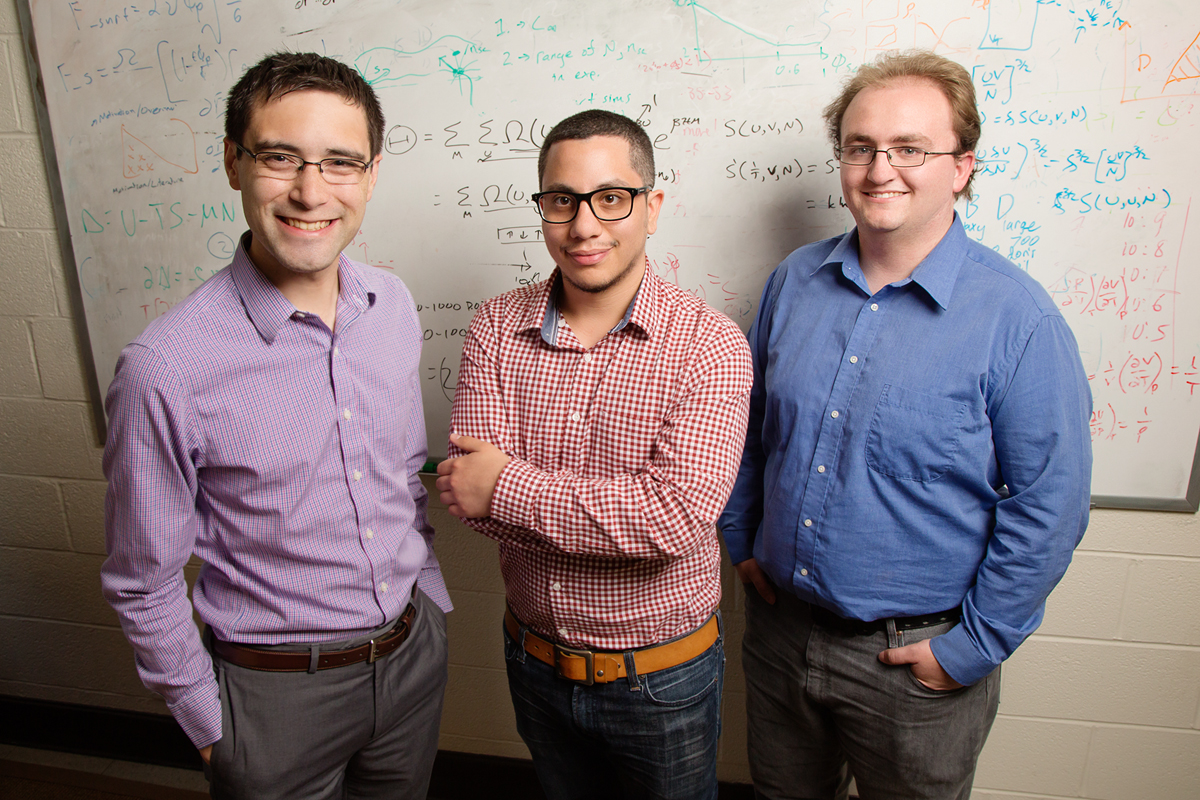
Inspired by the principles of natural polymer synthesis, Illinois chemical and biomolecular engineering professor Charles Sing, left, and graduate students Jason Madinya and Tyler Lytle co-authored a study that found they could create new synthetic materials by tuning the electrostatic charge of polymer chains. Photo by L. Brian Stauffer

 Researchers at the University of Illinois and the University of Massachusetts, Amherst have taken the first steps toward gaining control over the self-assembly of synthetic materials in the same way that biology forms natural polymers. This advance could prove useful in designing new bioinspired, smart materials for applications ranging from drug delivery to sensing to remediation of environmental contaminants.

Proteins, which are natural polymers, use amino acid building blocks to link together long molecular chains. The specific location of these building blocks, called monomers, within these chains creates sequences that dictate a polymer’s structure and function. In the journal Nature Communications, the researchers describe how to utilize the concept of monomer sequencing to control polymer structure and function by taking advantage of a property present in both natural and synthetic polymers – electrostatic charge.

“Proteins encode information through a precise sequence of monomers. However, this precise control over sequence is much harder to control in synthetic polymers, so there has been a limit to the quality and amount of information that can be stored,” said Charles Sing, a professor of chemical and biomolecular engineering at Illinois and a study co-author. “Instead, we can control the charge placement along the synthetic polymer chains to drive self-assembly processes.”

“Our study focuses on a class of polymers, called coacervates, that separate like oil and water and form a gel-like substance,” said Sarah Perry, a study co-author and University of Massachusetts, Amherst chemical engineering professor, as well as an Illinois alumna.

Through a series of experiments and computer simulations, the researchers found that the properties of the resulting charged gels can be tuned by changing the sequence of charges along the polymer chain.

“Manufacturers commonly use coacervates in cosmetics and food products to encapsulate flavors and additives, and as a way of controlling the ‘feel’ of the product,” Sing said. “The challenge has been if they need to change the texture or the thickness, they would have to change the material being used.”

Sing and Perry demonstrate that they can rearrange the structure of the polymer chains by tuning their charge to engineer the desired properties. “This is how biology makes the endless diversity of life with only a small number of molecular building blocks,” Perry said. “We envision bringing this bioinspiration concept full circle by using coacervates in biomedical and environmental applications.”

The results of this research open a tremendous number of opportunities to expand the diversity of polymers used and the scale of applications, the researchers said. “Currently, we are working with materials on the macro scale – things that we can see and touch,” Sing said. “We hope to expand this concept into the realm of nanotechnology, as well.”

The National Science Foundation and the U. of I. Graduate College supported this research.

Related Articles Read More >

Gadolyn names Jack Lifton advisory board chair, adds Gareth Hatch
Lead-free piezoelectric material converts motion to power without lead
R&D 100 Winners protecting nuclear materials
R&D Winners turn fruit waste into ‘leather’
rd newsletter
EXPAND YOUR KNOWLEDGE AND STAY CONNECTED
Get the latest info on technologies, trends, and strategies in Research & Development.
RD 25 Power Index

R&D World Digital Issues

Fall 2025 issue

Browse the most current issue of R&D World and back issues in an easy to use high quality format. Clip, share and download with the leading R&D magazine today.

R&D 100 Awards
Research & Development World
  • Subscribe to R&D World Magazine
  • Sign up for R&D World’s newsletter
  • Contact Us
  • About Us
  • Drug Discovery & Development
  • Pharmaceutical Processing
  • Global Funding Forecast

Copyright © 2025 WTWH Media LLC. All Rights Reserved. The material on this site may not be reproduced, distributed, transmitted, cached or otherwise used, except with the prior written permission of WTWH Media
Privacy Policy | Advertising | About Us

Search R&D World

  • R&D World Home
  • Topics
    • Aerospace
    • Automotive
    • Biotech
    • Careers
    • Chemistry
    • Environment
    • Energy
    • Life Science
    • Material Science
    • R&D Management
    • Physics
  • Technology
    • 3D Printing
    • A.I./Robotics
    • Software
    • Battery Technology
    • Controlled Environments
      • Cleanrooms
      • Graphene
      • Lasers
      • Regulations/Standards
      • Sensors
    • Imaging
    • Nanotechnology
    • Scientific Computing
      • Big Data
      • HPC/Supercomputing
      • Informatics
      • Security
    • Semiconductors
  • R&D Market Pulse
  • R&D 100
    • 2025 R&D 100 Award Winners
    • 2025 Professional Award Winners
    • 2025 Special Recognition Winners
    • R&D 100 Awards Event
    • R&D 100 Submissions
    • Winner Archive
  • Resources
    • Research Reports
    • Digital Issues
    • Educational Assets
    • R&D Index
    • Subscribe
    • Video
    • Webinars
    • Content submission guidelines for R&D World
  • Global Funding Forecast
  • Top Labs
  • Advertise
  • SUBSCRIBE