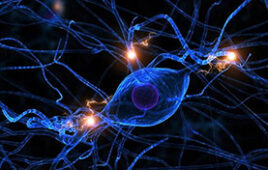
Working with units of material so small that it would take 50,000 to make up one drop, scientists are developing the profiles of the contents of individual brain cells in a search for the root causes of chronic pain, memory loss and other maladies that affect millions of people.
They described the latest results of this one-by-one exploration of cells or “neurons” from among the millions present in an animal brain at the 244th National Meeting & Exposition of the American Chemical Society (ACS), the world’s largest scientific society. The meeting, expected to attract almost 14,000 scientists and others from around the world, continues here through Thursday, with 8,600 presentations on new discoveries in science and other topics.
Jonathan Sweedler, PhD, a pioneer in the field, explained in a talk at the meeting that knowledge of the chemistry occurring in individual brain cells would provide the deepest possible insights into the causes of certain diseases and could point toward new ways of diagnosis and treatment. Until recently, however, scientists have not had the technology to perform such neuron-by-neuron research.
“Most of our current knowledge about the brain comes from studies in which scientists have been forced to analyze the contents of multiple nerve cells, and, in effect, average the results,” Sweedler said. He is with the University of Illinois at Urbana-Champaign and also serves as editor-in-chief of Analytical Chemistry, which is among ACS’ more than 40 peer-reviewed scientific journals. “That approach masks the sometimes-dramatic differences that can exist even between nerve cells that are shoulder-to-shoulder together. Suppose that only a few cells in that population are changing, perhaps as a disease begins to take root or starts to progress or a memory forms and solidifies. Then we would miss those critical changes by averaging the data.”
However, scientists have found it difficult to analyze the minute amounts of material inside single brain cells. Those amounts are in the so-called “nanoliter” range, units so small that it would take 355 billion nanoliters to fill a 12-ounce soft-drink can. Sweedler’s group spent much of the past decade developing the technology to analyze the chemicals found in individual cells — a huge feat with a potentially big pay-off. “We are using our new approaches to understand what happens in learning and memory in the healthy brain, and we want to better understand how long-lasting, chronic pain develops,” he said.
The 85 billion neurons in the brain are highly interconnected, forming an intricate communications network that makes the complexity of the Internet pale in comparison. The neural net’s chemical signaling agents and electrical currents orchestrate a person’s personality, thoughts, consciousness and memories. These connections are different from person to person and change over the course of a lifetime, depending on one’s experiences. Even now, no one fully understands how these processes happen.
To get a handle on these complex workings, Sweedler’s team and others have zeroed in on small sections of the central nervous system ― the brain and spinal cord ― using stand-ins for humans such as sea slugs and laboratory rats. Sweedler’s new methods enable scientists to actually select areas of the nervous system, spread out the individual neurons onto a glass surface, and one-by-one analyze the proteins and other substances inside each cell.
One major goal is to see how the chemical make-up of nerve cells changes during pain and other disorders. Pain from disease or injuries, for instance, is a huge global challenge, responsible for 40 million medical appointments annually in the United States alone.
Sweedler reported that some of the results are surprising, including tests on cells in an area of the nervous system involved in the sensation of pain. Analysis of the minute amounts of material inside the cells showed that the vast majority of cells undergo no detectable change after a painful event. The chemical imprint of pain occurs in only a few cells. Finding out why could point scientists toward ways of blocking those changes and in doing so, could lead to better ways of treating pain.
Date: August 21, 2012
Source: American Chemical Society