Scientists at the Department of Energy’s Oak Ridge National Laboratory have made the first direct observations of a one-dimensional boundary separating two different, atom-thin materials, enabling studies of long-theorized phenomena at these interfaces.
Theorists have predicted the existence of intriguing properties at one-dimensional (1-D) boundaries between two crystalline components, but experimental verification has eluded researchers because atomically precise 1-D interfaces are difficult to construct.
“While many theoretical studies of such 1-D interfaces predict striking behaviors, in our work we have provided the first experimental validation of those interface properties,” says ORNL’s An-Ping Li.
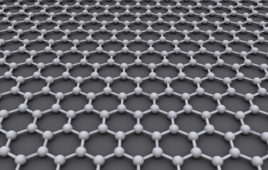
The new Nature Communications study builds on work by ORNL and University of Tennessee scientists published in Science earlier this year that introduced a method to grow different two-dimensional materials – graphene and boron nitride – into a single layer only one atom thick.
The team’s materials growth technique unlocked the ability to study the 1-D boundary and its electronic properties in atomic resolution. Using scanning tunneling microscopy, spectroscopy, and density-functional calculations, the researchers first obtained a comprehensive picture of spatial and energetic distributions of the 1-D interface states.
“In three-dimensional (3-D) systems, the interface is embedded so you cannot get a real-space view of the complete interface – you can only look at a projection of that plane,” says Jewook Park, ORNL postdoctoral researcher and the lead author of the work. “In our case, the 1-D interface is completely accessible to real-space study,”
“The combination of scanning tunneling microscopy and the first principles theory calculations allows us to distinguish the chemical nature of the boundary and evaluate the effects of orbital hybridization at the junction,” says ORNL’s Mina Yoon, a theorist on the team.
The researchers’ observations revealed a highly confined electric field at the interface and provided an opportunity to investigate an intriguing phenomenon known as a “polar catastrophe,” which occurs in 3-D oxide interfaces. This effect can cause atomic and electron reorganization at the interface to compensate for the electrostatic field resulting from materials’ different polarities.
“This is the first time we have been able to study the polar discontinuity effect in a 1-D boundary,” Li says.
Although the researchers focused on gaining a fundamental understanding of the system, they note their study could culminate in applications that take advantage of the 1-D interface.
“For instance, the 1-D chain of electrons could be exploited to pass a current along the boundary,” Li says. “It could be useful for electronics, especially for ultra-thin or flexible devices.”
The team plans to continue examining different aspects of the boundary including its magnetic properties and the effect of its supporting substrate.
The study is published as “Spatially resolved one-dimensional boundary states in graphene–hexagonal boron nitride planar heterostructures.” Coauthors are ORNL’s Jewook Park, Jaekwang Lee, Corentin Durand, Changwon Park, Bobby Sumpter, Arthur Baddorf, Mina Yoon, and An-Ping Li; the University of Tennessee’s Lei Liu, Ali Mohsin, and Gong Gu; and Central Methodist University’s Kendal Clark.
This research was conducted in part at the Center for Nanophase Materials Sciences and the National Energy Research Scientific Computing Center, both DOE Office of Science User Facilities. The research was supported by DOE’s Office of Science, ORNL’s Laboratory Directed Research and Development program, the National Science Foundation and DARPA.
ORNL is managed by UT-Battelle for the Department of Energy’s Office of Science. DOE’s Office of Science is the single largest supporter of basic research in the physical sciences in the United States, and is working to address some of the most pressing challenges of our time.
Release Date: November 10, 2014
Source: Oak Ridge National Laboratory