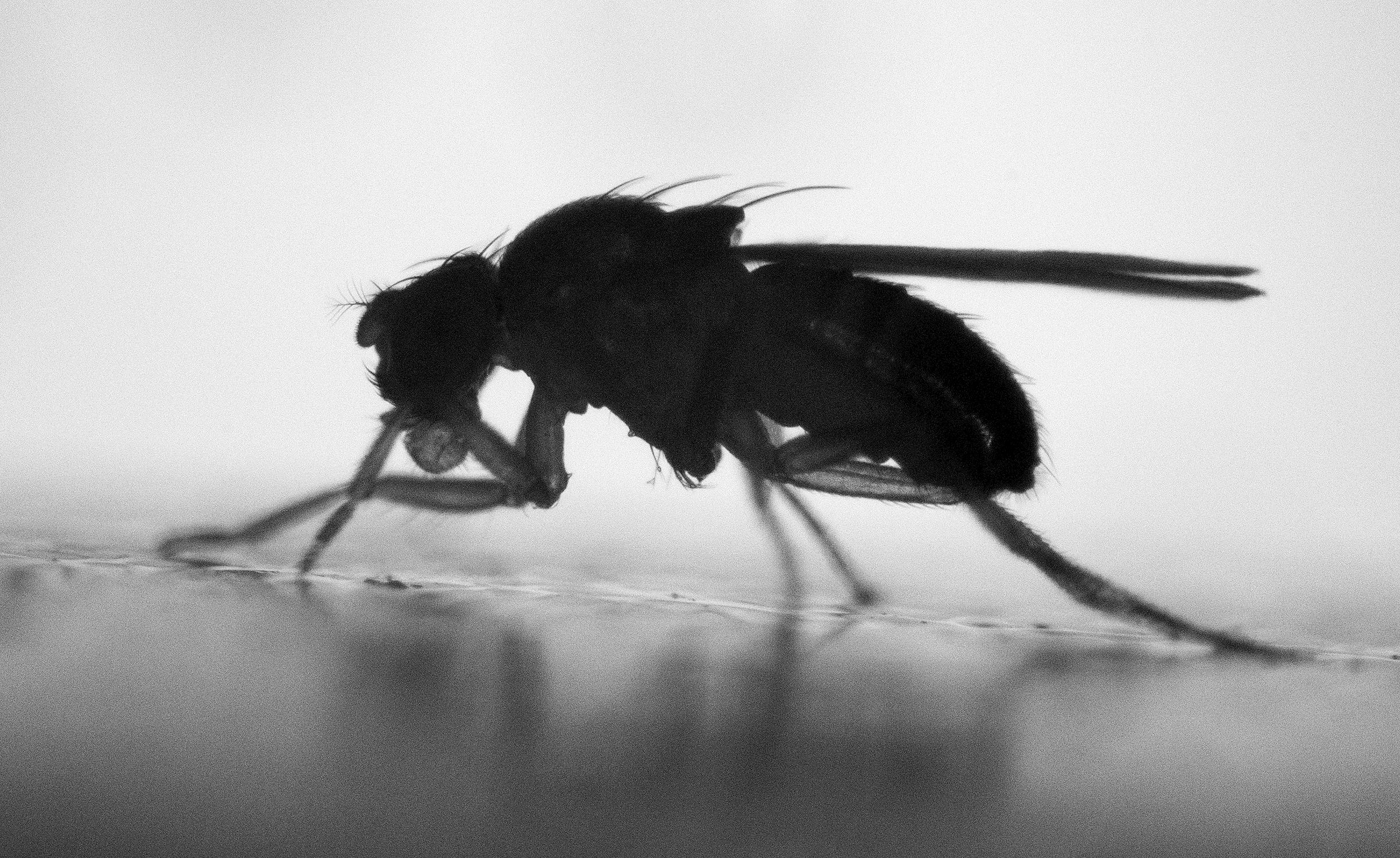
This is a close up of the common fruit fly usually found buzzing around the fruit bowl. Credit: Heath MacMillan at York University
Fruit flies may seem simple, but these common visitors to the fruit bowl can drastically alter their gene expression and metabolism to respond to temperature changes in their environment, an international team of researchers have shown.
The finding is important because understanding how insects tolerate changes in temperature is a crucial step in protecting and controlling insects worldwide, says Heath MacMillan, who led the study in collaboration with researchers in Canada, Switzerland and Japan. With rapid and unprecedented climate change, the need to understand how insects are affected is increasingly necessary, especially as they represent more than 75 per cent of all animal species. The research was published today in Scientific Reports.
“Temperature is one of the strongest predictors of the global distribution of insect species,” said MacMillan, a Banting postdoctoral fellow at York University. “This is because temperature affects all aspects of insect physiology, and limits the ability of insects to move, eat and reproduce.”
Unlike mammals and birds, most insects are ectotherms, meaning their body temperature tracks the temperature of their environment. This can be challenging because when winter hits insects have to cope with how their lower body temperature reduces the rates of all the chemical reactions needed to keep their metabolism humming.
As a result, insects modify their physiology and behaviour to respond to temperature and can continue to function, even at quite low temperatures. This ability, called thermal acclimation, is necessary for insect survival over the cold winter months, but how this happens is still not well understood.
Since many insects carry disease, are crop pests or, on the positive side, are helpful to humans as pollinators, understanding the mechanisms behind thermal acclimation improves scientists’ ability to predict changes to insect populations as the Earth’s climate rapidly changes.
For the study, researchers raised common fruit flies, Drosophila melanogaster, from eggs through to their larval or maggot stages at room temperature (21 C). Once they were adults, half of the flies were transferred to a 6 C space.
“The flies responded to this change by changing the expression of genes and proteins in their bodies, which has downstream impacts on the metabolic pathways they use. After six days of keeping the two groups of flies at 21 and 6 C, we sampled all of them and measured the expression of every one of their genes and the abundance of every metabolite, or chemical, in the flies that we could identify,” said MacMillan.
The researchers expected to see changes in the flies that were exposed to the cold, but were surprised by the extent of them. “We saw nearly a third of the fly’s genes increased or decreased in expression, and the abundance of roughly half of the metabolites changed at the same time,” said Brent Sinclair, Associate Professor at Western University and senior author of the study. “Many of the genes and metabolites we saw changing are in support of the current state of knowledge on insect cold tolerance, which is encouraging. However, a lot of what we saw was new and is providing us with some exciting paths forward.”
The researchers plan to use this information to examine specifically how the genes and metabolites identified in the study are contributing to insect survival in the cold. “Given the length of the list, it will be no small task,” said MacMillan. “The list of targets we have now is a hazy map to the treasure that is a complete understanding of cold tolerance. Ultimately, this map will help drive us toward new applications in the realms of agriculture and disease transmission.”