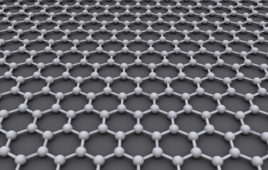
Graphene, a strong, lightweight carbon honeycombed structure that’s only one atom thick, holds great promise for energy research and development. Recently scientists with the Fluid Interface Reactions, Structures, and Transport (FIRST) Energy Frontier Research Center (EFRC), led by the US Department of Energy’s Oak Ridge National Laboratory, revealed graphene can serve as a proton-selective permeable membrane, providing a new basis for streamlined and more efficient energy technologies such as improved fuel cells.
The work, published in the March 17 issue of Nature Communications, pinpoints unprecedented proton movement through inherent atomic-scale defects, or gaps, in graphene.
“Now you’re able to take a barrier that you can make very thin, like graphene, and change it so you build gates on a molecular scale,” says principal investigator Franz Geiger of Northwestern University, the senior author and a FIRST researcher.
The foundation for the study was laid six years ago at ORNL as part of DOE’s EFRC initiative to accelerate the scientific breakthroughs needed to build a new 21st century energy economy. The goal of FIRST is to use interdisciplinary research to develop both a fundamental understanding and validated, predictive models of the unique nanoscale environment at fluid–solid interfaces, which will enable transformative advances in electrical energy storage and catalysis, according to FIRST Director David Wesolowski.
Of the paper’s 15 authors, all are FIRST researchers with diverse science backgrounds ranging from chemistry to computer modeling. Pooling their expertise, the scientists investigated the mechanisms and structure of graphene using a multifaceted theoretical, experimental, materials synthesis, and computational approach.
With a tight lattice of carbon reminiscent of chicken wire, pristine graphene was believed to be impenetrable. Current studies, however, have shown that in aqueous solutions, graphene allows surprising numbers of protons to pass through its atomic structure.
The researchers’ first step was to create an atomically thin layer of graphene on fused silica, an effort led by ORNL’s Ivan Vlassiouk, an expert in the synthesis of two-dimensional materials including graphene using chemical vapor deposition techniques.
Then Raymond Unocic at ORNL’s Center for Nanophase Materials Sciences, a DOE Office of Science User Facility, analyzed the graphene using an aberration-corrected scanning transmission electron microscope (STEM). The high-powered microscope, a state-of-the-art technology, allowed direct imaging of individual carbon atoms of the adjoining hexagons that compose graphene.
Unocic and associates were able to focus on rare, naturally occurring atomic-scale defects in graphene that allowed aqueous protons to “hop” through holes in the thin, strong single layer.
Regions of missing atoms are so small that they cannot be detected by standard microscopic techniques, so access to ORNL’s STEM facility was critical. “To be able to see these images—the individual positions of the carbon atoms in the graphene—is just spectacular,” says Geiger.
The scientists later isolated the paths of movement the protons followed. By creating a single-layer sliver of graphene on silica glass, separated from the glass by mere molecules of water, the scientists designed a trap for the hopping protons. Changes in the acidity of the aqueous solution on either side of the graphene layer revealed the covert gating mechanism in the material’s structure, which they were able to detect using a laser technique called second harmonic generation.
“The major advantage of second harmonic generation,” says Northwestern’s Jennifer Achtyl, lead author of the Nature Communications article, “is that it is highly sensitive to chemistry at the interface or, in this case, the nanometer-thick environment between the aqueous solution and the surface of the silica. This acute sensitivity and the fact that these experiments can be run nondestructively were critical to our ability to capture experimental evidence of the transfer of protons through graphene.”
Using computational methods to analyze the configurations of defects in the graphene, the FIRST researchers isolated proton-transfer occurrences at defect areas. In addition, the team demonstrated that even the smallest of molecules, hydrogen and helium, are unable to pass through the proton gates under normal conditions.
“Finally, when we were able to put all the pieces together, we made a conclusive statement that—even though there’s a high energetic barrier for proton transport through graphene—if you lower that energetic barrier, you can allow protons to pass right through,” says Unocic. “This opens a new pathway for the atomic-scale engineering of graphene.”
Although the scientists focused on the fundamental mechanics of graphene surfaces, the results of this study open the doors for further graphene development across the energy economy and beyond.
With fuel cells, to name but one area of promise, issues range from cumbersome size to fleeting efficiency. Isolating single ion-transfer mechanisms and structural gaps in graphene could facilitate improvements in the production, transportation and use of energy.
“We’ve looked at this problem from really as many sides as you can possibly look at it with today’s technology,” Geiger says. “It makes a very strong case for taking the effect that we’ve observed and the mechanism that we’ve found and doing something technologically relevant with it. There are so many people working with graphene that to show how aqueous protons actually transfer across graphene will make a big difference.”
Coauthors of “Aqueous Proton Transfer Across Single Layer Graphene” are ORNL’s Unocic, Robert Sacci, Vlassiouk, Pasquale Fulvio, Panchapakesan Ganesh, Wesolowski and Sheng Dai; Northwestern University’s Achtyl and Geiger; University of Virginia’s Lijun Xu, Yu Cai and Matthew Neurock (all three now at the University of Minnesota); and Pennsylvania State University’s Muralikrishna Raju, Weiwei Zhang and Adri van Duin.
This work was supported by the FIRST Center, an EFRC funded by the US Department of Energy’s Office of Science. Microscopy was conducted as part of a user proposal at ORNL’s Center for Nanophase Materials Sciences.
ORNL is managed by UT-Battelle for the Department of Energy’s Office of Science. DOE’s Office of Science is the single largest supporter of basic research in the physical sciences in the United States and is working to address some of the most pressing challenges of our time.
Release Date: March 17, 2015
Source: Oak Ridge National Laboratory