Research & Development World

  • R&D World Home
  • Topics
    • Aerospace
    • Automotive
    • Biotech
    • Careers
    • Chemistry
    • Environment
    • Energy
    • Life Science
    • Material Science
    • R&D Management
    • Physics
  • Technology
    • 3D Printing
    • A.I./Robotics
    • Software
    • Battery Technology
    • Controlled Environments
      • Cleanrooms
      • Graphene
      • Lasers
      • Regulations/Standards
      • Sensors
    • Imaging
    • Nanotechnology
    • Scientific Computing
      • Big Data
      • HPC/Supercomputing
      • Informatics
      • Security
    • Semiconductors
  • R&D Market Pulse
  • R&D 100
    • 2025 R&D 100 Award Winners
    • 2025 Professional Award Winners
    • 2025 Special Recognition Winners
    • R&D 100 Awards Event
    • R&D 100 Submissions
    • Winner Archive
  • Resources
    • Research Reports
    • Digital Issues
    • Educational Assets
    • R&D Index
    • Subscribe
    • Video
    • Webinars
    • Content submission guidelines for R&D World
  • Global Funding Forecast
  • Top Labs
  • Advertise
  • SUBSCRIBE

High-Power Electronics Keep Their Cool With New Heat-Conducting Crystals

By R&D Editors | July 5, 2018

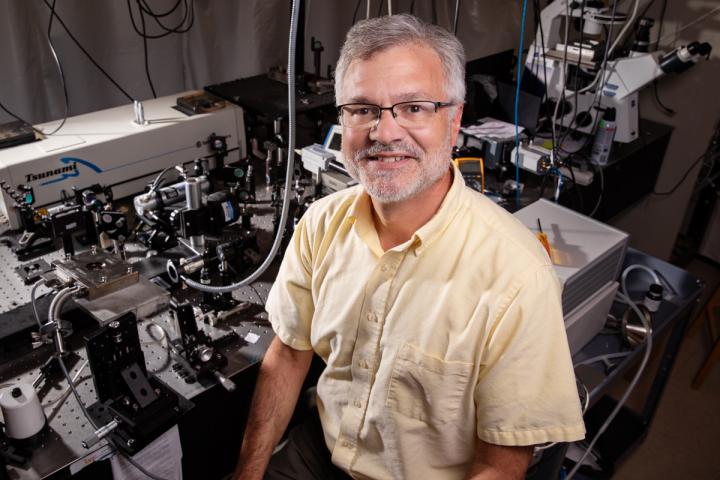
Materials science and engineering professor and department head David Cahill co-led research that helped optimize the synthesis of boron arsenide — a highly thermally conductive material — to help dissipate heat inside high-powered electronics. Credit: L. Brian Stauffer

The inner workings of high-power electronic devices must remain cool to operate reliably. High internal temperatures can make programs run slower, freeze or shut down. Researchers at the University of Illinois at Urbana-Champaign and The University of Texas, Dallas have collaborated to optimize the crystal-growing process of boron arsenide – a material that has excellent thermal properties and can effectively dissipate the heat generated in electronic devices.

The results of the study, published in the journal Science, mark the first realization of previously predicted class of ultrahigh thermal conductivity materials.

Boron arsenide is not a naturally occurring material, so scientists must synthesize it in the lab, the researchers said. It also needs to have a very specific structure and low defect density for it to have peak thermal conductivity, so that its growth happens in a very controlled way.

“We studied the structural defects and measured the thermal conductivity of the boron arsenide crystals produced at UT Dallas,” said co-author David Cahill a professor and head of the department of materials science and engineering at Illinois. “Our experiments also show that the original theory is incomplete and will need to be refined to fully understand the high thermal conductivity.”

Most of today’s high-performance computer chips and high-power electronic devices are made of silicon, a crystalline semiconducting material that does an adequate job of dissipating heat. But in combination with other cooling technology incorporated into devices, silicon can handle only so much, the team said.

Diamond has the highest known thermal conductivity – about 15 times that of silicon – but there are problems when it comes to using it for thermal management of electronics. “Although diamond has been incorporated occasionally in demanding heat-dissipation applications, the cost of natural diamonds and structural defects in manmade diamond films make the material impractical for widespread use in electronics,” said co-author Bing Lv, a physics professor at UT Dallas.

“The boron arsenide crystals were synthesized using a technique called chemical vapor transport,” said Illinois postdoctoral researcher Qiye Zheng. “Elemental boron and arsenic are combined while in the vapor phase and then cool and condense into small crystals. We combined extensive materials characterization and trial-and-error synthesis to find the conditions that produce crystals of high enough quality.”

The Illinois team used electron microscopy and a technique called time-domain thermoreflectance to determine if the lab-grown crystals were free of the types of defects that cause a reduction in thermal conductivity.

“We measured dozens of the boron arsenide crystals produced in this study and found that the thermal conductivity of the material can be three times higher than that of best materials being used as heat spreaders today,” Zheng said.

The next step in the work will be to try other processes to improve the growth and properties of this material for large-scale applications, the researchers said.


Related Articles Read More >

R&D 100 red carpet recap: NETL team turns plastic waste into battery-grade graphite
R&D 100 Spotlight: Looping nylon recycles fishnets into medical grade nylon
R&D 100 Winner Spotlight: How Qnity beat the industry timeline on PFAS-free lithography
R&D 100 Red Carpet: DuPont’s triple win
rd newsletter
EXPAND YOUR KNOWLEDGE AND STAY CONNECTED
Get the latest info on technologies, trends, and strategies in Research & Development.
RD 25 Power Index

R&D World Digital Issues

Fall 2025 issue

Browse the most current issue of R&D World and back issues in an easy to use high quality format. Clip, share and download with the leading R&D magazine today.

R&D 100 Awards
Research & Development World
  • Subscribe to R&D World Magazine
  • Sign up for R&D World’s newsletter
  • Contact Us
  • About Us
  • Drug Discovery & Development
  • Pharmaceutical Processing
  • Global Funding Forecast

Copyright © 2026 WTWH Media LLC. All Rights Reserved. The material on this site may not be reproduced, distributed, transmitted, cached or otherwise used, except with the prior written permission of WTWH Media
Privacy Policy | Advertising | About Us

Search R&D World

  • R&D World Home
  • Topics
    • Aerospace
    • Automotive
    • Biotech
    • Careers
    • Chemistry
    • Environment
    • Energy
    • Life Science
    • Material Science
    • R&D Management
    • Physics
  • Technology
    • 3D Printing
    • A.I./Robotics
    • Software
    • Battery Technology
    • Controlled Environments
      • Cleanrooms
      • Graphene
      • Lasers
      • Regulations/Standards
      • Sensors
    • Imaging
    • Nanotechnology
    • Scientific Computing
      • Big Data
      • HPC/Supercomputing
      • Informatics
      • Security
    • Semiconductors
  • R&D Market Pulse
  • R&D 100
    • 2025 R&D 100 Award Winners
    • 2025 Professional Award Winners
    • 2025 Special Recognition Winners
    • R&D 100 Awards Event
    • R&D 100 Submissions
    • Winner Archive
  • Resources
    • Research Reports
    • Digital Issues
    • Educational Assets
    • R&D Index
    • Subscribe
    • Video
    • Webinars
    • Content submission guidelines for R&D World
  • Global Funding Forecast
  • Top Labs
  • Advertise
  • SUBSCRIBE