Research & Development World

  • R&D World Home
  • Topics
    • Aerospace
    • Automotive
    • Biotech
    • Careers
    • Chemistry
    • Environment
    • Energy
    • Life Science
    • Material Science
    • R&D Management
    • Physics
  • Technology
    • 3D Printing
    • A.I./Robotics
    • Software
    • Battery Technology
    • Controlled Environments
      • Cleanrooms
      • Graphene
      • Lasers
      • Regulations/Standards
      • Sensors
    • Imaging
    • Nanotechnology
    • Scientific Computing
      • Big Data
      • HPC/Supercomputing
      • Informatics
      • Security
    • Semiconductors
  • R&D Market Pulse
  • R&D 100
    • 2025 R&D 100 Award Winners
    • 2025 Professional Award Winners
    • 2025 Special Recognition Winners
    • R&D 100 Awards Event
    • R&D 100 Submissions
    • Winner Archive
  • Resources
    • Research Reports
    • Digital Issues
    • Educational Assets
    • R&D Index
    • Subscribe
    • Video
    • Webinars
    • Content submission guidelines for R&D World
  • Global Funding Forecast
  • Top Labs
  • Advertise
  • SUBSCRIBE

How AI and 3D Printing are Revolutionizing Materials Design

By Andrea LePain, MIT Professional Education | December 11, 2018

Imagine building a bridge, not with concrete and steel, but with a completely new synthetic material fabricated with a unique blend of protein molecules similar to the ones used to produce spider web silk. Or, creating a medical implant made of biomaterials that have the ability to self-heal and regenerate.

Technology and science innovations are revolutionizing the materials design world.  But how do engineers actually invent these new materials with superior functions? Artificial intelligence (AI) is playing a key role in the process. 

The traditional way of designing materials typically involves considering material properties at the macro level. But in recent years, a more advanced wave of materials design has emerged and it involves fabricating materials at the nanoscale. This new paradigm in engineering is enabling scientists and engineers to design a new class of materials that are stronger, lighter, more flexible, and less expensive to manufacture. 

Machine learning, and predictive modeling, a powerful subset of AI, is being used to accelerate the discovery of these new materials. Designers simply enter the desired properties into a program and algorithms predict which chemical building blocks can be combined at a micro level to create a structure with the desired functions and properties. 

“We’re using insights from physics and chemistry and applying these to quantum mechanics. What we’re doing with AI is letting computers rediscover the relationships between variables, going back to before Newton discovered gravity,” said Markus Buehler, McAfee Professor of Engineering at MIT and instructor of the MIT Professional Education course, Predictive Multiscale Materials Design

“We can create the relationships between variables and then ask the AI system, ‘how would this design perform? What if I make the molecules longer, or shorter, or add different chemistry?’ The computer will tell us whether the performance will be better or worse. It takes only a couple of microseconds to perform one iteration, while the conventional method might take days or weeks,” said Buehler. 

In other words, engineers are making materials utilizing simple building blocks and assembling them in a way that allows larger scale materials with the same high-performing properties to be developed. And AI makes it possible for computers to solve problems in a fraction of the time it would engineers to solve by hand. 

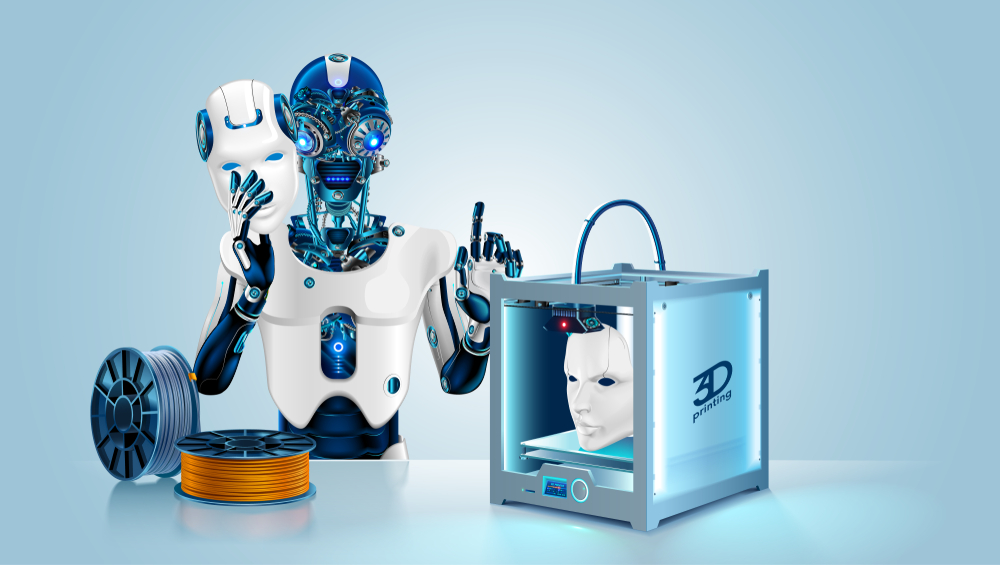
Scientists can synthesize and test thousands of materials at a time. But even at that speed, it would be a waste of time to blindly try out every possible combination. That’s where 3D printing and other advanced methods of manufacturing come into play. 3D printing is contributing to innovation in the materials science space because it enables engineers and designers to test new materials. Using modern additive manufacturing and other experimental techniques, designers can deposit these new materials deliberately in a particular point in space to build any scale structure, and either validate or eliminate the result. Each time this occurs, more data can be sent back to the algorithm so it grows smarter and smarter over time.

The future of AI in advanced materials, design, and engineering is promising. Experts agree it will serve as a cornerstone to future innovation in almost every industry. But challenges remain. Chief among them: the need for training. In order to realize the full potential of AI in materials science, engineers, researchers and scientists must learn about cutting-edge tools and technologies that will no doubt transform the industry and, perhaps, create the next wonder material. 

Related Articles Read More >

Caltech team 3D-prints drug depots deep inside living tissue
What could make MXene a key to ultra-precise, additive-free 3D microprinting?
Industry 4.0 Modern Factory: Facility Operator Controls Workshop Production Line, Uses Computer with Screens Showing Complex UI of Machine Operation Processes, Controllers, Machinery Blueprints
Building the thinking factory: An additive exec on AI, automation, and the skills crisis
Red Bull and Mercedes F1 cars 3D illustration, 30 Aug, 2022, Texas, EUA
6 technologies pushing Formula 1’s engineering frontier
rd newsletter
EXPAND YOUR KNOWLEDGE AND STAY CONNECTED
Get the latest info on technologies, trends, and strategies in Research & Development.
RD 25 Power Index

R&D World Digital Issues

Fall 2025 issue

Browse the most current issue of R&D World and back issues in an easy to use high quality format. Clip, share and download with the leading R&D magazine today.

Research & Development World
  • Subscribe to R&D World Magazine
  • Sign up for R&D World’s newsletter
  • Contact Us
  • About Us
  • Drug Discovery & Development
  • Pharmaceutical Processing
  • Global Funding Forecast

Copyright © 2025 WTWH Media LLC. All Rights Reserved. The material on this site may not be reproduced, distributed, transmitted, cached or otherwise used, except with the prior written permission of WTWH Media
Privacy Policy | Advertising | About Us

Search R&D World

  • R&D World Home
  • Topics
    • Aerospace
    • Automotive
    • Biotech
    • Careers
    • Chemistry
    • Environment
    • Energy
    • Life Science
    • Material Science
    • R&D Management
    • Physics
  • Technology
    • 3D Printing
    • A.I./Robotics
    • Software
    • Battery Technology
    • Controlled Environments
      • Cleanrooms
      • Graphene
      • Lasers
      • Regulations/Standards
      • Sensors
    • Imaging
    • Nanotechnology
    • Scientific Computing
      • Big Data
      • HPC/Supercomputing
      • Informatics
      • Security
    • Semiconductors
  • R&D Market Pulse
  • R&D 100
    • 2025 R&D 100 Award Winners
    • 2025 Professional Award Winners
    • 2025 Special Recognition Winners
    • R&D 100 Awards Event
    • R&D 100 Submissions
    • Winner Archive
  • Resources
    • Research Reports
    • Digital Issues
    • Educational Assets
    • R&D Index
    • Subscribe
    • Video
    • Webinars
    • Content submission guidelines for R&D World
  • Global Funding Forecast
  • Top Labs
  • Advertise
  • SUBSCRIBE