Research & Development World

  • R&D World Home
  • Topics
    • Aerospace
    • Automotive
    • Biotech
    • Careers
    • Chemistry
    • Environment
    • Energy
    • Life Science
    • Material Science
    • R&D Management
    • Physics
  • Technology
    • 3D Printing
    • A.I./Robotics
    • Software
    • Battery Technology
    • Controlled Environments
      • Cleanrooms
      • Graphene
      • Lasers
      • Regulations/Standards
      • Sensors
    • Imaging
    • Nanotechnology
    • Scientific Computing
      • Big Data
      • HPC/Supercomputing
      • Informatics
      • Security
    • Semiconductors
  • R&D Market Pulse
  • R&D 100
    • 2025 R&D 100 Award Winners
    • 2025 Professional Award Winners
    • 2025 Special Recognition Winners
    • R&D 100 Awards Event
    • R&D 100 Submissions
    • Winner Archive
  • Resources
    • Research Reports
    • Digital Issues
    • Educational Assets
    • R&D Index
    • Subscribe
    • Video
    • Webinars
    • Content submission guidelines for R&D World
  • Global Funding Forecast
  • Top Labs
  • Advertise
  • SUBSCRIBE

Hubble Shows Light Echo Expanding From Exploded Star

By Nasa/Goddard Space Flight Center | November 10, 2017

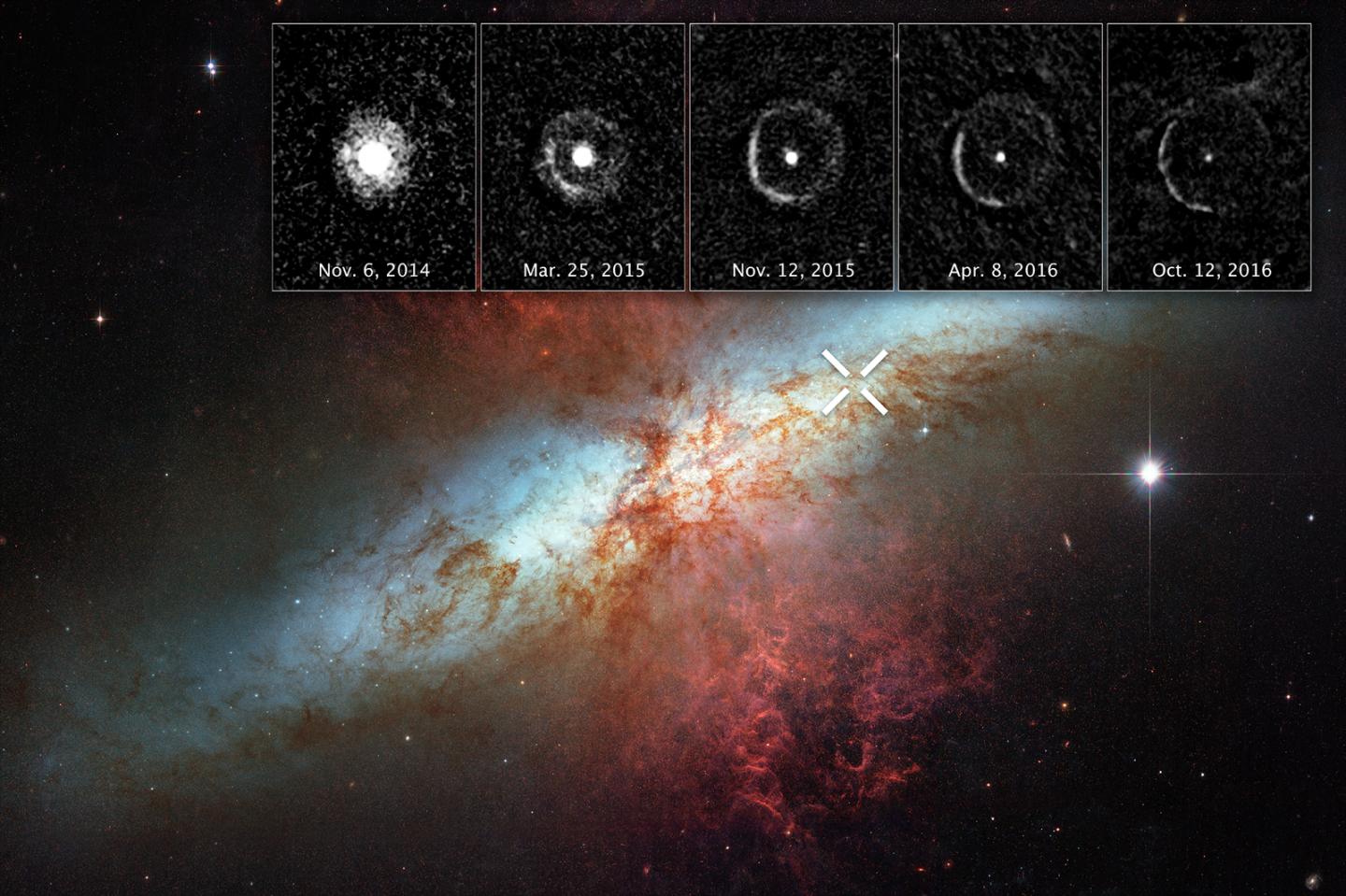
The inset images at top reveal an expanding shell of light from the stellar explosion sweeping through interstellar space, called a “light echo.” The images were taken 10 months to nearly two years after the violent event (Nov. 6, 2014 to Oct. 12, 2016). The light is bouncing off a giant dust cloud that extends 300 to 1,600 light-years from the supernova and is being reflected toward Earth.

Light from a supernova explosion in the nearby starburst galaxy M82 is reverberating off a huge dust cloud in interstellar space.

The supernova, called SN 2014J, occurred at the upper right of M82, and is marked by an “X.” The supernova was discovered on Jan. 21, 2014.

The inset images at top reveal an expanding shell of light from the stellar explosion sweeping through interstellar space, called a “light echo.” The images were taken 10 months to nearly two years after the violent event (Nov. 6, 2014 to Oct. 12, 2016). The light is bouncing off a giant dust cloud that extends 300 to 1,600 light-years from the supernova and is being reflected toward Earth.

SN 2014J is classified as a Type Ia supernova and is the closest such blast in at least four decades. A Type Ia supernova occurs in a binary star system consisting of a burned-out white dwarf and a companion star. The white dwarf explodes after the companion dumps too much material onto it.

The image of M82 reveals a bright blue disk, webs of shredded clouds, and fiery-looking plumes of glowing hydrogen blasting out of its central regions.

Close encounters with its larger neighbor, the spiral galaxy M81, is compressing gas in M82 and stoking the birth of multiple star clusters. Some of these stars live for only a short time and die in cataclysmic supernova blasts, as shown by SN 2014J.

Located 11.4 million light-years away, M82 appears high in the northern spring sky in the direction of the constellation Ursa Major, the Great Bear. It is also called the “Cigar Galaxy” because of the elliptical shape produced by the oblique tilt of its starry disk relative to our line of sight.
Related Articles Read More >

NASA R&D 100 Winner enables high-speed data transfer from space
The Milky Way is glowing: these scientists think dark matter may be the cause
Reusable rocket startup raises $510 million
2025 R&D layoffs tracker: hardware and chips lead the year’s biggest cuts while biopharma pares pipelines
rd newsletter
EXPAND YOUR KNOWLEDGE AND STAY CONNECTED
Get the latest info on technologies, trends, and strategies in Research & Development.
RD 25 Power Index

R&D World Digital Issues

Fall 2025 issue

Browse the most current issue of R&D World and back issues in an easy to use high quality format. Clip, share and download with the leading R&D magazine today.

Research & Development World
  • Subscribe to R&D World Magazine
  • Sign up for R&D World’s newsletter
  • Contact Us
  • About Us
  • Drug Discovery & Development
  • Pharmaceutical Processing
  • Global Funding Forecast

Copyright © 2025 WTWH Media LLC. All Rights Reserved. The material on this site may not be reproduced, distributed, transmitted, cached or otherwise used, except with the prior written permission of WTWH Media
Privacy Policy | Advertising | About Us

Search R&D World

  • R&D World Home
  • Topics
    • Aerospace
    • Automotive
    • Biotech
    • Careers
    • Chemistry
    • Environment
    • Energy
    • Life Science
    • Material Science
    • R&D Management
    • Physics
  • Technology
    • 3D Printing
    • A.I./Robotics
    • Software
    • Battery Technology
    • Controlled Environments
      • Cleanrooms
      • Graphene
      • Lasers
      • Regulations/Standards
      • Sensors
    • Imaging
    • Nanotechnology
    • Scientific Computing
      • Big Data
      • HPC/Supercomputing
      • Informatics
      • Security
    • Semiconductors
  • R&D Market Pulse
  • R&D 100
    • 2025 R&D 100 Award Winners
    • 2025 Professional Award Winners
    • 2025 Special Recognition Winners
    • R&D 100 Awards Event
    • R&D 100 Submissions
    • Winner Archive
  • Resources
    • Research Reports
    • Digital Issues
    • Educational Assets
    • R&D Index
    • Subscribe
    • Video
    • Webinars
    • Content submission guidelines for R&D World
  • Global Funding Forecast
  • Top Labs
  • Advertise
  • SUBSCRIBE