Research & Development World

  • R&D World Home
  • Topics
    • Aerospace
    • Automotive
    • Biotech
    • Careers
    • Chemistry
    • Environment
    • Energy
    • Life Science
    • Material Science
    • R&D Management
    • Physics
  • Technology
    • 3D Printing
    • A.I./Robotics
    • Software
    • Battery Technology
    • Controlled Environments
      • Cleanrooms
      • Graphene
      • Lasers
      • Regulations/Standards
      • Sensors
    • Imaging
    • Nanotechnology
    • Scientific Computing
      • Big Data
      • HPC/Supercomputing
      • Informatics
      • Security
    • Semiconductors
  • R&D Market Pulse
  • R&D 100
    • 2025 R&D 100 Award Winners
    • 2025 Professional Award Winners
    • 2025 Special Recognition Winners
    • R&D 100 Awards Event
    • R&D 100 Submissions
    • Winner Archive
  • Resources
    • Research Reports
    • Digital Issues
    • Educational Assets
    • R&D Index
    • Subscribe
    • Video
    • Webinars
    • Content submission guidelines for R&D World
  • Global Funding Forecast
  • Top Labs
  • Advertise
  • SUBSCRIBE

Imaging Agents Keep an Eye on Tumors

By Ross Neitz, University of Alberta | October 6, 2017

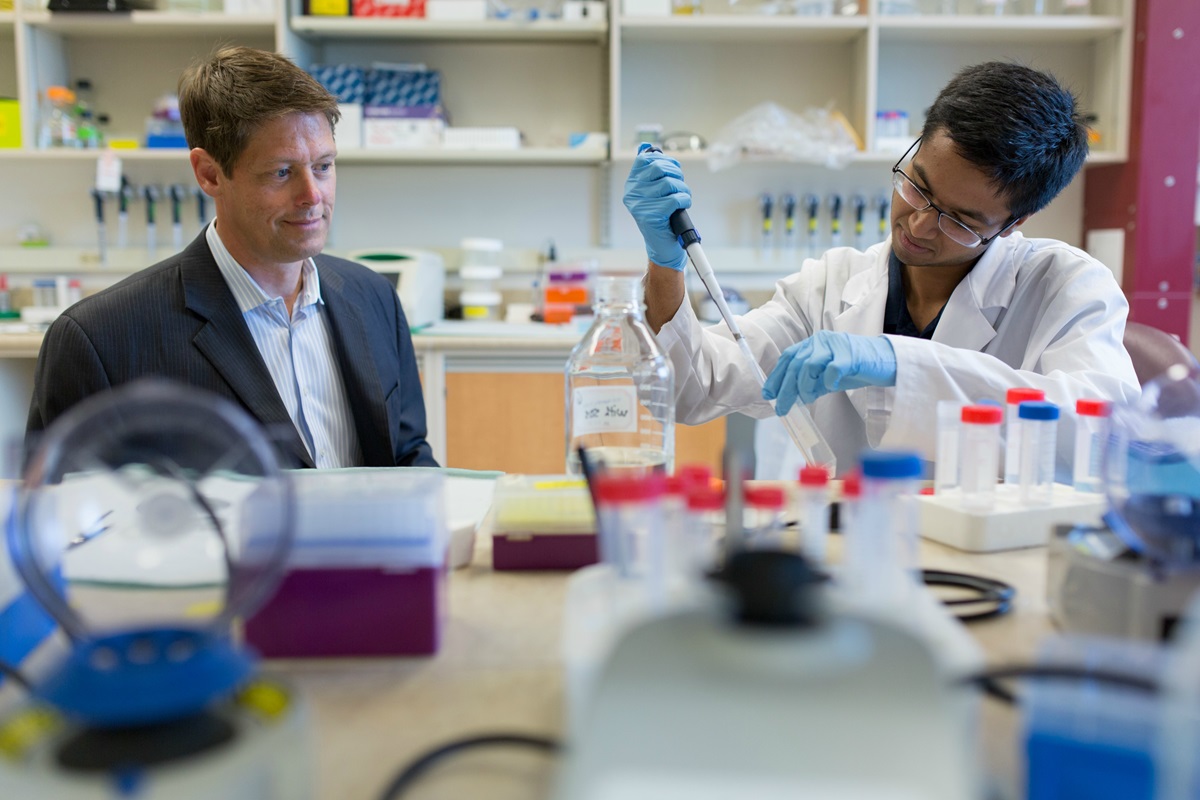
John Lewis (left) says newly created imaging agents could provide helpful insight for physicians determining the best course of action for cancer patients.

University of Alberta researchers have created two new imaging agents that could help physicians visualize the formation of tumor-associated blood vessels, keep track of tumor growth, and possibly generate new therapies.

“Blood vessel growth is critical to tumor growth,” says John Lewis, the Alberta Cancer Foundation Frank and Carla Sojonky Chair in Prostate Cancer Research at the U of A and a member of the Cancer Research Institute of Northern Alberta (CRINA). “When a tumor starts growing, cells start to divide out of control and they lack an organized blood vessel network to feed them. When that happens, there are help signals that tell the surrounding blood vessels to branch off and supply the tumor with new blood vessels for oxygen and nutrients.”

The process is called angiogenesis. There are a number of approved cancer drugs to prevent the formation of new tumor-related blood vessels, but according to Lewis, many haven’t yet lived up to their promise due to wide variability among patients. He believes the newly created imaging agents, which can be used in PET scans and fluorescence imaging, could provide physicians helpful insight when determining the best course of action for their patients.

“These drugs can be toxic and expensive, but potentially life-saving for certain patients. An imaging agent could be used before treatment to see how many new blood vessels are forming to determine whether an individual patient is a candidate for treatments that will inhibit new blood vessel growth. This would allow treatment to be personalized for those patients most likely to respond. Also, during the treatment, you could use the same imaging agent to monitor the response to the therapy.”

In his research, Lewis, along with collaborators at Western University and Case Western Reserve University, worked with a protein, EGFL7, that is specific to actively growing blood vessels. Together they created new peptides that home into EGFL7 to test if they would be useful for imaging purposes.

“Once we had the peptide, we validated in two ways,” says Lewis. “First we did some PET imaging of mice tumors and the peptide localized to those tumors and lit them up. We also created nanoparticles with the peptide and they were able to accumulate in the new blood vessels and light them up as well.”

The imaging agents now need to be tested in a treatment setting. Lewis plans to begin that work in animal models before moving on to clinical work in humans. His aim is to provide new tools which will help doctors make better and quicker treatment decisions for their patients.

“Ideally we would get a measure of response 24 hours after we first give the drug,” says Lewis, “Currently we measure any changes in tumor size up to a month after treatment, which is a long time to wait to find out if an expensive drug isn’t working.”

Lewis’ research was recently published in Nanoscale. It was funded by Prostate Cancer Canada, the Ontario Institute for Cancer Research, National Institutes of Health, and the Alberta Cancer Foundation.

Source: University of Alberta

Related Articles Read More >

Parallel Bio’s embraces in-house drug development as FDA backs animal testing alternatives
R&D 100 Winner Spotlight: A closer look at Thermo Fisher Scientific’s trio of R&D 100 wins in 2025
Life sciences M&A hit $240B in 2025 as Big Pharma preps for patent cliffs
Hansoh Bio signs 32,000-sq.-ft. lab lease at Research Square in Rockville, MD
rd newsletter
EXPAND YOUR KNOWLEDGE AND STAY CONNECTED
Get the latest info on technologies, trends, and strategies in Research & Development.
RD 25 Power Index

R&D World Digital Issues

Fall 2025 issue

Browse the most current issue of R&D World and back issues in an easy to use high quality format. Clip, share and download with the leading R&D magazine today.

R&D 100 Awards
Research & Development World
  • Subscribe to R&D World Magazine
  • Sign up for R&D World’s newsletter
  • Contact Us
  • About Us
  • Drug Discovery & Development
  • Pharmaceutical Processing
  • Global Funding Forecast

Copyright © 2026 WTWH Media LLC. All Rights Reserved. The material on this site may not be reproduced, distributed, transmitted, cached or otherwise used, except with the prior written permission of WTWH Media
Privacy Policy | Advertising | About Us

Search R&D World

  • R&D World Home
  • Topics
    • Aerospace
    • Automotive
    • Biotech
    • Careers
    • Chemistry
    • Environment
    • Energy
    • Life Science
    • Material Science
    • R&D Management
    • Physics
  • Technology
    • 3D Printing
    • A.I./Robotics
    • Software
    • Battery Technology
    • Controlled Environments
      • Cleanrooms
      • Graphene
      • Lasers
      • Regulations/Standards
      • Sensors
    • Imaging
    • Nanotechnology
    • Scientific Computing
      • Big Data
      • HPC/Supercomputing
      • Informatics
      • Security
    • Semiconductors
  • R&D Market Pulse
  • R&D 100
    • 2025 R&D 100 Award Winners
    • 2025 Professional Award Winners
    • 2025 Special Recognition Winners
    • R&D 100 Awards Event
    • R&D 100 Submissions
    • Winner Archive
  • Resources
    • Research Reports
    • Digital Issues
    • Educational Assets
    • R&D Index
    • Subscribe
    • Video
    • Webinars
    • Content submission guidelines for R&D World
  • Global Funding Forecast
  • Top Labs
  • Advertise
  • SUBSCRIBE