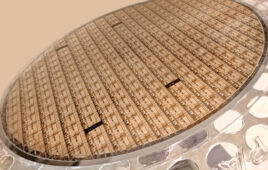
New York Governor Andrew M. Cuomo recently announced that technology company ams AG, which makes high performance sensor solutions and analog ICs, will construct a 360,000 sq. ft. wafer fab at the Nano Utica site in Marcy. This plan is expected to generate more than 1,000 new jobs and will provide an initial investment of over $2 billion.
The wafer fab construction is scheduled to begin in spring 2016. ams will construct, staff and operate a state-of-the-art 200/300 mm facility in support of the company’s high performance analog semiconductor operations. Reports say that the cleanroom will be the “first of its kind in the nation: a 56,000 sq. ft. facility stacked on two levels that is now five times larger than initial plans.”
Additionially, GE Global Research will expand its New York global operations to the Mohawk Valley, serving as the anchor tenant of the Computer Chip Commercialization Center (QUAD C) on the campus of SUNY Polytechnic Institute’s Colleges of Nanoscale Science and Engineering in Utica. This move will create about 500 jobs within the next five years.
According to Mark Little, Senior Vice President and Chief Technology Officer of GE, “We are creating a Silicon Carbide Corridor that will be the epicenter of the next revolution in power. In Utica, it will expand the focus from computer chip commercialization to creating the first U.S. based Power Electronics Manufacturing Center with GE’s silicon carbide technology.” Advanced packaging technologies assist the progress of faster and more powerful computer chips, in addition to silicon carbide chips for power electronics applications.
This is all part of Cuomo’s aforementioned “Nano Utica” initiative, which is a consortium spearheaded by the SUNY College of Nanoscale Science & Engineering and SUNYIT. First announced in 2013, the project includes major technology companies such as Advanced Nanotechnology Solutions Incorporated (ANS), SEMATECH, Atotech, and SEMATECH and CNSE partners, including IBM, Lam Research, and Tokyo Electron. The most recent announcement is said to be the biggest ecnomic announcement for the Mohawk Valley in 50 years.
The region is also home to SUNY’s College of Nanoscale Science and Engineering (CNSE) — the first college in the world dedicated to education, research, development, and deployment in the emerging disciplines of nanoscience, nanoengineering, nanobioscience, and nanoeconomics. The school has made more than $20 billion in high-tech investments in order to offer students a unique academic experience, as well as to provide them with more than 300 corporate partners. CNSE is home to a 1.3 million sq. ft. megaplex that boasts the only university-based fully-integrated, 300mm wafer, computer chip pilot prototyping and demonstration line within 140,000 square feet of Class 1 capable cleanrooms. This provides ready access for field-based assessments of semiconductor research and development operations utilizing nanoparticles. (Read more in this exclusive Controlled Environments article: Advancing Health and Safety for the 21st Century Nanotechnology Workforce)
Cuomo and others are looking at the nanotechnology industry to serve as an “economic engine” for this area of New York State. The Utica region experienced a business boom after the Erie Canal opened in 1825 — settlers utilized it to move into western New York and the upper Midwest, goods could be transported in half the time and at one-tenth their previous cost, and the cost of construction was repaid by toll fees within 9 years. However, the spread of railroads and motor highways, plus the opening of the Saint Lawrence Seaway, sent the Erie Canal (and its surrounding communities) into a period of decline that’s persisted in some areas for the last 50 years. The steel industry — plus companies such as Xerox and Kodak — cut thousands of jobs and/or pulled out of the upstate New York area entirely. Between 1995 and 1997, departures exceeded arrivals in the region by nearly 169,000 people. Engineering students at schools such as Syracuse University weren’t sticking around the upstate New York area to work once they completed their degrees.
However, Tech Valley was still living up to its name, playing host to big-name companies such as IBM (the corporate headquarters opened in Armonk in 1964); Corning Inc. (based in the town of Corning since 1878, the company has stated that it plans to stay); and GE — in 1946, GE and the U.S. government opened the Knolls Atomic Power Laboratory. Today there are sites in Niskayuna and West Milton, both near Schenectady. GE Global Research is based in Niskayuna. GLOBALFOUNDRIES, world’s first full-service semiconductor foundry, is a bit further downstate in Hopewell Junction. The company was launched in 2009 and integrated Chartered Semiconductor in 2010 and IBM Microelectronics Division in 2015. Rensselaer Polytechnic Institute in Troy is the country’s oldest technical university.
The formation of SEMATECH — an industry-and federally-funded research consortium created to enhance U.S. production quality and competitiveness in semiconductor manufacturing — in 1987 was also a big help. SEMATECH began partnering with the State of New York in 2003, and moved its headquarters to Albany in 2008. This resulted from then-Gov. George Pataki, along with IBM and SUNY Albany, convincing the organization that upstate New York was the place for semiconductor and nanotechnology firms to be.
CONFERENCE AGENDA ANNOUNCED:
The highly-anticipated educational tracks for the 2015 R&D 100 Awards & Technology Conference feature 28 sessions, plus keynote speakers Dean Kamen and Oak Ridge National Laboratory Director Thom Mason. Learn more.
New York’s political leaders have showed a firm commitment to long-range economic development. The federal government has been involved, but it’s primarily the politicians, the state, local companies and individuals, and SUNY pushing this initiative to success. The upstate New York semiconductor/nanotechnology revitalization plan works because the individuals and organizations involved are willing to work together, make and honor long-term commitments, and put their money where their mouths are.