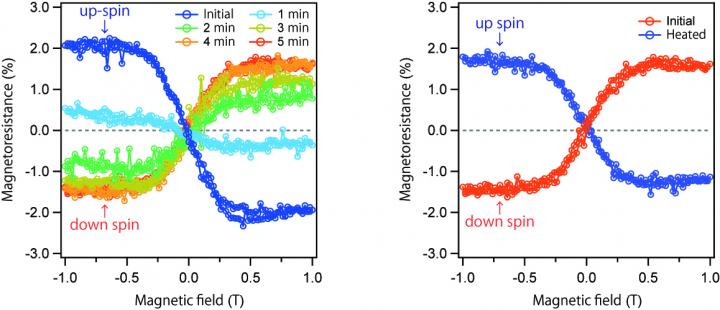
(Left) MR curves recorded after various visible light-irradiation time for a device fabricated with a left-handed isomer. (Right) MR curves recorded before and after the thermal treatment for a device with a right-handed isomer. Credit: NINS/IMS
In spintronics, the use of organic materials as a “spin transport material” has recently garnered significant attention as they exhibit long spin-relaxation times and long spin-diffusion lengths owing to the weak spin-orbit interaction (SOI) of light elements. Meanwhile, the weak SOI of organic materials become a drawback when they are used as a “spin filter”. A spin-polarized current is, therefore, typically generated by inorganic materials with ferromagnetism or strong SOIs. However, the recent finding of spin-selective electron transport through chiral molecules, i.e., the so-called chirality-induced spin selectivity (CISS) effect, suggests an alternative method of using organic materials as spin filters for spintronics applications. Through this effect, right-handed and left-handed molecules generate down- and up-spin, respectively. However, chiral molecules used in the experiments reported so far are static molecules. Hence, the manipulation of spin-polarization direction by external stimuli has not been realized yet.
Now, researchers at Institute for Molecular Science, RIKEN, Nara Institute of Science and Technology, Suranaree University and Vidyasirimedhi Institute of Science and Technology fabricated a novel solid-state spin filtering device that sandwiches a thin layer of artificial molecular motors (Figure 1). Because the artificial molecular motors demonstrate 4 times chirality inversion by light irradiation and thermal treatments during the 360-degree molecular rotation, the spin-polarization direction of electrons that pass through the molecular motors should be switched by light irradiation or thermal treatments.
Figure 2 shows (left) the magnetoresistance (MR) curves recorded after various visible light-irradiation time for a device fabricated with a left-handed isomer. In the initial state, a clear antisymmetric MR curve with a negative slope was observed, which means a clear up-spin selectivity. The MR signal decreased as light irradiation proceeded, and finally the slope of the MR signal was inverted to positive, indicating a light-induced spin switching in the spin-polarized current from up-spin selective to down-spin through the left-handed-to-right-handed chirality inversion. A subsequent thermal activation process for the left-handed isomer inverted the slope of the MR curve from positive to negative again, as shown in Figure 2 (right), implying a thermal-activation-induced spin switching from down-spin selective to up-spin selective through the right-handed-to-left-handed chirality inversion. Similar phenomena were observed in subsequent measurements after photo-irradiation and thermal treatments. This series of experiments clearly demonstrated that 4 times spin switching were induced during the 360-degree rotation of the molecular motors.
In this new type of novel organic spintronics device, the right-handed/left-handed chirality, which is the origin of spin-polarization generation through the CISS effect, is reconfigurable by external stimuli and precise control of the spin-polarization direction in the spin-polarized currents by utilizing an artificial molecular motor was realized, for the first time. The present results are beneficial for the development of next-generation organic photo/thermospintronic devices combined with molecular machines.