Research & Development World

  • R&D World Home
  • Topics
    • Aerospace
    • Automotive
    • Biotech
    • Careers
    • Chemistry
    • Environment
    • Energy
    • Life Science
    • Material Science
    • R&D Management
    • Physics
  • Technology
    • 3D Printing
    • A.I./Robotics
    • Software
    • Battery Technology
    • Controlled Environments
      • Cleanrooms
      • Graphene
      • Lasers
      • Regulations/Standards
      • Sensors
    • Imaging
    • Nanotechnology
    • Scientific Computing
      • Big Data
      • HPC/Supercomputing
      • Informatics
      • Security
    • Semiconductors
  • R&D Market Pulse
  • R&D 100
    • 2025 R&D 100 Award Winners
    • 2025 Professional Award Winners
    • 2025 Special Recognition Winners
    • R&D 100 Awards Event
    • R&D 100 Submissions
    • Winner Archive
  • Resources
    • Research Reports
    • Digital Issues
    • Educational Assets
    • R&D Index
    • Subscribe
    • Video
    • Webinars
    • Content submission guidelines for R&D World
  • Global Funding Forecast
  • Top Labs
  • Advertise
  • SUBSCRIBE

Mirrors Control Chemical Selectivity

By University of Strasbourg | March 29, 2019

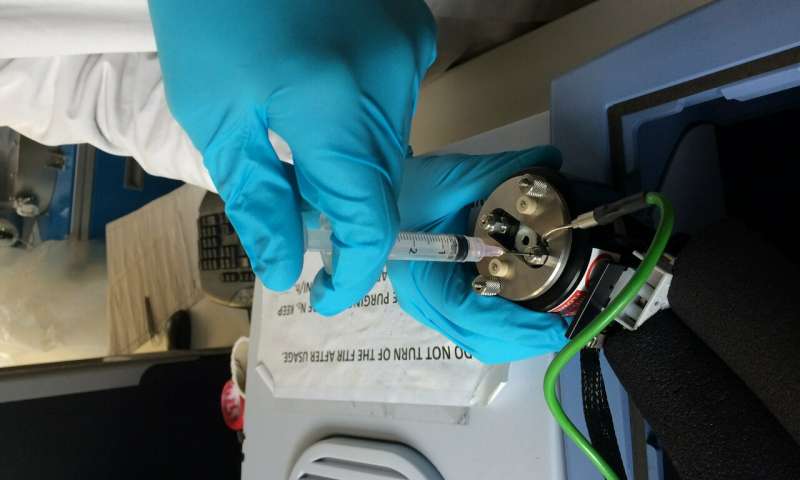
Injecting the reaction mixture into the optical cavity changes the rate of the chemical reaction. Credit: University of Strasbourg

A chemical reaction transforms the molecules that make up matter. To influence chemical reactions, chemists typically act on the molecules themselves, rather than the space in which the reaction takes places. However, researchers at the University of Strasbourg have shown that chemical reactions can indeed be influenced simply by conducting them between two appropriately spaced mirrors, kept only micrometers apart, a vessel physicist call an “optical cavity”.

Inside these microscopic “optical cavities”, like everywhere else in the universe, electromagnetic fluctuations happen, even in the dark. These fluctuations can be thought of as waves confined between two walls. When the walls are spaced at a suitable distance, the waves are amplified, just as the movement of a swing is amplified when pushed at regular intervals corresponding to its swinging frequency. When a liquid is injected between the walls of the cavity, the electromagnetic fluctuations interact with the molecules inside, provided that the cavity resonates with one of the molecule’s vibrations. If the interaction is strong enough, the vibrations and optical resonance form hybrid states (half photonic, half vibrational). In that case, the molecules can be said to be under the influence of vibrational strong coupling (VSC).

The teams of professors Thomas Ebbesen and Joseph Moran, specialized in nanoscience and chemical catalysis, respectively, began a collaboration in 2015 to try to understand if VSC could have an effect on chemical reactions. The following year, they published a first article showing that it is possible to slow down the deprotection of a trimethylsilyl protecting group by fluoride by a factor of five.

These promising results led them to try to control the selectivity of chemical reactions by VSC. In other words, to study the possibility of promoting the formation of one product over another in a transformation that could give two different outcomes. For this purpose, they designed a substrate comprising two distinct silyl groups that can react with the fluoride ion to form two different products. By tuning the optical cavity to different vibrations of the molecule, they could not only change the relative yield of two products, but also show which vibrations are involved in the reaction mechanism.

This pioneering discovery is a proof of concept that opens the way to control chemical reactions by simple physical means: by adjusting the distance between two mirrors in the dark. Moreover, it is a tool to understand fundamental chemical reactivity. But the collaboration between the two teams does not stop there. They are currently studying other types of reactions to try to understand the rules that govern chemistry under the influence of VSC.

Related Articles Read More >

R&D 100 Winner Spotlight: DuPont Tychem 6000 SFR tackles the chemical vs. flame protection trade-off
R&D 100 Winner Spotlight: DuPont’s high-salinity wastewater membrane
Engineered enzymes turn industrial pollutant Into pharmaceutical building block
Chemistry Nobel goes to ‘molecular architecture’ with spaces big enough to trap gases
rd newsletter
EXPAND YOUR KNOWLEDGE AND STAY CONNECTED
Get the latest info on technologies, trends, and strategies in Research & Development.
RD 25 Power Index

R&D World Digital Issues

Fall 2025 issue

Browse the most current issue of R&D World and back issues in an easy to use high quality format. Clip, share and download with the leading R&D magazine today.

R&D 100 Awards
Research & Development World
  • Subscribe to R&D World Magazine
  • Sign up for R&D World’s newsletter
  • Contact Us
  • About Us
  • Drug Discovery & Development
  • Pharmaceutical Processing
  • Global Funding Forecast

Copyright © 2026 WTWH Media LLC. All Rights Reserved. The material on this site may not be reproduced, distributed, transmitted, cached or otherwise used, except with the prior written permission of WTWH Media
Privacy Policy | Advertising | About Us

Search R&D World

  • R&D World Home
  • Topics
    • Aerospace
    • Automotive
    • Biotech
    • Careers
    • Chemistry
    • Environment
    • Energy
    • Life Science
    • Material Science
    • R&D Management
    • Physics
  • Technology
    • 3D Printing
    • A.I./Robotics
    • Software
    • Battery Technology
    • Controlled Environments
      • Cleanrooms
      • Graphene
      • Lasers
      • Regulations/Standards
      • Sensors
    • Imaging
    • Nanotechnology
    • Scientific Computing
      • Big Data
      • HPC/Supercomputing
      • Informatics
      • Security
    • Semiconductors
  • R&D Market Pulse
  • R&D 100
    • 2025 R&D 100 Award Winners
    • 2025 Professional Award Winners
    • 2025 Special Recognition Winners
    • R&D 100 Awards Event
    • R&D 100 Submissions
    • Winner Archive
  • Resources
    • Research Reports
    • Digital Issues
    • Educational Assets
    • R&D Index
    • Subscribe
    • Video
    • Webinars
    • Content submission guidelines for R&D World
  • Global Funding Forecast
  • Top Labs
  • Advertise
  • SUBSCRIBE