Research & Development World

  • R&D World Home
  • Topics
    • Aerospace
    • Automotive
    • Biotech
    • Careers
    • Chemistry
    • Environment
    • Energy
    • Life Science
    • Material Science
    • R&D Management
    • Physics
  • Technology
    • 3D Printing
    • A.I./Robotics
    • Software
    • Battery Technology
    • Controlled Environments
      • Cleanrooms
      • Graphene
      • Lasers
      • Regulations/Standards
      • Sensors
    • Imaging
    • Nanotechnology
    • Scientific Computing
      • Big Data
      • HPC/Supercomputing
      • Informatics
      • Security
    • Semiconductors
  • R&D Market Pulse
  • R&D 100
    • 2025 R&D 100 Award Winners
    • 2025 Professional Award Winners
    • 2025 Special Recognition Winners
    • R&D 100 Awards Event
    • R&D 100 Submissions
    • Winner Archive
  • Resources
    • Research Reports
    • Digital Issues
    • Educational Assets
    • R&D Index
    • Subscribe
    • Video
    • Webinars
    • Content submission guidelines for R&D World
  • Global Funding Forecast
  • Top Labs
  • Advertise
  • SUBSCRIBE

Nano Lubricant Tuning Means Better Electronics and Surface Coatings

By Rick Kubetz, Engineering Communications Office, University of Illinois at Urbana-Champaign | February 13, 2017

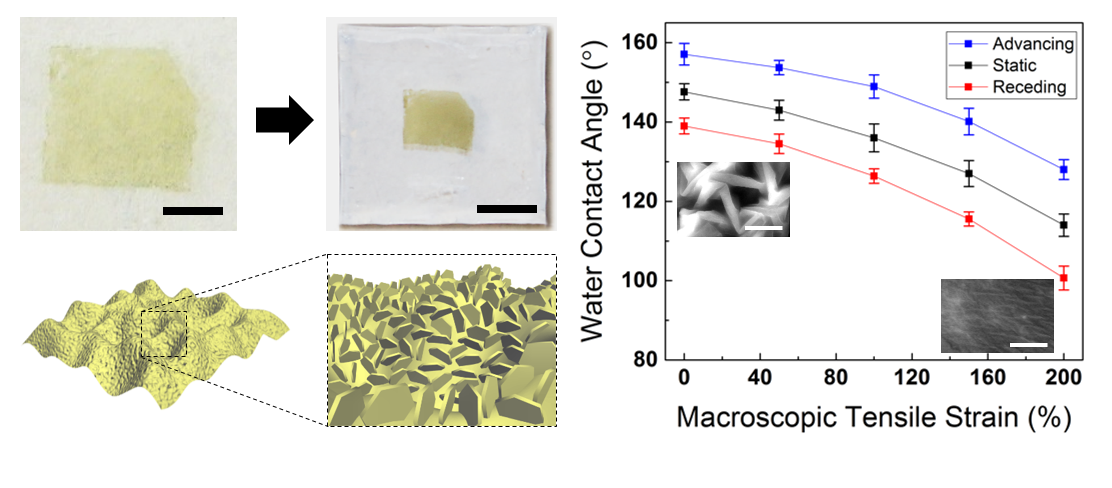
Image shows how controlled and dynamic surface architecturing/roughening of atomically thin MoS2 affects wettability.

Molybdenum disulfide (MoS2), which is ubiquitously used as a solid lubricant, has recently been shown to have a two-dimensional (2D) form that is similar to graphene. But, when thinned down to less than a nanometer thick, MoS2 demonstrates properties with great promise as a functional material for electronic devices and surface coatings.

Researchers at the University of Illinois at Urbana-Champaign have developed a new approach to dynamically tune the micro- and nano-scale roughness of atomically thin MoS2, and consequently the appropriate degree of hydrophobicity for various potential MoS2-based applications.

“The knowledge of how new materials interact with water is a fundamental,” explains SungWoo Nam, an assistant professor of mechanical science and engineering at Illinois. “Whereas the wettability of its more famous cousin, graphene, has been substantially investigated, that of atomically thin MoS2 — in particular atomically thin MoS2 with micro- and nano-scale roughness — has remained relatively unexplored despite its strong potential for fundamental research and device applications. Notably, systematic study of how hierarchical microscale and nanoscale roughness of MoS2 influence its wettability has been lacking in the scientific community.”

“This work will provide a new approach to dynamically tune the micro- and nano-scale roughness of atomically thin MoS2 and consequently the appropriate degree of hydrophobicity for various potential MoS2-based applications,” says Jonghyun Choi, a mechanical engineering graduate student and first author of the article, “Hierarchical, Dual-Scale Structures of Atomically Thin MoS2 for Tunable Wetting,” appearing in the journal, Nano Letters. “These include waterproof electronic devices with superhydrophobicity with water contact angle greater than 150 degrees. It may also be useful for medical applications with reduced hydrophobicity (WCA less than 100 degrees) for effective contact with biological substances.”

According to the authors, this study, expands the toolkit to allow tunable wettability of 2D materials, many of which are just beginning to be discovered.

“When deformed and patterned to produce micro- and nano-scale structures, MoS2 shows promise as a functional material for hydrogen evolution catalysis systems, electrodes for alkali metal-ion batteries, and field-emission arrays,” Nam adds. “The results should also contribute to future MoS2-based applications, such as tunable wettability coatings for desalination and hydrogen evolution.”

In addition to Nam and Choi, co-authors of the paper include graduate students Michael Cai Wang and Ali Ashraf (Illinois), Jihun Mun and Sang-Woo Kang (Korea Research Institute of Standards and Science, Korea). Experiments were carried out in part in the Frederick Seitz Materials Research Laboratory, the Micro + Nano Technology Laboratory, and the Beckman Institute Imaging Technology Group at Illinois.


Source: University of Illinois at Urbana-Champaign

Related Articles Read More >

FDA approves first non-drug depression treatment
These R&D 100 Finalists are improving pharmaceutical research with their award-winning CyroProbe
Lab automation is “vaporizing”: Why the hottest innovation is invisible
Maryland set for first subsea internet cable: AWS’s 320+ Tbps “Fastnet” to Ireland
rd newsletter
EXPAND YOUR KNOWLEDGE AND STAY CONNECTED
Get the latest info on technologies, trends, and strategies in Research & Development.
RD 25 Power Index

R&D World Digital Issues

Fall 2025 issue

Browse the most current issue of R&D World and back issues in an easy to use high quality format. Clip, share and download with the leading R&D magazine today.

R&D 100 Awards
Research & Development World
  • Subscribe to R&D World Magazine
  • Sign up for R&D World’s newsletter
  • Contact Us
  • About Us
  • Drug Discovery & Development
  • Pharmaceutical Processing
  • Global Funding Forecast

Copyright © 2025 WTWH Media LLC. All Rights Reserved. The material on this site may not be reproduced, distributed, transmitted, cached or otherwise used, except with the prior written permission of WTWH Media
Privacy Policy | Advertising | About Us

Search R&D World

  • R&D World Home
  • Topics
    • Aerospace
    • Automotive
    • Biotech
    • Careers
    • Chemistry
    • Environment
    • Energy
    • Life Science
    • Material Science
    • R&D Management
    • Physics
  • Technology
    • 3D Printing
    • A.I./Robotics
    • Software
    • Battery Technology
    • Controlled Environments
      • Cleanrooms
      • Graphene
      • Lasers
      • Regulations/Standards
      • Sensors
    • Imaging
    • Nanotechnology
    • Scientific Computing
      • Big Data
      • HPC/Supercomputing
      • Informatics
      • Security
    • Semiconductors
  • R&D Market Pulse
  • R&D 100
    • 2025 R&D 100 Award Winners
    • 2025 Professional Award Winners
    • 2025 Special Recognition Winners
    • R&D 100 Awards Event
    • R&D 100 Submissions
    • Winner Archive
  • Resources
    • Research Reports
    • Digital Issues
    • Educational Assets
    • R&D Index
    • Subscribe
    • Video
    • Webinars
    • Content submission guidelines for R&D World
  • Global Funding Forecast
  • Top Labs
  • Advertise
  • SUBSCRIBE