An international research team has found a way to make light frequency conversion at the nanoscale 100 times more efficient. The new method is based on isolated dielectric nanoparticles supporting bound states in the continuum. Such states form when radiating field oscillations in the particle suppress each other. This way, the electromagnetic energy inside the particle can be locked securely. The obtained results can be used for further studies of nonlinear optics, in particular, for development of tiny light conversion devices. The research was published in Physical Review Letters on July 19.
Today, one of the key problems of nonlinear physics is the frequency conversion of electromagnetic radiation at the nanoscale. By changing the frequency, the radiation can be converted from one spectral band to another: from terahertz to infrared, and from infrared to visible. This task can be carried out effectively by macroscopic devices, but it is a challenge to reproduce their work at the nanoscale. The reason is that interaction of nanoparticles with light is quite specific because of their small size. Therefore, in order to increase efficiency of light frequency conversion at the nanoscale, it is necessary to reduce energy losses during three key processes in the nanoparticle: radiation input, confinement and nonlinear conversion.
To solve these problems, an international team of physicists from ITMO University, the Nonlinear Physics Centre of the Australian National University and the University of Brescia in Italy proposed exploiting a new type of resonator. It is comprised of disk-shaped, dielectric nanoparticles that support bound states in the continuum. Such states form when several types of electromagnetic energy oscillations in the particle mutually suppress their radiation. This way, light energy can be “locked” inside the particle. Theoretically, the energy can be locked forever, provided that resonators are of infinite size. Even though there are no infinite structures in practice, it is possible to “catch” light for a finite, yet quite long time, even in a single nanoparticle. This requires the optimal ratio of the particle shape, size, and material.
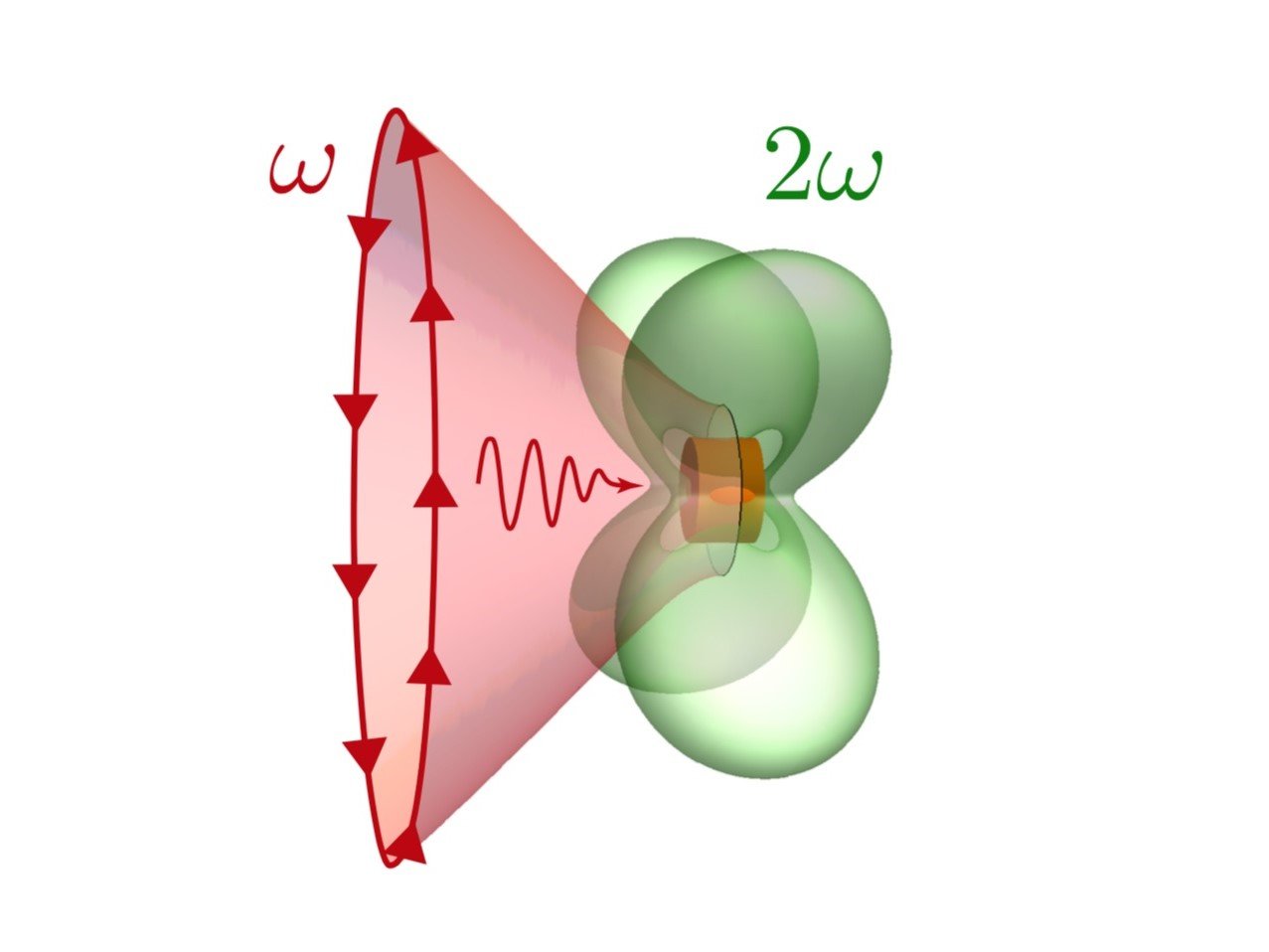
Nano-resonator described in the research. Image: ITMO University
“Although we described such single dielectric nanoresonators in our previous research, we have not yet analyzed their practical perspectives. Now, we calculated how this resonator generates the light with a double frequency. The results show that this structure helps to increase the efficiency of the process by two orders of magnitude. However, this was not easy, as we had to find the optimal way of pumping the energy into the resonator. We found out that in our case, the incident wave had to be polarized in such a way that it oscillates along the tangent to the circle. This coincides with the structure of the electromagnetic field inside the particle,” says Kirill Koshelev, a member of the International Metamaterial Laboratory of ITMO University.
As a result, the scientists achieved a record efficiency of doubling of light frequency by dielectric nanoparticles. Now, instead of a hundredth part of a percent, it is possible to save several percent of light energy during the conversion. This result paves the way towards experimental detection of radiation converted by a nanoparticle, which means the proposed system can be used in practical applications.
“We have suggested a design of nanoconverters of light which can be used for various applications. For example, they can be used in night vision devices which convert infrared radiation into visible light. At the same time, the dielectric material we chose, aluminum-gallium arsenide, has the mature fabrication technology. Since the material is available for various laboratories, we hope that our work will contribute to further research in the field of nonlinear nanophotonics, as well as to the expansion of the application scope for nanoscale radiation converters,” adds Yuri Kivshar, co-director of the Nanophotonics and Metamaterials Department at ITMO University, distinguished Professor of the Australian National University.
Source: ITMO University