Research & Development World

  • R&D World Home
  • Topics
    • Aerospace
    • Automotive
    • Biotech
    • Careers
    • Chemistry
    • Environment
    • Energy
    • Life Science
    • Material Science
    • R&D Management
    • Physics
  • Technology
    • 3D Printing
    • A.I./Robotics
    • Software
    • Battery Technology
    • Controlled Environments
      • Cleanrooms
      • Graphene
      • Lasers
      • Regulations/Standards
      • Sensors
    • Imaging
    • Nanotechnology
    • Scientific Computing
      • Big Data
      • HPC/Supercomputing
      • Informatics
      • Security
    • Semiconductors
  • R&D Market Pulse
  • R&D 100
    • 2025 R&D 100 Award Winners
    • 2025 Professional Award Winners
    • 2025 Special Recognition Winners
    • R&D 100 Awards Event
    • R&D 100 Submissions
    • Winner Archive
  • Resources
    • Research Reports
    • Digital Issues
    • Educational Assets
    • R&D Index
    • Subscribe
    • Video
    • Webinars
    • Content submission guidelines for R&D World
  • Global Funding Forecast
  • Top Labs
  • Advertise
  • SUBSCRIBE

Nanopore Detection of Single Flu Viruses to Control Outbreaks

By Osaka University | November 21, 2018

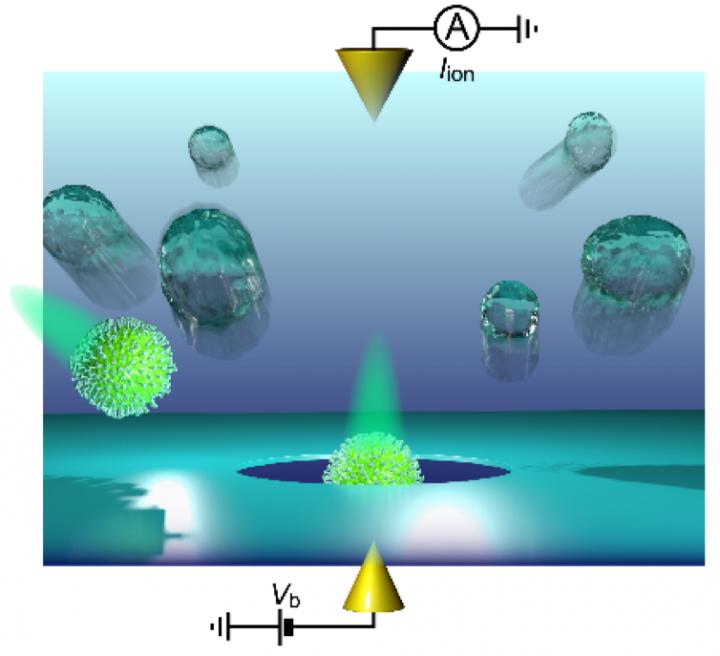
Detection of a single influenza virion using a solid-state nanopore. Credit: Osaka University

Influenza is a highly contagious respiratory disease of global importance, which causes millions of infections annually with the ever-present risk of a serious outbreak. Passive vaccination is the only method available for partial control of the virus. Rapid diagnosis of influenza has been explored to prevent outbreaks by enabling medication at very early stages of infection; however, diagnostic sensitivity has not been high enough, until now.

In a new study published in Scientific Reports, a team of researchers led by Osaka University explored the usefulness of combining a single-particle nanopore sensor with artificial intelligence technology, and found that this approach created a new virus typing method that can be used to identify single influenza virions.

Genetic methods can identify many virus species, but require time-intensive processes and specialized staff. Therefore, these methods are unsuitable for point-of-care screening. In a novel approach, the researchers designed a sensor that could assess distinct nanoscale properties of influenza virions within physiological samples.

“We used machine-learning analysis of the electrical signatures of the virions,” says corresponding author Makusu Tsutsui. “Using this artificial intelligence approach to signal analysis, our method can recognize a slight current waveform difference, which cannot be discerned by human eyes. This enables high-precision identification of viruses.”

In testing this sensor, the research team found that electroosmotic flow (liquid motion induced by an electric current across the nanopore) through the pore channel could block the passage of non-virus particles. This ensured that the only particles evaluated by the sensor were virus particles, regardless of the complexity of the sample that contained those viruses.

“Our testing revealed that this new sensor may be suitable for use in a viral test kit that is both quick and simple,” says lead author Akihide Arima, “Importantly, use of this sensor does not require specialized human expertise, so it can readily be applied as a point-of-care screening approach by a wide variety of healthcare personnel.”

In addition to enabling early detection of influenza, this nanosensor method could be modified to enable early detection of other viral particles. This would enable rapid prevention and tracking for a variety of local epidemics and potential pandemics.


Related Articles Read More >

How Prelude and QDX are using quantum chemistry to discover cancer treatments
US political drama is pushing life sciences talent toward Switzerland, Basel leader says
Thermo Fisher targets early-stage CGT bottlenecks with new Philadelphia hub
AUTOMA+ 2025 brings global pharma expertise to Austria
rd newsletter
EXPAND YOUR KNOWLEDGE AND STAY CONNECTED
Get the latest info on technologies, trends, and strategies in Research & Development.
RD 25 Power Index

R&D World Digital Issues

Fall 2025 issue

Browse the most current issue of R&D World and back issues in an easy to use high quality format. Clip, share and download with the leading R&D magazine today.

Research & Development World
  • Subscribe to R&D World Magazine
  • Sign up for R&D World’s newsletter
  • Contact Us
  • About Us
  • Drug Discovery & Development
  • Pharmaceutical Processing
  • Global Funding Forecast

Copyright © 2025 WTWH Media LLC. All Rights Reserved. The material on this site may not be reproduced, distributed, transmitted, cached or otherwise used, except with the prior written permission of WTWH Media
Privacy Policy | Advertising | About Us

Search R&D World

  • R&D World Home
  • Topics
    • Aerospace
    • Automotive
    • Biotech
    • Careers
    • Chemistry
    • Environment
    • Energy
    • Life Science
    • Material Science
    • R&D Management
    • Physics
  • Technology
    • 3D Printing
    • A.I./Robotics
    • Software
    • Battery Technology
    • Controlled Environments
      • Cleanrooms
      • Graphene
      • Lasers
      • Regulations/Standards
      • Sensors
    • Imaging
    • Nanotechnology
    • Scientific Computing
      • Big Data
      • HPC/Supercomputing
      • Informatics
      • Security
    • Semiconductors
  • R&D Market Pulse
  • R&D 100
    • 2025 R&D 100 Award Winners
    • 2025 Professional Award Winners
    • 2025 Special Recognition Winners
    • R&D 100 Awards Event
    • R&D 100 Submissions
    • Winner Archive
  • Resources
    • Research Reports
    • Digital Issues
    • Educational Assets
    • R&D Index
    • Subscribe
    • Video
    • Webinars
    • Content submission guidelines for R&D World
  • Global Funding Forecast
  • Top Labs
  • Advertise
  • SUBSCRIBE