Research & Development World

  • R&D World Home
  • Topics
    • Aerospace
    • Automotive
    • Biotech
    • Careers
    • Chemistry
    • Environment
    • Energy
    • Life Science
    • Material Science
    • R&D Management
    • Physics
  • Technology
    • 3D Printing
    • A.I./Robotics
    • Software
    • Battery Technology
    • Controlled Environments
      • Cleanrooms
      • Graphene
      • Lasers
      • Regulations/Standards
      • Sensors
    • Imaging
    • Nanotechnology
    • Scientific Computing
      • Big Data
      • HPC/Supercomputing
      • Informatics
      • Security
    • Semiconductors
  • R&D Market Pulse
  • R&D 100
    • 2025 R&D 100 Award Winners
    • 2025 Professional Award Winners
    • 2025 Special Recognition Winners
    • R&D 100 Awards Event
    • R&D 100 Submissions
    • Winner Archive
  • Resources
    • Research Reports
    • Digital Issues
    • Educational Assets
    • R&D Index
    • Subscribe
    • Video
    • Webinars
    • Content submission guidelines for R&D World
  • Global Funding Forecast
  • Top Labs
  • Advertise
  • SUBSCRIBE

New Device could Increase Battery Life of Electronics by a Hundred-Fold

By R&D Editors | May 16, 2018

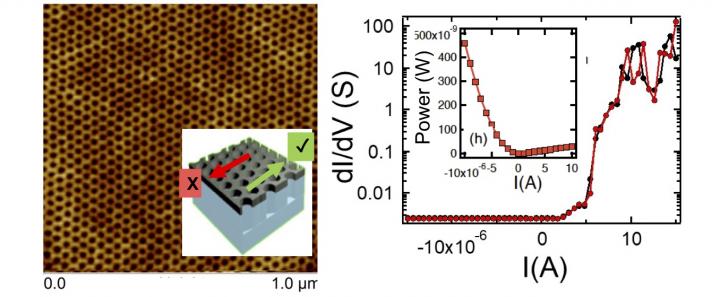
The left shows the atomic force micrograph, exhibiting honeycomb structure pattern behind a magnetic device. Inset shows the schematic of current flow direction. On the right: electrical data reveals diode-type behavior of current flowing in one direction. Inset shows that the dissipative power is of the order of nano-watt in the current flowing direction, which is at least three orders of magnitude smaller than the semiconductor diode. Credit: Deepak Singh

Among the chief complaints for smartphone, laptop and other battery-operated electronics users is that the battery life is too short and–in some cases–that the devices generate heat. Now, a group of physicists led by Deepak K. Singh, associate professor of physics and astronomy at the University of Missouri, has developed a device material that can address both issues. The team has applied for a patent for a magnetic material that employs a unique structure–a “honeycomb” lattice that exhibits distinctive electronic properties.

“Semiconductor diodes and amplifiers, which often are made of silicon or germanium, are key elements in modern electronic devices,” said Singh, who also serves as the principal investigator of the Magnetism and Superconductivity Research Laboratory at MU. “A diode normally conducts current and voltage through the device along only one biasing direction, but when the voltage is reversed, the current stops. This switching process costs significant energy due to dissipation, or the depletion of the power source, thus affecting battery life. By substituting the semiconductor with a magnetic system, we believed we could create an energetically effective device that consumes much less power with enhanced functionalities.”

Singh’s team developed a two-dimensional, nanostructured material created by depositing a magnetic alloy, or permalloy, on the honeycomb structured template of a silicon surface. The new material conducts unidirectional current, or currents that only flow one way. The material also has significantly less dissipative power compared to a semiconducting diode, which is normally included in electronic devices.

The magnetic diode paves the way for new magnetic transistors and amplifiers that dissipate very little power, thus increasing the efficiency of the power source. This could mean that designers could increase the life of batteries by more than a hundred-fold. Less dissipative power in computer processors could also reduce the heat generated in laptop or desktop CPUs.

“Although more works need to be done to develop the end product, the device could mean that a normal 5-hour charge could increase to more than a 500-hour charge,” Singh said. “The device could also act as an ‘on/off switch’ for other periphery components such as closed-circuit cameras or radio frequency attenuators, which reduces power flowing through a device. We have applied for a U.S. patent and have begun the process of incorporating a spin-off company to help us take the device to market.”

The proposed startup company associated with this research, highlights the university’s impact on the state’s economic development efforts, including commercialization of research conducted at Mizzou, workforce development and job growth, quality of life improvements for residents, and attracting corporations and businesses to the state. Companies commercializing MU technologies have secured hundreds of millions of dollars in investments and grants to advance their commercialization efforts. In 2017, the Office of Technology Management and Industry Relations reported that 31 U.S. patents were issued to members of the MU community.
Related Articles Read More >

Lithium iron phosphate (LFP) is a mineral of the olivine family. LFP is one of the materials used as the cathode in a lithium ion battery. The structure of LFP includes Fe(III)O6 octahedra (green) sharing bridged oxygen atoms (red) with tetrahedral phosphate groups (PO4, orange). The channels formed by the interlocking polyhedra are filled with rows of Li(+) ions (gray). (The anode of a lithium ion battery is carbon graphite with intercalated lithium ions. LFP batteries deliver a constant voltage of ~3.2 V over entire life of the battery. They are particularly well-suited for electric vehicles because the high discharge rates for these batteries are need for acceleration. LFP batteries are also lower in weight and have longer lifetimes than other Li ion batteries.
How designer solvents are changing battery recycling
California microgrid pilots EV integration model for wildfire-prone regions
Solving the EV charger problem with streetlights
New scalable supercapacitors store more energy using graphene
rd newsletter
EXPAND YOUR KNOWLEDGE AND STAY CONNECTED
Get the latest info on technologies, trends, and strategies in Research & Development.
RD 25 Power Index

R&D World Digital Issues

Fall 2025 issue

Browse the most current issue of R&D World and back issues in an easy to use high quality format. Clip, share and download with the leading R&D magazine today.

R&D 100 Awards
Research & Development World
  • Subscribe to R&D World Magazine
  • Sign up for R&D World’s newsletter
  • Contact Us
  • About Us
  • Drug Discovery & Development
  • Pharmaceutical Processing
  • Global Funding Forecast

Copyright © 2026 WTWH Media LLC. All Rights Reserved. The material on this site may not be reproduced, distributed, transmitted, cached or otherwise used, except with the prior written permission of WTWH Media
Privacy Policy | Advertising | About Us

Search R&D World

  • R&D World Home
  • Topics
    • Aerospace
    • Automotive
    • Biotech
    • Careers
    • Chemistry
    • Environment
    • Energy
    • Life Science
    • Material Science
    • R&D Management
    • Physics
  • Technology
    • 3D Printing
    • A.I./Robotics
    • Software
    • Battery Technology
    • Controlled Environments
      • Cleanrooms
      • Graphene
      • Lasers
      • Regulations/Standards
      • Sensors
    • Imaging
    • Nanotechnology
    • Scientific Computing
      • Big Data
      • HPC/Supercomputing
      • Informatics
      • Security
    • Semiconductors
  • R&D Market Pulse
  • R&D 100
    • 2025 R&D 100 Award Winners
    • 2025 Professional Award Winners
    • 2025 Special Recognition Winners
    • R&D 100 Awards Event
    • R&D 100 Submissions
    • Winner Archive
  • Resources
    • Research Reports
    • Digital Issues
    • Educational Assets
    • R&D Index
    • Subscribe
    • Video
    • Webinars
    • Content submission guidelines for R&D World
  • Global Funding Forecast
  • Top Labs
  • Advertise
  • SUBSCRIBE