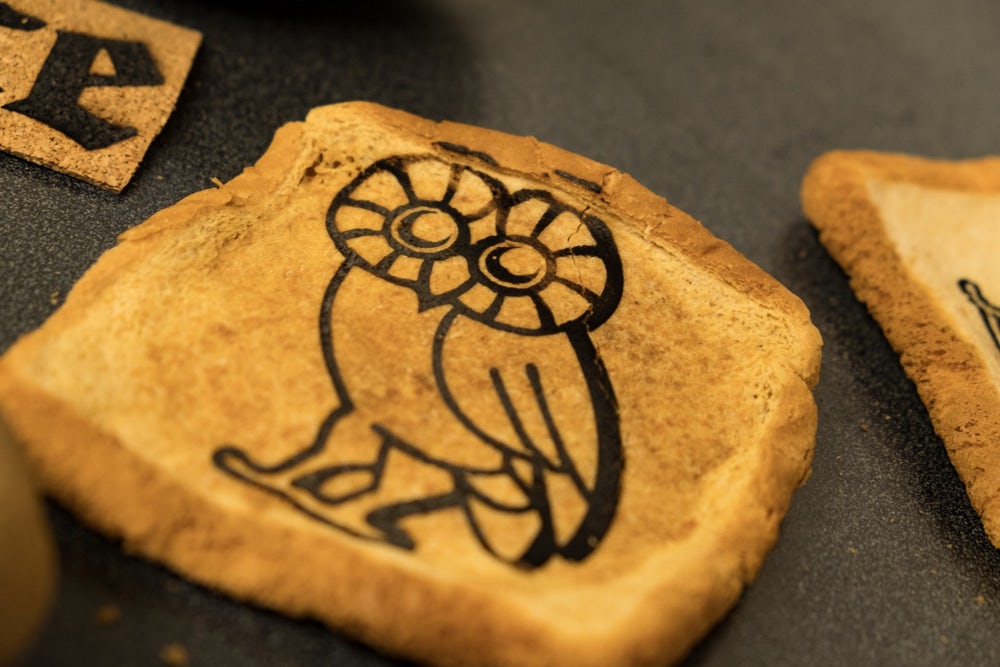
Bread, coconuts, potatoes and even toast may be the next platform for graphene.
A team of researchers from Rice University has enhanced their laser-induced graphene (LIG) technique so they can “write” graphene patterns onto food and other materials, enabling embed conductive identification tags and sensors onto the products. The writing is not ink, but the material itself, which has been converted to graphene.
James Tour, a chemist from Rice University, said in an interview with R&D Magazine that the new technology would give consumers more information about the food they are purchasing and streamline manufacturing processes for a number of goods, including clothing.
“If you want to do it on food it could help to track things from farm to table,” Tour said. “Instead of sticking a sticker on each apple you can build an RFID [radio frequency identification] tag on to it, so you can put it directly on the food item.
“You could also build sensors into it so you know if it hit a certain temperature,” he added.
If an item is marketed as fresh meat and not frozen, this technology could also alert the consumer whether or not that claim is truthful. The sensor couls also alert the consumer about things like E. coli. The RFID or sensor could be connected to a cell phone, alerting a user that their meat or milk is about to spoil.
“It depends on what kind of sophistication you want to build in, but the electronics are not hard,” Tour said.
Tour also said that at about 20 microns thick, the graphene would be unnoticeable by consumers. The graphene is safe to ingest, said Tour.
The researchers have also demonstrated that laser-induced graphene can be burned into paper, cardboard, cloth, or coal. Companies could use the graphene to streamline inventory and track the routes of products being shipped.
“We also showed we could do it on cotton, so you can have electronics embedded in clothing were you are not adding an ink you are just converting the cellulose to graphene,” Tour said. “Now we can do it on all sorts of things.”
How it works
To implement this technology, companies would use a laser that could embed the graphene into the product at extremely fast speeds. The laser would work similar to how companies print expiration date messages on plastic bottles of milk or juice.
“This gives you a way to scribble electronics on all sorts of plastics, on all sorts of food directly,” Tour said.
The researchers would use multiple laser passes with a defocused beam to create patterns into cloth, paper, potatoes, coconut shells and cork. The process happens in air at ambient temperatures.
Tour explained that in some cases, multiple lasing creates a two-step reaction where the laser photothermally converts the target surface into amorphous carbon. Then on subsequent passes of the laser, the selective absorption of infrared light converts the amphorous carbon into LIG.
The researchers then discovered that simply turning up the laser’s power did not make better graphene on a coconut or other organic materials.
However, by adjusting the process they were able to make a micro super capacitor in the shape of a Rice University “R” on their twice-lased coconut skin.
Defocusing the laser sped the process for many materials as the wider beam allowed each spot on a target to be lased many times in a single raster scan, allowing for fine control over the product.
Defocusing allowed them to turn previously unsuitable polyetherimide into LIG.
According to Tour, the common element of all the materials that can be converted into graphene appears to be lignin, a complex organic polymer that form rigid cell walls. Lignin is known as a carbon precursor to burn LIG in oven-dried wood. However, the researchers found that cork, coconut shells and potato skins have even higher lignin content, making it easier to convert them to graphene.
The new process is an extension of the Tour lab’s contention that anything with the proper carbon content can be converted into graphene. In recent years, the lab has developed and expanded upon its method to make graphene foam by using a commercial laser to transform the top layer of an inexpensive polymer film. The foam consists of microscopic, cross-linked flakes of graphene and LIG can be written into target materials in patterns and used as a supercapacitor, an electrocatalyst for fuel cells, RFIDs and biological sensors, among other potential applications.