
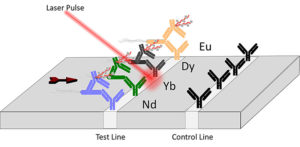
Purdue innovators have developed a lanthanide-based assay coupled with a laser that can be used to detect toxins and pathogenic E. coli in food samples, water and a variety of industrial materials.
Researchers at Purdue University have been working to develop new technologies to help stop the spread of foodborne illnesses, which kill 3,000 people a year, by detecting them more efficiently. They have developed a lanthanide-based assay coupled with a laser that can be used to detect toxins and pathogenic E. coli in food samples, water and a variety of industrial materials.
The two key features of the new technology are the incorporation of lanthanides and simple lateral flow paper-based assays. The Purdue team created a method for combining different heavy metals that when linked to antibodies can detect multiple agents in a single analysis. The team’s work is published in the January edition of Analytical and Bioanalytical Chemistry.
“Our goal was to incorporate easily detectable elements into a paper-based assay which is low-cost and effective,” said J. Paul Robinson, the SVM Professor of Cytomics in Purdue’s College of Veterinary Medicine and a professor of biomedical engineering in Purdue’s College of Engineering. “Designing a technology that is both low-cost but also accurate and can detect multiple antigens simultaneously was a critical factor in our decision to work on this problem.”
The innovators worked with the Purdue Research Foundation Office of Technology Commercialization to patent the technology in the United States and in Europe. They are looking for partners. For more information, contact Dipak Narula of OTC at [email protected] and reference track code 2019-ROBI-68413.
“We are very excited about the acceptance of the intellectual property as this will enhance the possibility of finding commercial partners,” Robinson said. “The potential for moving this to handheld, field deployable use is something we see in the future.”
The group is evaluating the potential for fully portable use that would allow field use in virtually any environment.
The approach uses a high-powered laser pulse to obliterate a sample, while simultaneously collecting the spectral signature of the resultant emission. These signals are then compared with a database that translates the signals into an identification of the toxin or pathogen.
The work presented in this paper shows the proof of principle and is the basis for significant expansion of the studies. What makes the technology effective is the linking of antibodies to different heavy metal tags. This creates a unique fingerprint of atomic signatures that can be used to determine if any particular pathogen of interest is present in a sample.
The U.S. Department of Agriculture Agricultural Research Service (ARS) and Center for Food Safety Engineering (CFSE) provided funding for the technology research in addition to Hatch Funds, which support agricultural research at land-grant institutions across the U.S.
About Purdue Research Foundation Office of Technology Commercialization
The Purdue Research Foundation Office of Technology Commercialization operates one of the most comprehensive technology transfer programs among leading research universities in the U.S. Services provided by this office support the economic development initiatives of Purdue University and benefit the university’s academic activities through commercializing, licensing and protecting Purdue intellectual property. The office recently moved into the Convergence Center for Innovation and Collaboration in Discovery Park District, located on the west side of the Purdue campus. The office is managed by the Purdue Research Foundation, which received the 2019 Innovation and Economic Prosperity Universities Award for Place from the Association of Public and Land-grant Universities. The Purdue Research Foundation is a private, nonprofit foundation created to advance the mission of Purdue University. Contact [email protected] for more information.
Writer: Chris Adam, 765-588-3341, [email protected]



Tell Us What You Think!