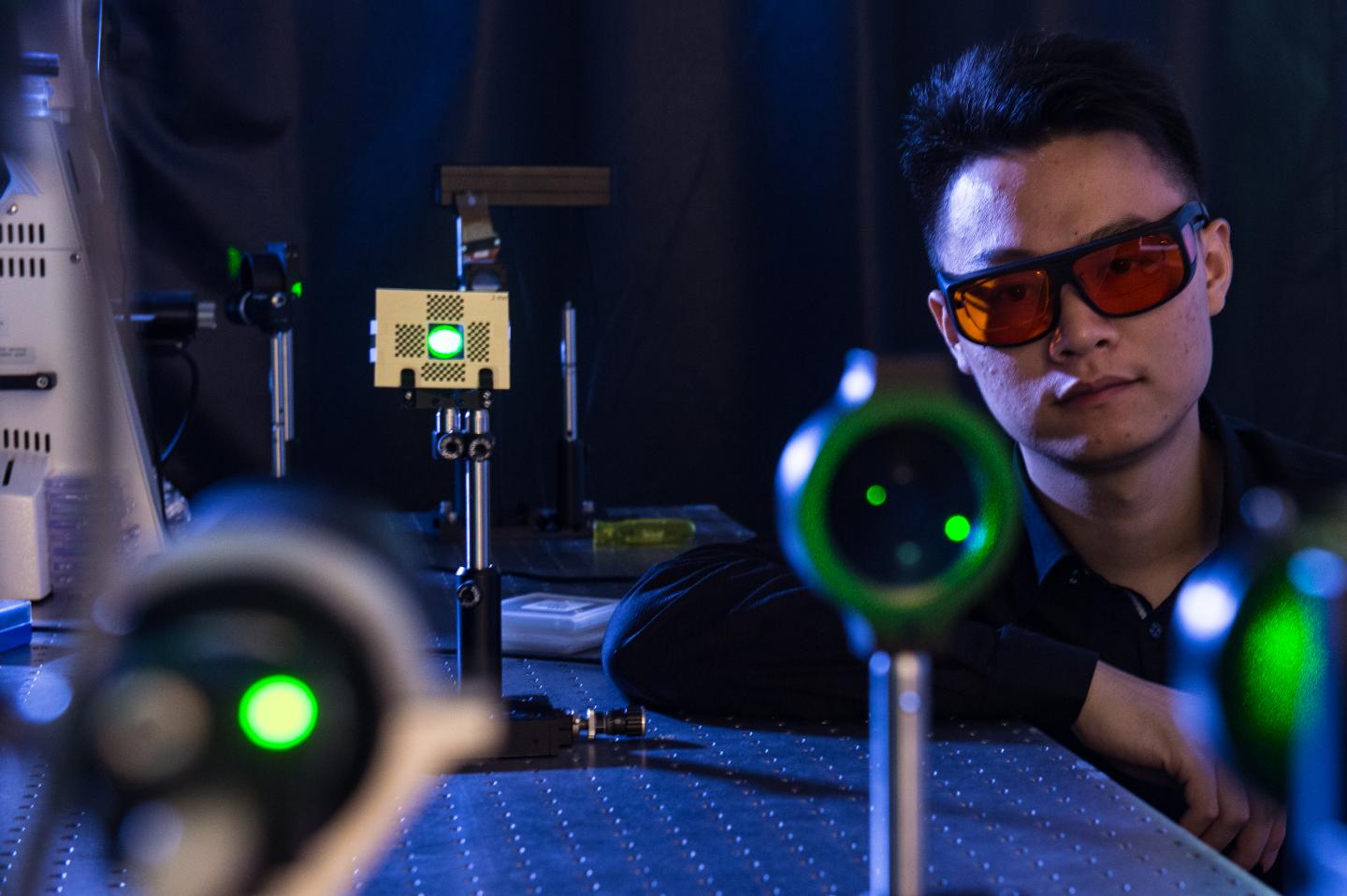
Rice University graduate student Yicheng Wu demonstrates the SAVI prototype, which is able to capture fine details of an object from a distance, effectively replacing a large telephoto lens. The prototype camera is on a motorized track in the foreground at left, while a laser at right creates a speckle pattern on the target, a fingerprint. Credit: Jeff Fitlow/Rice University
A unique camera that can capture a detailed micron-resolution image from a distance uses a laser and techniques that borrow from holography, microscopy and “Matrix”-style bullet time.
A prototype built and tested by engineers at Rice and Northwestern universities reads a spot illuminated by a laser and captures the “speckle” pattern with a camera sensor. Raw data from dozens of camera positions is fed to a computer program that interprets it and constructs a high-resolution image.
The system known as SAVI – for “Synthetic Apertures for long-range, subdiffraction-limited Visible Imaging” — doesn’t need a long lens to take a picture of a faraway object. The prototype only works with coherent illumination sources such as lasers, but Ashok Veeraraghavan, a Rice assistant professor of electrical and computer engineering, said it’s a step toward a SAVI camera array for use in visible light.
“Today, the technology can be applied only to coherent (laser) light,” he said. “That means you cannot apply these techniques to take pictures outdoors and improve resolution for sunlit images – as yet. Our hope is that one day, maybe a decade from now, we will have that ability.”
The technology is the subject of an open-access paper in Science Advances.
Labs led by Veeraraghavan at Rice and Oliver Cossairt at Northwestern’s McCormick School of Engineering built and tested the device that compares interference patterns between multiple speckled images. Like the technique used to achieve the “Matrix” special effect, the images are taken from slightly different angles, but with one camera that is moved between shots instead of many fired in sequence.
Veeraraghavan explained the speckles serve as reference beams and essentially replace one of the two beams used to create holograms. When a laser illuminates a rough surface, the viewer sees grain-like speckles in the dot. That’s because some of the returning light scattered from points on the surface has farther to go and throws the collective wave out of phase. The texture of a piece of paper – or even a fingerprint – is enough to cause the effect.
The researchers use these phase irregularities to their advantage.
“The problem we’re solving is that no matter what wavelength of light you use, the resolution of the image – the smallest feature you can resolve in a scene – depends upon this fundamental quantity called the diffraction limit, which scales linearly with the size of your aperture,” Veeraraghavan said.
“With a traditional camera, the larger the physical size of the aperture, the better the resolution,” he said. “If you want an aperture that’s half a foot, you may need 30 glass surfaces to remove aberrations and create a focused spot. This makes your lens very big and bulky.”
SAVI’s “synthetic aperture” sidesteps the problem by replacing a long lens with a computer program the resolves the speckle data into an image. “You can capture interference patterns from a fair distance,” Veeraraghavan said. “How far depends on how strong the laser is and how far away you can illuminate.”
“By moving aberration estimation and correction out to computation, we can create a compact device that gives us the same surface area as the lens we want without the size, weight, volume and cost,” said Cossairt, an assistant professor of electrical engineering and computer science at Northwestern.
Lead author Jason Holloway, a Rice alumnus who is now a postdoctoral researcher at Columbia University, suggested an array of inexpensive sensors and plastic lenses that cost a few dollars each may someday replace traditional telephoto lenses that cost more than $100,000. “We should be able to capture that exact same performance but at orders-of-magnitude lower cost,” he said.
Such an array would eliminate the need for a moving camera and capture all the data at once, “or as close to that as possible,” Cossairt said. “We want to push this to where we can do things dynamically. That’s what is really unique: There’s an avenue toward real-time, high-resolution capture using this synthetic aperture approach.”
Cossairt started thinking about the idea when applying for his National Science Foundation (NSF) CAREER Award. “Later on, Ashok and I got interested in synthetic aperture techniques through some colleagues of ours in California who were using them in microscopy.”
Veeraraghavan said SAVI leans on work by the California Institute of Technology and the University of California, Berkeley, which developed the Fourier ptychography technique that allows microscopes to resolve images beyond the physical limitations of their optics.
The SAVI team’s breakthrough was the discovery that it could put the light source on the same side as the camera rather than behind the target, as in transmission microscopy, Cossairt said. He spent three months at Rice to develop the system with Holloway and others in Veeraraghavan’s lab.
“We started by making a larger version of their microscope, but SAVI has additional technical challenges. Solving those is what this paper is about,” Veeraraghavan said.