A team of engineers at the University of Delaware is developing next-generation smart textiles by creating flexible carbon nanotube composite coatings on a wide range of fibers, including cotton, nylon and wool. Their discovery is reported in the journal ACS Sensors where they demonstrate the ability to measure an exceptionally wide range of pressure — from the light touch of a fingertip to being driven over by a forklift.
Fabric coated with this sensing technology could be used in future “smart garments” where the sensors are slipped into the soles of shoes or stitched into clothing for detecting human motion.
Carbon nanotubes give this light, flexible, breathable fabric coating impressive sensing capability. When the material is squeezed, large electrical changes in the fabric are easily measured.
“As a sensor, it’s very sensitive to forces ranging from touch to tons,” says Erik Thostenson, an associate professor in the Departments of Mechanical Engineering and Materials Science and Engineering.
Nerve-like electrically conductive nanocomposite coatings are created on the fibers using electrophoretic deposition (EPD) of polyethyleneimine functionalized carbon nanotubes.
“The films act much like a dye that adds electrical sensing functionality,” says Thostenson. “The EPD process developed in my lab creates this very uniform nanocomposite coating that is strongly bonded to the surface of the fiber. The process is industrially scalable for future applications.”
Now, researchers can add these sensors to fabric in a way that is superior to current methods for making smart textiles. Existing techniques, such as plating fibers with metal or knitting fiber and metal strands together, can decrease the comfort and durability of fabrics, says Thostenson, who directs UD’s Multifunctional Composites Laboratory. The nanocomposite coating developed by Thostenson’s group is flexible and pleasant to the touch and has been tested on a range of natural and synthetic fibers, including Kevlar, wool, nylon, Spandex and polyester. The coatings are just 250 to 750 nanometers thick — about 0.25 to 0.75 percent as thick as a piece of paper — and would only add about a gram of weight to a typical shoe or garment. What’s more, the materials used to make the sensor coating are inexpensive and relatively eco-friendly, since they can be processed at room temperature with water as a solvent.
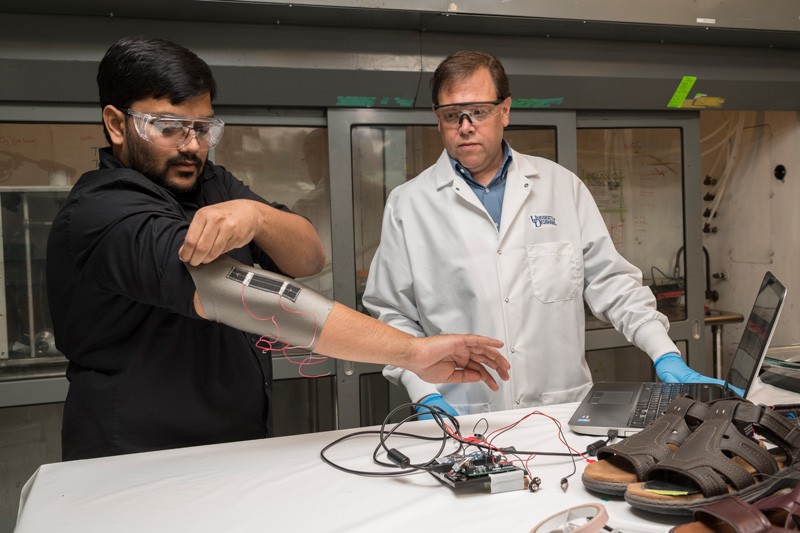
Sagar Doshi (left) and Erik Thostenson test an elbow sleeve outfitted with one of their novel sensors. Image: Kathy F. Atkinson
One potential application of the sensor-coated fabric is to measure forces on people’s feet as they walk. This data could help clinicians assess imbalances after injury or help to prevent injury in athletes. Specifically, Thostenson’s research group is collaborating with Jill Higginson, professor of mechanical engineering and director of the Neuromuscular Biomechanics Lab at UD, and her group as part of a pilot project funded by Delaware INBRE. Their goal is to see how these sensors, when embedded in footwear, compare to biomechanical lab techniques such as instrumented treadmills and motion capture.
During lab testing, people know they are being watched, but outside the lab, behavior may be different.
“One of our ideas is that we could utilize these novel textiles outside of a laboratory setting — walking down the street, at home, wherever,” says Thostenson.
Sagar Doshi, a doctoral student in mechanical engineering at UD, is the lead author on the paper. He worked on making the sensors, optimizing their sensitivity, testing their mechanical properties and integrating them into sandals and shoes. He has worn the sensors in preliminary tests, and so far, the sensors collect data that compares with that collected by a force plate, a laboratory device that typically costs thousands of dollars.
“Because the low-cost sensor is thin and flexible the possibility exists to create custom footwear and other garments with integrated electronics to store data during their day-to-day lives,” Doshi says. “This data could be analyzed later by researchers or therapists to assess performance and ultimately bring down the cost of healthcare.”
This technology could also be promising for sports medicine applications, post-surgical recovery, and for assessing movement disorders in pediatric populations.
“It can be challenging to collect movement data in children over a period of time and in a realistic context,” says Robert Akins, Director of the Center for Pediatric Clinical Research and Development at the Nemours — Alfred I. duPont Hospital for Children in Wilmington and affiliated professor of materials science and engineering, biomedical engineering and biological sciences at UD. “Thin, flexible, highly sensitive sensors like these could help physical therapists and doctors assess a child’s mobility remotely, meaning that clinicians could collect more data, and possibly better data, in a cost-effective way that requires fewer visits to the clinic than current methods do.”
Interdisciplinary collaboration is essential for the development of future applications, and at UD, engineers have a unique opportunity to work with faculty and students from the College of Health Sciences on UD’s Science, Technology and Advanced Research (STAR) Campus.
“As engineers, we develop new materials and sensors but we don’t always understand the key problems that doctors, physical therapists and patients are facing,” says Doshi. “We collaborate with them to work on the problems they are facing and either direct them to an existing solution or create an innovative solution to solve that problem.”
Thostenson’s research group also uses nanotube-based sensors for other applications, such as structural health monitoring.
“We’ve been working with carbon nanotubes and nanotube-based composite sensors for a long time,” says Thostenson, who is affiliated faculty at UD’s Center for Composite Materials (UD-CCM). Working with researchers in civil engineering his group has pioneered the development of flexible nanotube sensors to help detect cracks in bridges and other types of large-scale structures. “One of the things that has always intrigued me about composites is that we design them at varying lengths of scale, all the way from the macroscopic part geometries, an airplane or an airplane wing or part of a car, to the fabric structure or fiber level. Then, the nanoscale reinforcements like carbon nanotubes and graphene give us another level to tailor the material structural and functional properties. Although our research may be fundamental, there is always an eye towards applications. UD-CCM has a long history of translating fundamental research discoveries in the laboratory to commercial products through UD-CCM’s industrial consortium.”
This work was supported by the U.S. National Science Foundation (NSF) CAREER Program and the Delaware INBRE program with a grant from NIH-NIGMS (P20-GM103446) and the State of Delaware.
Source: University of Delaware