Research & Development World

  • R&D World Home
  • Topics
    • Aerospace
    • Automotive
    • Biotech
    • Careers
    • Chemistry
    • Environment
    • Energy
    • Life Science
    • Material Science
    • R&D Management
    • Physics
  • Technology
    • 3D Printing
    • A.I./Robotics
    • Software
    • Battery Technology
    • Controlled Environments
      • Cleanrooms
      • Graphene
      • Lasers
      • Regulations/Standards
      • Sensors
    • Imaging
    • Nanotechnology
    • Scientific Computing
      • Big Data
      • HPC/Supercomputing
      • Informatics
      • Security
    • Semiconductors
  • R&D Market Pulse
  • R&D 100
    • 2025 R&D 100 Award Winners
    • 2025 Professional Award Winners
    • 2025 Special Recognition Winners
    • R&D 100 Awards Event
    • R&D 100 Submissions
    • Winner Archive
  • Resources
    • Research Reports
    • Digital Issues
    • Educational Assets
    • R&D Index
    • Subscribe
    • Video
    • Webinars
    • Content submission guidelines for R&D World
  • Global Funding Forecast
  • Top Labs
  • Advertise
  • SUBSCRIBE

Placing Buildings in a Landscape With Computational Mathematics

By Chalmers University | February 15, 2017

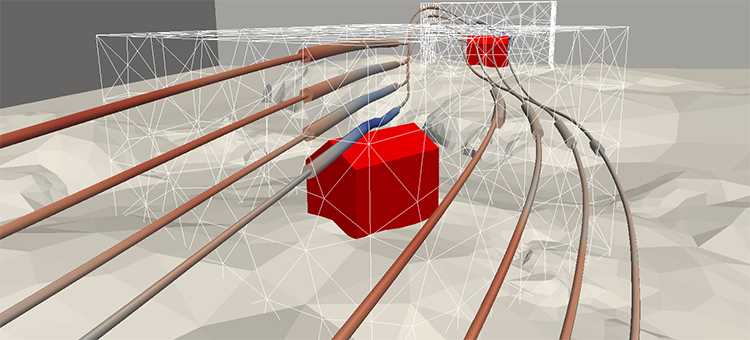
​Simulation results from models with overlapping meshes for the project titled: Computational Design of Settlement Layouts. Source: Chalmers University

A research project within the Building Futures Area of Advance at Chalmers is investigating how to model and compute wind and view by using computational mathematics in order to find suitable sites on which to position buildings.

Carl Lundholm has been a Doctoral Student in Computational Mathematics in the Mathematical Sciences Department since August 2015. Together with his supervisor, Anders Logg, Professor of Computational Mathematics and Profile Leader of Virtual Cities within Building Futures, he is conducting research into finite element methods on overlapping meshes. Working with the architecture firm CREAM Architects and the University of Gothenburg, they are looking into how this research can be used to find suitable sites on which to position buildings in the landscape. This is taking place within the project titled: Computational Design of Settlement Layouts.

What is an overlapping mesh?
Mesh refers to the computational mesh obtained from a space discretisation. Space discretisation means that an area is divided up into smaller sections, for example like a chessboard. In this context, overlapping meshes means that a small mesh is generated around each building, which is then placed into a larger mesh that has been generated around the landscape. 

What are the advantages of overlapping meshes?
The idea is to quickly and easily be able to test various settlement configurations by moving the smaller house meshes in the static landscape mesh. This means that computationally costly mesh generation is only initially required in contrast to the classic method of using a single mesh that would need to be re-generated when a building is moved.

What are the criteria for positioning buildings?
The suitability of a site has until now been determined by two factors: wind (flow) around and view from the building. In order to model flow, a finite element method for Stokes equations on overlapping meshes has been used. The model for the view from the building is based on a measure of view that has been created specially for the project, as well as rasterization. With a given position and direction, the view measure produces a value between zero and one, where the higher value represents a better view. FEniCS software, with its new multimesh functionality, has been used for implementation and computation. Figure 1 illustrates some of the simulation results from the models for flow and view. The main challenges in the project are currently the task of making the software more robust and faster. 

 

Related Articles Read More >

Google on how AI will extend researchers
Kythera Labs’ Wayfinder remasters incomplete medical data for AI analysis
Adviser Labs raises $1M to simplify cloud HPC for in AI and scientific computing
R&D World announces 2025 R&D 100 Professional Award Winners
rd newsletter
EXPAND YOUR KNOWLEDGE AND STAY CONNECTED
Get the latest info on technologies, trends, and strategies in Research & Development.
RD 25 Power Index

R&D World Digital Issues

Fall 2024 issue

Browse the most current issue of R&D World and back issues in an easy to use high quality format. Clip, share and download with the leading R&D magazine today.

Research & Development World
  • Subscribe to R&D World Magazine
  • Sign up for R&D World’s newsletter
  • Contact Us
  • About Us
  • Drug Discovery & Development
  • Pharmaceutical Processing
  • Global Funding Forecast

Copyright © 2025 WTWH Media LLC. All Rights Reserved. The material on this site may not be reproduced, distributed, transmitted, cached or otherwise used, except with the prior written permission of WTWH Media
Privacy Policy | Advertising | About Us

Search R&D World

  • R&D World Home
  • Topics
    • Aerospace
    • Automotive
    • Biotech
    • Careers
    • Chemistry
    • Environment
    • Energy
    • Life Science
    • Material Science
    • R&D Management
    • Physics
  • Technology
    • 3D Printing
    • A.I./Robotics
    • Software
    • Battery Technology
    • Controlled Environments
      • Cleanrooms
      • Graphene
      • Lasers
      • Regulations/Standards
      • Sensors
    • Imaging
    • Nanotechnology
    • Scientific Computing
      • Big Data
      • HPC/Supercomputing
      • Informatics
      • Security
    • Semiconductors
  • R&D Market Pulse
  • R&D 100
    • 2025 R&D 100 Award Winners
    • 2025 Professional Award Winners
    • 2025 Special Recognition Winners
    • R&D 100 Awards Event
    • R&D 100 Submissions
    • Winner Archive
  • Resources
    • Research Reports
    • Digital Issues
    • Educational Assets
    • R&D Index
    • Subscribe
    • Video
    • Webinars
    • Content submission guidelines for R&D World
  • Global Funding Forecast
  • Top Labs
  • Advertise
  • SUBSCRIBE