Enter the 2019 R&D 100 Awards!
The soybean-based floor coating from the Ohio Soybean Council is 2018 R&D 100 Award winner. All of the R&D 100 Awardees were announced at the R&D 100 Awards Gala held in Orlando, Florida on Nov. 16, 2018.
The R&D 100 Awards have served as the most prestigious innovation awards program for the past 57 years, honoring R&D pioneers and their revolutionary ideas in science and technology.
Submissions for the 2019 R&D 100 Awards are now being accepted. Any new technical product or process that was first available for purchase or licensing between January 1, 2018 and March 31, 2019, is eligible for entry in the 2019 awards.
Start or complete your entry now: visit: https://rd1002019.secure-platform.com/a For more info: www.rd100conference.com/awards
The epoxies predominantly used to coat industrial flooring effectively protect the floor, but often require a long-curing process that could take up to a week and can result in harmful pollutants being emitted into the atmosphere.
The current floor coating market is dominated by two-part epoxies, with polyurethanes, acrylics, and polyurea/polyaspartics also in the market mix. While effective, it is well-documented that many of these coatings emit volatile organic compounds (VOCs) and other hazardous airborne pollutants into the atmosphere.
To combat these issues, the Ohio Soybean Council (OSC) and Light Curable Coatings (LCC) have developed a soybean-based floor coating product that cures almost immediately without the harmful environmental impact.
“We’ve developed this floor coating that is based on soybeans, based on biorenewable raw materials, that is solvent-free, that is free of VOCs and is able to applied and cured much more quickly than epoxies and other coatings on the market place,” Ben Curatolo, PhD, the president of Light Curable Coatings, said in an exclusive interview with R&D Magazine. “Not only is there the biorenewability aspect, but it is also more efficient.”
In November 2018, the OSC and Light Curable Coatings received a R&D 100 Award for this technology and were also honored as part of the R&D 100 Awards with a Special Recognition for Green Technology. Quick Cure Protective Coatings and Redwood Innovations were also honored as co-developers.
One of the benefits of the soybean-based coating is that it is easily cured with a UV light.
“Some of the standard epoxy floors, if you have an installation in a warehouse or an airplane hangar it may take a week or more for that coating to be completely dried and ready to use,” said Curatolo. “Ours, you walk a light over it that basically looks like a lawnmower, except there’s a light instead of a blade and as soon as you walk over it, it is completely cured and you can walk over it.”
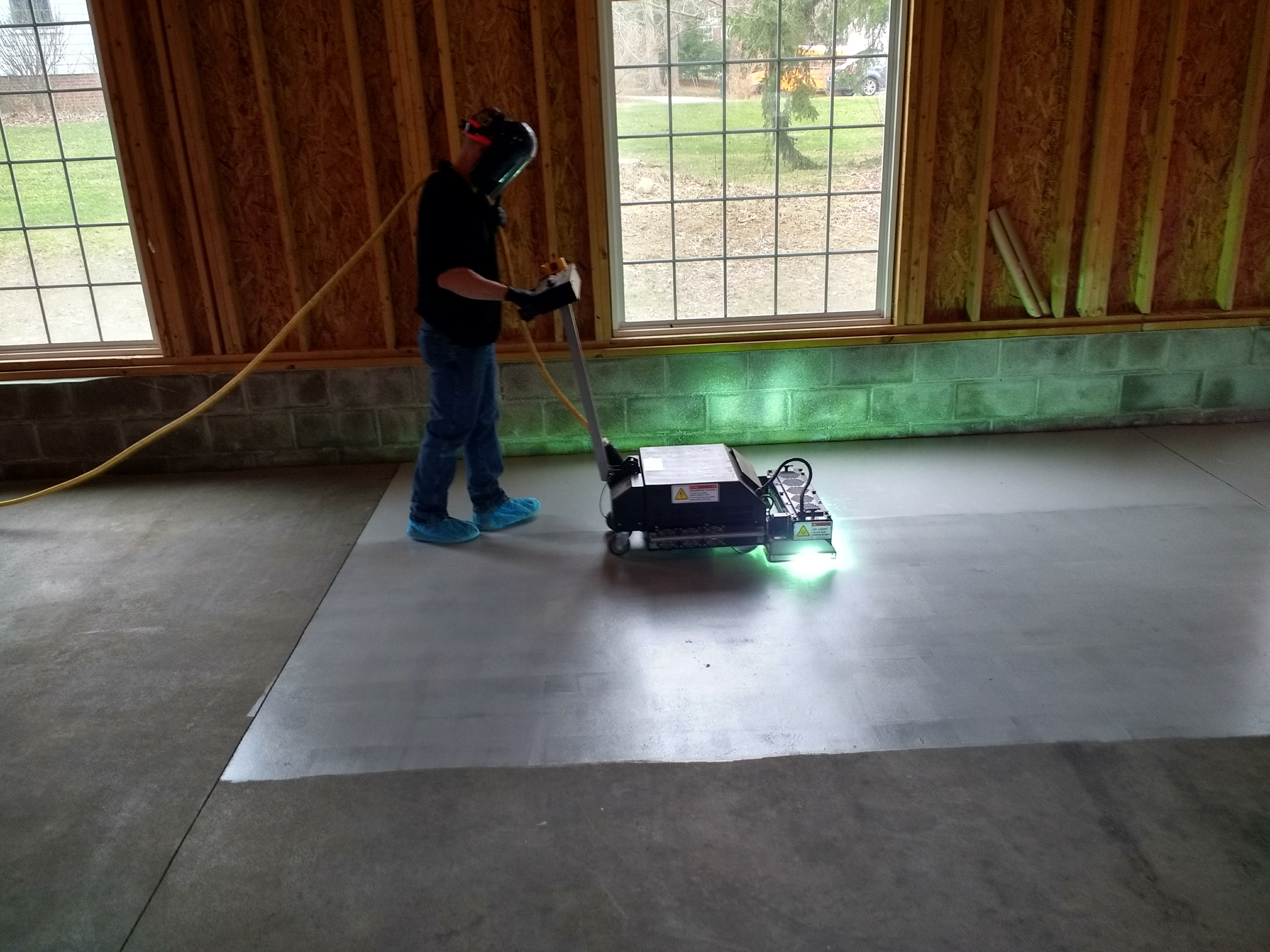
The efficiency of the UV technology significantly reduces the time required to apply a high-performance coating to a floor, cure the coating, and put that floor back into service.
“It’s usually for industrial areas where they want to get that area back and into use really quickly,” Barry McGraw, Director, Product Development and Commercialization at the OSC, said in an interview with R&D Magazine. “Things where if you can’t use that room for a period of time you’re really losing a lot of money.”
The new coating is targeted for a variety of high-traffic buildings, including hospitals, retail stores and industrial warehouses, which are locations where heavy machinery and equipment may be commonly traveling over the flooring.
To coat the flooring in a lot of these types of buildings and businesses with normal epoxy coating, the area could need to be shut off to people for up to a week or more. However, with the soybean-based coating, the researchers said it can be cured almost immediately, saving money on both labor costs and reducing the loss of productivity.
The soybean-based coating can be applied with a lower thickness than most epoxies, meaning that less of it is needed to coat the floors and walls. The researchers also said that some epoxies can still emit an odor even a week after coating, but the soybean-based coating is basically odorless once it cures.
“The cost benefit comes largely from the reduced labor costs,” Curatolo said. “The material costs are comparable or less, but the labor costs are much less because it doesn’t take as much time to apply different layers. It’s something that’s hard to exactly quantify because each job is different but if you have an area where it would take an entire week to apply multiple layers of an epoxy coating and you can do all of ours in one day then obviously you would have much lower costs.”
While they have not tested the coating against every possible chemical, the researchers said it was resistant to many chemicals and solvents that are commonly used in industry, including the major cleaning and automotive fluids. Although it is not known exactly how long the new coating will last before it needs to be replaced, the researchers believe its toughness and resistance is proof that it will last as long or longer than epoxy floor coatings.
The soybean-based coating also has proven to be effective even in areas where epoxies have not been effective. For example, the coolers used to store dairy at grocery stores are often too cold for traditional coatings to cure, while the soybean-based coating is effective in this scenario.
Education is sometimes required to get customers on board with the novel product, said researchers.
Because it is a newer concept, the researchers must often prove to a potential contractor client how it works. The team said they often demonstrate on a small floor area how well the soybean-based coating works before they move on to larger areas.