Research & Development World

  • R&D World Home
  • Topics
    • Aerospace
    • Automotive
    • Biotech
    • Careers
    • Chemistry
    • Environment
    • Energy
    • Life Science
    • Material Science
    • R&D Management
    • Physics
  • Technology
    • 3D Printing
    • A.I./Robotics
    • Software
    • Battery Technology
    • Controlled Environments
      • Cleanrooms
      • Graphene
      • Lasers
      • Regulations/Standards
      • Sensors
    • Imaging
    • Nanotechnology
    • Scientific Computing
      • Big Data
      • HPC/Supercomputing
      • Informatics
      • Security
    • Semiconductors
  • R&D Market Pulse
  • R&D 100
    • 2025 R&D 100 Award Winners
    • 2025 Professional Award Winners
    • 2025 Special Recognition Winners
    • R&D 100 Awards Event
    • R&D 100 Submissions
    • Winner Archive
  • Resources
    • Research Reports
    • Digital Issues
    • Educational Assets
    • R&D Index
    • Subscribe
    • Video
    • Webinars
    • Content submission guidelines for R&D World
  • Global Funding Forecast
  • Top Labs
  • Advertise
  • SUBSCRIBE

Researchers Find New HIV Target

By R&D Editors | April 24, 2014

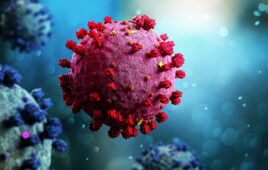
A team at The Scripps Research Institute has discovered a new vulnerable site on the HIV virus. Shown here is an electron microscopic reconstruction of the HIV-1 envelope glycoprotein trimer (pale blue) with antibodies representing each site of vulnerability in different colors, including the newly discovered PGT151 shown in red. (Source: Image by Christina Corbaci, courtesy of The Scripps Research Institute.)Scientists from The Scripps Research Institute (TSRI) and the International AIDS Vaccine Initiative (IAVI) have discovered a new vulnerable site on HIV that antibodies can attack to prevent infection from a broad range of the virus’ many variants.
 
“HIV has very few known sites of vulnerability, but in this work we’ve described a new one, and we expect it will be useful in developing a vaccine,” said Dennis Burton, professor in TSRI’s Department of Immunology and Microbial Science and scientific director of the IAVI Neutralizing Antibody Center (NAC) and of the National Institutes of Health’s Center for HIV/AIDS Vaccine Immunology and Immunogen Discovery (CHAVI-ID).
 
“HIV mutates very quickly, within the individual and across populations,” said IAVI Chief Scientific Officer Wayne Koff. “This new target offers a stable mark for vaccine design, increasing the potential to find a vaccine that can provide broad, lasting protection to people around the world.” 
 
The findings, reported in two studies published online Thursday and in the May issue of Immunity, are part of a large effort sponsored by IAVI and the U.S. National Institutes of Health (NIH) to develop AIDS vaccines that can trigger the human immune system to produce broadly neutralizing antibodies (bNAbs). Since 2009, researchers have: determined that a small proportion of HIV-infected individuals naturally generate bNAbs against a wide range of HIV variants; isolated scores of these bNAbs; identified a handful of regions they target on HIV; and found they can prevent HIV infection in non-human primates. The next step is to design immunogens to elicit these bNAbs in humans.
 
In the first study, a team of scientists from TSRI, IAVI and Theraclone Sciences, led by Burton, identified and described a promising new set of bNAbs, the PGT151 series, building on the Protocol G project that studied HIV-infected people who naturally produce bNAbs. The researchers found that two of the antibodies in the series could block infection by more than two-thirds of HIV strains found in patients worldwide.
 
In the second study, a team led by Ian Wilson, TSRI Hansen Professor of Structural Biology and chair of the Department of Integrative Structural and Computational Biology, explored the newly identified target, which becomes the fifth well-characterized epitope, or binding site, on the surface of HIV.
 
The International AIDS Vaccine Initiative (IAVI) is a global not-for-profit organization whose mission is to ensure the development of safe, effective, accessible, preventive HIV vaccines for use throughout the world. Founded in 1996, IAVI works with private companies, academics, and civil society partners in 25 countries to research, design, and develop AIDS vaccine candidates. In addition, IAVI conducts policy analyses and serves as an advocate for the AIDS vaccine field. IAVI supports a comprehensive approach to addressing HIV and AIDS that balances the expansion and strengthening of existing HIV-prevention and treatment programs with targeted investments in the design and development of new tools to prevent HIV. IAVI is dedicated to ensuring that a future AIDS vaccine will be available and accessible to all who need it.
 
Date: April 24, 2014
Source: The Scripps Research Institute

Related Articles Read More >

Who’s building in pharma, and who would be spared from 100% tariffs, if enacted
2025 R&D layoffs tracker: hardware and chips lead the year’s biggest cuts while biopharma pares pipelines
Skin’s built-in “stretch sensor” helps tissue grow in mouse study
Meissner launches rotary impeller mixing solutions (RMS) portfolio for biocontainer mixing
rd newsletter
EXPAND YOUR KNOWLEDGE AND STAY CONNECTED
Get the latest info on technologies, trends, and strategies in Research & Development.
RD 25 Power Index

R&D World Digital Issues

Fall 2024 issue

Browse the most current issue of R&D World and back issues in an easy to use high quality format. Clip, share and download with the leading R&D magazine today.

Research & Development World
  • Subscribe to R&D World Magazine
  • Sign up for R&D World’s newsletter
  • Contact Us
  • About Us
  • Drug Discovery & Development
  • Pharmaceutical Processing
  • Global Funding Forecast

Copyright © 2025 WTWH Media LLC. All Rights Reserved. The material on this site may not be reproduced, distributed, transmitted, cached or otherwise used, except with the prior written permission of WTWH Media
Privacy Policy | Advertising | About Us

Search R&D World

  • R&D World Home
  • Topics
    • Aerospace
    • Automotive
    • Biotech
    • Careers
    • Chemistry
    • Environment
    • Energy
    • Life Science
    • Material Science
    • R&D Management
    • Physics
  • Technology
    • 3D Printing
    • A.I./Robotics
    • Software
    • Battery Technology
    • Controlled Environments
      • Cleanrooms
      • Graphene
      • Lasers
      • Regulations/Standards
      • Sensors
    • Imaging
    • Nanotechnology
    • Scientific Computing
      • Big Data
      • HPC/Supercomputing
      • Informatics
      • Security
    • Semiconductors
  • R&D Market Pulse
  • R&D 100
    • 2025 R&D 100 Award Winners
    • 2025 Professional Award Winners
    • 2025 Special Recognition Winners
    • R&D 100 Awards Event
    • R&D 100 Submissions
    • Winner Archive
  • Resources
    • Research Reports
    • Digital Issues
    • Educational Assets
    • R&D Index
    • Subscribe
    • Video
    • Webinars
    • Content submission guidelines for R&D World
  • Global Funding Forecast
  • Top Labs
  • Advertise
  • SUBSCRIBE