Research & Development World

  • R&D World Home
  • Topics
    • Aerospace
    • Automotive
    • Biotech
    • Careers
    • Chemistry
    • Environment
    • Energy
    • Life Science
    • Material Science
    • R&D Management
    • Physics
  • Technology
    • 3D Printing
    • A.I./Robotics
    • Software
    • Battery Technology
    • Controlled Environments
      • Cleanrooms
      • Graphene
      • Lasers
      • Regulations/Standards
      • Sensors
    • Imaging
    • Nanotechnology
    • Scientific Computing
      • Big Data
      • HPC/Supercomputing
      • Informatics
      • Security
    • Semiconductors
  • R&D Market Pulse
  • R&D 100
    • 2025 R&D 100 Award Winners
    • 2025 Professional Award Winners
    • 2025 Special Recognition Winners
    • R&D 100 Awards Event
    • R&D 100 Submissions
    • Winner Archive
  • Resources
    • Research Reports
    • Digital Issues
    • Educational Assets
    • R&D Index
    • Subscribe
    • Video
    • Webinars
    • Content submission guidelines for R&D World
  • Global Funding Forecast
  • Top Labs
  • Advertise
  • SUBSCRIBE

Reservoir Computer Marks Revolutionary Neural Network Application

By American Institute of Physics | October 17, 2018

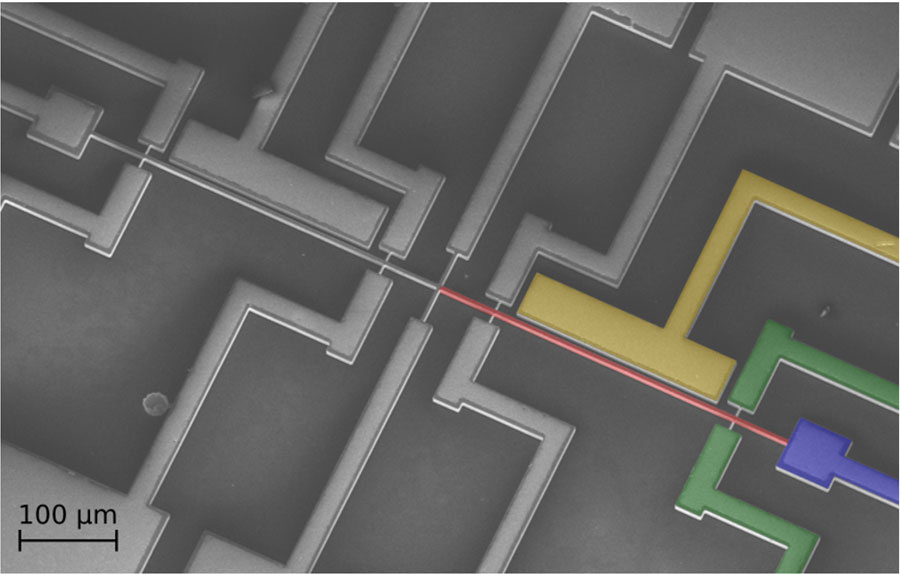
A single silicon beam (red), along with its drive (yellow) and readout (green and blue) electrodes, implements a MEMS capable of nontrivial computations. Image: Guillaume Dion

As artificial intelligence has become increasingly sophisticated, it has inspired renewed efforts to develop computers whose physical architecture mimics the human brain.

One approach, called reservoir computing, allows hardware devices to achieve the higher-dimension calculations required by emerging artificial intelligence.

One new device highlights the potential of extremely small mechanical systems to achieve these calculations.

A group of researchers at the Université de Sherbrooke in Québec, Canada, reports the construction of the first reservoir computing device built with a microelectromechanical system (MEMS).

Published in the Journal of Applied Physics, from AIP Publishing, the neural network exploits the nonlinear dynamics of a microscale silicon beam to perform its calculations.

The group’s work looks to create devices that can act simultaneously as a sensor and a computer using a fraction of the energy a normal computer would use.

The article appears in a special topic section of the journal devoted to “New Physics and Materials for Neuromorphic Computation,” which highlights new developments in physical and materials science research that hold promise for developing the very large-scale, integrated “neuromorphic” systems of tomorrow that will carry computation beyond the limitations of current semiconductors today.

“These kinds of calculations are normally only done in software, and computers can be inefficient,” says Guillaume Dion, an author on the paper.

“Many of the sensors today are built with MEMS, so devices like ours would be ideal technology to blur the boundary between sensors and computers.”

The device relies on the nonlinear dynamics of how the silicon beam, at widths 20 times thinner than a human hair, oscillates in space.

The results from this oscillation are used to construct a virtual neural network that projects the input signal into the higher dimensional space required for neural network computing.

In demonstrations, the system was able to switch between different common benchmark tasks for neural networks with relative ease, Dion says, including classifying spoken sounds and processing binary patterns with accuracies of 78.2 percent and 99.9 percent respectively.

“This tiny beam of silicon can do very different tasks,” says Julien Sylvestre, another author on the paper. “It’s surprisingly easy to adjust it to make it perform well at recognizing words.”

Sylvestre says he and his colleagues are looking to explore increasingly complicated computations using the silicon beam device, with the hopes of developing small and energy-efficient sensors and robot controllers.

Source: American Institute of Physics
Related Articles Read More >

R&D 100 winner flags even unknown fentanyl analogs
New nanopore sensor paves the way for fast, accurate, low-cost DNA sequencing
IoT
Sensor data, reimagined: When 90% less data can fuel 100x gains in efficiency in AI projects
Sandia Labs joins with other institutions to tackle AI energy challenges with microelectronics research
rd newsletter
EXPAND YOUR KNOWLEDGE AND STAY CONNECTED
Get the latest info on technologies, trends, and strategies in Research & Development.
RD 25 Power Index

R&D World Digital Issues

Fall 2024 issue

Browse the most current issue of R&D World and back issues in an easy to use high quality format. Clip, share and download with the leading R&D magazine today.

Research & Development World
  • Subscribe to R&D World Magazine
  • Sign up for R&D World’s newsletter
  • Contact Us
  • About Us
  • Drug Discovery & Development
  • Pharmaceutical Processing
  • Global Funding Forecast

Copyright © 2025 WTWH Media LLC. All Rights Reserved. The material on this site may not be reproduced, distributed, transmitted, cached or otherwise used, except with the prior written permission of WTWH Media
Privacy Policy | Advertising | About Us

Search R&D World

  • R&D World Home
  • Topics
    • Aerospace
    • Automotive
    • Biotech
    • Careers
    • Chemistry
    • Environment
    • Energy
    • Life Science
    • Material Science
    • R&D Management
    • Physics
  • Technology
    • 3D Printing
    • A.I./Robotics
    • Software
    • Battery Technology
    • Controlled Environments
      • Cleanrooms
      • Graphene
      • Lasers
      • Regulations/Standards
      • Sensors
    • Imaging
    • Nanotechnology
    • Scientific Computing
      • Big Data
      • HPC/Supercomputing
      • Informatics
      • Security
    • Semiconductors
  • R&D Market Pulse
  • R&D 100
    • 2025 R&D 100 Award Winners
    • 2025 Professional Award Winners
    • 2025 Special Recognition Winners
    • R&D 100 Awards Event
    • R&D 100 Submissions
    • Winner Archive
  • Resources
    • Research Reports
    • Digital Issues
    • Educational Assets
    • R&D Index
    • Subscribe
    • Video
    • Webinars
    • Content submission guidelines for R&D World
  • Global Funding Forecast
  • Top Labs
  • Advertise
  • SUBSCRIBE