Research & Development World

  • R&D World Home
  • Topics
    • Aerospace
    • Automotive
    • Biotech
    • Careers
    • Chemistry
    • Environment
    • Energy
    • Life Science
    • Material Science
    • R&D Management
    • Physics
  • Technology
    • 3D Printing
    • A.I./Robotics
    • Software
    • Battery Technology
    • Controlled Environments
      • Cleanrooms
      • Graphene
      • Lasers
      • Regulations/Standards
      • Sensors
    • Imaging
    • Nanotechnology
    • Scientific Computing
      • Big Data
      • HPC/Supercomputing
      • Informatics
      • Security
    • Semiconductors
  • R&D Market Pulse
  • R&D 100
    • 2025 R&D 100 Award Winners
    • 2025 Professional Award Winners
    • 2025 Special Recognition Winners
    • R&D 100 Awards Event
    • R&D 100 Submissions
    • Winner Archive
  • Resources
    • Research Reports
    • Digital Issues
    • Educational Assets
    • R&D Index
    • Subscribe
    • Video
    • Webinars
    • Content submission guidelines for R&D World
  • Global Funding Forecast
  • Top Labs
  • Advertise
  • SUBSCRIBE

Scientists Discover Oxidation State for Molecular Plutonium

By Kenny Walter | March 9, 2017

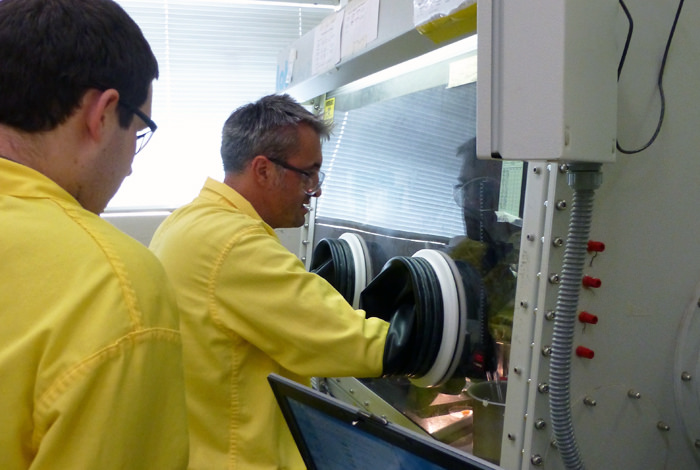
Scientists from Los Alamos National Laboratory and the University of California – Irvine are exploring a new oxidation state of plutonium. Credit Los Alamos National Laboratory

Researchers have identified the +2 oxidation state in a molecular system of plutonium.

The findings by researchers at Los Alamos National Laboratory in collaboration with the University of California- Irvine provide a significant step towards a more complete understanding of chemical trends across the actinide series and ultimately will provide knowledge about how to manipulate and control oxidation-state chemistry and electronic structure.

“This finding marks out plutonium, already known for its extremely complex chemistry, as the actinide element with the largest number of confirmed oxidation states,” Andrew Gaunt, lead Los Alamos investigator, said in a statement.

One of the most fundamental properties of an element’s chemical behavior is its oxidation state chemistry, which relates to the number of electrons that are removed from or added to a neutral element to form cations or anions.

Most accessible oxidation states are generally presumed to have already been identified over the last century for the elements of the periodic table. However, plutonium was revealed as among the most complex of all elements, with just six oxidation states previously known and verified.

“Over time, it’s easy to get bogged down in the daily but important, details of more incremental experiments and analyzing data but this project was the kind of research experience and more profound fundamental discovery that excites,” Gaunt said. “This is exactly the kind of plutonium chemistry that the Laboratory is uniquely positioned to achieve in conjunction with academic collaborators.

The research built on prior work by UCI professors that showed the +2 oxidation state of the lanthanides, uranium and thorium could be generated using organometallic anions to facilitate reduction of molecules containing a +3 metal cation to molecules containing a +2 metal cation.

These +2 molecules were shown to be accessible on account of the organometallic framework around the metal ion, which allows the extra electron upon reduction of +3 to +2 to populate a ‘d’ rather than an ‘f’ orbital.

After successful isolating the molecule containing Pu +2, the research team revealed that unlike in the lanthanide, uranium and thorium analogs, plutonium appears to exhibit an intriguing electronic structure ‘crossover point’ with the extra electron primarily residing in an ‘f’ orbital, not a ‘d’ orbital.

“Elucidating the nature of this electronic structure ‘break’ in actinide +2 cations as the actinide series is traversed was previously inaccessible but we have now made the breakthrough and the area is brimming with potential for further exploration,” Los Alamos investigator Stosh Kozimor, said in a statement.

“Working with the highly radioactive elements beyond uranium (called the transuranics) is extremely technically challenging, given limited availability of isotopes of these elements and the safety protocols under which the research must be conducted, but we have now paved the way for future discovery of additional transuranic molecules containing the +2 oxidation state,” Kozimor added.

The study was published in the Journal of the American Chemical Society.  
Related Articles Read More >

Chemistry Nobel goes to ‘molecular architecture’ with spaces big enough to trap gases
ORNL named on 20 R&D 100 Awards, including carbon-capture and AM tools
2025 R&D Technician of the Year: Dow’s Richard Tapper pushes flame-retardant limits to curb real-world fire risks
Researchers synthesize first Berkelium-containing molecule
rd newsletter
EXPAND YOUR KNOWLEDGE AND STAY CONNECTED
Get the latest info on technologies, trends, and strategies in Research & Development.
RD 25 Power Index

R&D World Digital Issues

Fall 2025 issue

Browse the most current issue of R&D World and back issues in an easy to use high quality format. Clip, share and download with the leading R&D magazine today.

Research & Development World
  • Subscribe to R&D World Magazine
  • Sign up for R&D World’s newsletter
  • Contact Us
  • About Us
  • Drug Discovery & Development
  • Pharmaceutical Processing
  • Global Funding Forecast

Copyright © 2025 WTWH Media LLC. All Rights Reserved. The material on this site may not be reproduced, distributed, transmitted, cached or otherwise used, except with the prior written permission of WTWH Media
Privacy Policy | Advertising | About Us

Search R&D World

  • R&D World Home
  • Topics
    • Aerospace
    • Automotive
    • Biotech
    • Careers
    • Chemistry
    • Environment
    • Energy
    • Life Science
    • Material Science
    • R&D Management
    • Physics
  • Technology
    • 3D Printing
    • A.I./Robotics
    • Software
    • Battery Technology
    • Controlled Environments
      • Cleanrooms
      • Graphene
      • Lasers
      • Regulations/Standards
      • Sensors
    • Imaging
    • Nanotechnology
    • Scientific Computing
      • Big Data
      • HPC/Supercomputing
      • Informatics
      • Security
    • Semiconductors
  • R&D Market Pulse
  • R&D 100
    • 2025 R&D 100 Award Winners
    • 2025 Professional Award Winners
    • 2025 Special Recognition Winners
    • R&D 100 Awards Event
    • R&D 100 Submissions
    • Winner Archive
  • Resources
    • Research Reports
    • Digital Issues
    • Educational Assets
    • R&D Index
    • Subscribe
    • Video
    • Webinars
    • Content submission guidelines for R&D World
  • Global Funding Forecast
  • Top Labs
  • Advertise
  • SUBSCRIBE