Research & Development World

  • R&D World Home
  • Topics
    • Aerospace
    • Automotive
    • Biotech
    • Careers
    • Chemistry
    • Environment
    • Energy
    • Life Science
    • Material Science
    • R&D Management
    • Physics
  • Technology
    • 3D Printing
    • A.I./Robotics
    • Software
    • Battery Technology
    • Controlled Environments
      • Cleanrooms
      • Graphene
      • Lasers
      • Regulations/Standards
      • Sensors
    • Imaging
    • Nanotechnology
    • Scientific Computing
      • Big Data
      • HPC/Supercomputing
      • Informatics
      • Security
    • Semiconductors
  • R&D Market Pulse
  • R&D 100
    • 2025 R&D 100 Award Winners
    • 2025 Professional Award Winners
    • 2025 Special Recognition Winners
    • R&D 100 Awards Event
    • R&D 100 Submissions
    • Winner Archive
  • Resources
    • Research Reports
    • Digital Issues
    • Educational Assets
    • R&D Index
    • Subscribe
    • Video
    • Webinars
    • Content submission guidelines for R&D World
  • Global Funding Forecast
  • Top Labs
  • Advertise
  • SUBSCRIBE

Sensory Stimuli Control Dopamine in the Brain

By Bloss - Centre for Biological Signalling Studies | January 17, 2017

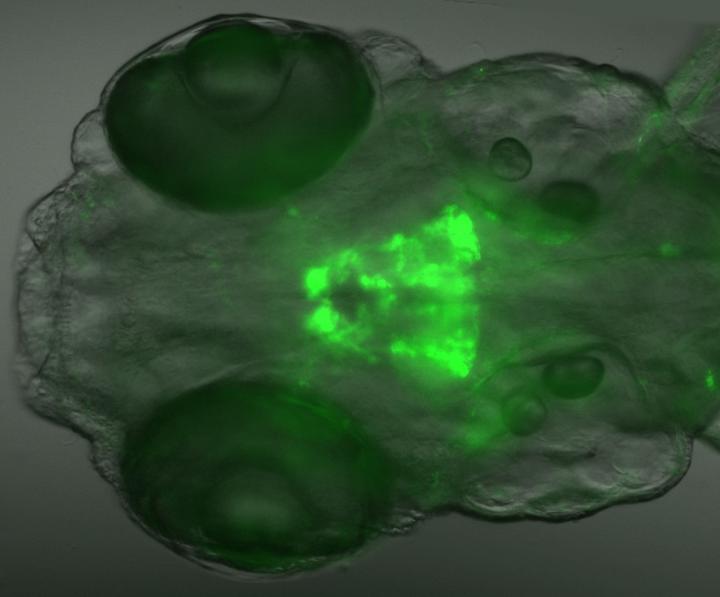
This is a four-millimetre-long larvae of zebrafish with visible nerve cells under the microscope. (Research group Driever)

Regardless of whether we are sitting in a loud aeroplane or walking through a quiet forest clearing, how humans perceive their environment depends on the stimuli. This, in turn, affects our behaviour – sometimes consciously, sometimes subconsciously. In their study of fish larvae, Prof. Dr. Wolfgang Driever and his team of neurobiologists at the University of Freiburg have discovered that a group of nerve cells in the forebrain release the neurotransmitter dopamine when activated by tactile or certain visual stimuli. These dopaminergic nerve cells send connections to almost all parts of the brain and spinal cord, thereby affecting the functions of many circuits. These new findings could play a role in the future treatment of such illnesses as restless leg syndrome, a condition in which patients have unpleasant sensations in their limbs during sleep. The researchers have published their research results in the journal Current Biology.

For their research, the scientists studied the four-millimetre-long larvae of zebrafish, which are common aquarium fish. The scientists observed the activity of individual dopaminergic nerve cells within the brains of the larvae, which were alert and active, under a microscope. The researchers were able to make their activity visible using optogenetic calcium sensors, which emit light in active nerve cells. Until now, studies of the dopaminergic nerve cells in vertebrates have primarily focused on the midbrain, where the dopaminergic cells are involved in the control of locomotion and reward behaviour. These become functionally impaired in patients with Parkinson’s disease. The dopaminergic neurons of the forebrain, on the other hand, have been little researched until now because they are located deep in the brain and are therefore difficult to reach. In the forebrain, they are also connected to parts of the hypothalamus, which controls the switch in basic behaviour, such as fight or flight and rest or sleep.

The findings of the team of researchers from the University of Freiburg reveal that certain intense sensory stimuli may affect such basic behaviour through the activity of dopaminergic nerve cells. Because there are also connections between these nerve cells and the sensory organs, it is possible that dopaminergic nerve cells are involved in adjusting the sensitivity of sensory organs’ reactions to stimuli. This function could be useful for treating diseases. The properties of dopaminergic nerve cells in the forebrain could thus be used in the future to reduce the sensation of patients with restless legs syndrome and hence to supress the tingling in their extremities that occurs when sleeping. Further research of these dopaminergic neurons is expected to help scientists understand how these diseases develop – and in general how humans adapt to quickly changing stimuli and sensations in their environments.


Related Articles Read More >

MIT team uses mysterious cell structure to record genetic activity
Pancreas or pancreatic cancer with organs and tumors or cancerous cells 3D rendering illustration with male body. Anatomy, oncology, disease, medical, biology, science, healthcare concepts.
AI tool used to detect pancreatic cancer in routine CT scans in China 
Drones help diagnose deadly whale viruses 
Drowning in variants? Mount Sinai tool adds phenotype filter
rd newsletter
EXPAND YOUR KNOWLEDGE AND STAY CONNECTED
Get the latest info on technologies, trends, and strategies in Research & Development.
RD 25 Power Index

R&D World Digital Issues

Fall 2025 issue

Browse the most current issue of R&D World and back issues in an easy to use high quality format. Clip, share and download with the leading R&D magazine today.

R&D 100 Awards
Research & Development World
  • Subscribe to R&D World Magazine
  • Sign up for R&D World’s newsletter
  • Contact Us
  • About Us
  • Drug Discovery & Development
  • Pharmaceutical Processing
  • Global Funding Forecast

Copyright © 2026 WTWH Media LLC. All Rights Reserved. The material on this site may not be reproduced, distributed, transmitted, cached or otherwise used, except with the prior written permission of WTWH Media
Privacy Policy | Advertising | About Us

Search R&D World

  • R&D World Home
  • Topics
    • Aerospace
    • Automotive
    • Biotech
    • Careers
    • Chemistry
    • Environment
    • Energy
    • Life Science
    • Material Science
    • R&D Management
    • Physics
  • Technology
    • 3D Printing
    • A.I./Robotics
    • Software
    • Battery Technology
    • Controlled Environments
      • Cleanrooms
      • Graphene
      • Lasers
      • Regulations/Standards
      • Sensors
    • Imaging
    • Nanotechnology
    • Scientific Computing
      • Big Data
      • HPC/Supercomputing
      • Informatics
      • Security
    • Semiconductors
  • R&D Market Pulse
  • R&D 100
    • 2025 R&D 100 Award Winners
    • 2025 Professional Award Winners
    • 2025 Special Recognition Winners
    • R&D 100 Awards Event
    • R&D 100 Submissions
    • Winner Archive
  • Resources
    • Research Reports
    • Digital Issues
    • Educational Assets
    • R&D Index
    • Subscribe
    • Video
    • Webinars
    • Content submission guidelines for R&D World
  • Global Funding Forecast
  • Top Labs
  • Advertise
  • SUBSCRIBE