Research & Development World

  • R&D World Home
  • Topics
    • Aerospace
    • Automotive
    • Biotech
    • Careers
    • Chemistry
    • Environment
    • Energy
    • Life Science
    • Material Science
    • R&D Management
    • Physics
  • Technology
    • 3D Printing
    • A.I./Robotics
    • Software
    • Battery Technology
    • Controlled Environments
      • Cleanrooms
      • Graphene
      • Lasers
      • Regulations/Standards
      • Sensors
    • Imaging
    • Nanotechnology
    • Scientific Computing
      • Big Data
      • HPC/Supercomputing
      • Informatics
      • Security
    • Semiconductors
  • R&D Market Pulse
  • R&D 100
    • 2025 R&D 100 Award Winners
    • 2025 Professional Award Winners
    • 2025 Special Recognition Winners
    • R&D 100 Awards Event
    • R&D 100 Submissions
    • Winner Archive
  • Resources
    • Research Reports
    • Digital Issues
    • Educational Assets
    • R&D Index
    • Subscribe
    • Video
    • Webinars
    • Content submission guidelines for R&D World
  • Global Funding Forecast
  • Top Labs
  • Advertise
  • SUBSCRIBE

Study is first to observe oscillatory cracking behavior of materials

By R&D Editors | October 25, 2012

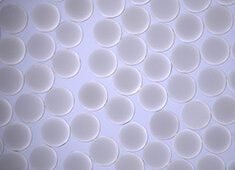
A microcrystal array for which extremely small forces and motions are tracked with atomic-scale precision to probe and model the avalanche response at slow driving rates. Within the image, a view of the San Andreas fault, where such effects can be seen in the world. Credit: Stefanos Papanikolaou“Avalanches”—the crackling behavior of materials under slowly increasing stress, like crumpling paper or earthquakes—may have a novel facet previously unknown, say Cornell researchers.

A study led by former postdoctoral associate Stefanos Papanikolaou employs both theory and experiment to describe never-before-seen oscillatory behavior of microcrystal plastic bursts at very small scales, under highly controlled conditions.

The study, co-authored by James Sethna, professor of physics, is featured on the cover of the journal Nature, Oct. 25.

The experiments were done by co-author Dennis M. Dimiduk of the Air Force Research Laboratory, using microfabricated nickel microcrystals. They recorded individual microcrystals’ behavior as they were slowly crushed, causing microscale avalanches. What emerged was a new power law that determined the probability of crackles of different sizes.

Analyzing the data, Papanikolaou and collaborators found that slowing the crushing of microcrystals led to an oscillation of avalanches themselves—large then small, in a repeating pattern, and with time periods between the large events roughly periodic. This was different from previous experiments and theories of crackling noise and avalanches.

Avalanches have previously been known to happen at random times following a power law behavior, in that the number of avalanches is given by a power of the avalanches’ size. The new experiments not only display oscillations, but also give a markedly different power law—a “new route to criticality, with a perpetual cycle leading to the emergence of self-similarity,” Sethna said.

They explain and model the oscillations and this new law by including other smooth “oozing” processes that compete with the avalanches; oozing becomes important when the crystals are crushed nearly as slowly as they ooze.

It’s a theory the scientists think could apply to many intermittent phenomena that become oscillatory as “relaxation” increases—earthquakes deep in the earth crust, for one, but even less conventional ones—like the low-frequency oscillations of brain waves during sleep.

“We could maybe open a window to actually starting to model accurately the emergence of such phenomena in large collections of neurons,” Papanikolaou said.

The work was supported by the Defense Threat Reduction Agency, the Basic Energy Sciences division of the Department of Energy, the Air Force Research Laboratory and the Air Force Office of Scientific Research.

Quasi-periodic events in crystal plasticity and the self-organized avalanche oscillator
Source: Cornell University

Related Articles Read More >

U.S.–China pause eases rare-earth shock risk, but supply security questions remain
Materials driving the next phase in semiconductor performance
An easier way to separate rare earth elements
ORNL named on 20 R&D 100 Awards, including carbon-capture and AM tools
rd newsletter
EXPAND YOUR KNOWLEDGE AND STAY CONNECTED
Get the latest info on technologies, trends, and strategies in Research & Development.
RD 25 Power Index

R&D World Digital Issues

Fall 2024 issue

Browse the most current issue of R&D World and back issues in an easy to use high quality format. Clip, share and download with the leading R&D magazine today.

Research & Development World
  • Subscribe to R&D World Magazine
  • Sign up for R&D World’s newsletter
  • Contact Us
  • About Us
  • Drug Discovery & Development
  • Pharmaceutical Processing
  • Global Funding Forecast

Copyright © 2025 WTWH Media LLC. All Rights Reserved. The material on this site may not be reproduced, distributed, transmitted, cached or otherwise used, except with the prior written permission of WTWH Media
Privacy Policy | Advertising | About Us

Search R&D World

  • R&D World Home
  • Topics
    • Aerospace
    • Automotive
    • Biotech
    • Careers
    • Chemistry
    • Environment
    • Energy
    • Life Science
    • Material Science
    • R&D Management
    • Physics
  • Technology
    • 3D Printing
    • A.I./Robotics
    • Software
    • Battery Technology
    • Controlled Environments
      • Cleanrooms
      • Graphene
      • Lasers
      • Regulations/Standards
      • Sensors
    • Imaging
    • Nanotechnology
    • Scientific Computing
      • Big Data
      • HPC/Supercomputing
      • Informatics
      • Security
    • Semiconductors
  • R&D Market Pulse
  • R&D 100
    • 2025 R&D 100 Award Winners
    • 2025 Professional Award Winners
    • 2025 Special Recognition Winners
    • R&D 100 Awards Event
    • R&D 100 Submissions
    • Winner Archive
  • Resources
    • Research Reports
    • Digital Issues
    • Educational Assets
    • R&D Index
    • Subscribe
    • Video
    • Webinars
    • Content submission guidelines for R&D World
  • Global Funding Forecast
  • Top Labs
  • Advertise
  • SUBSCRIBE