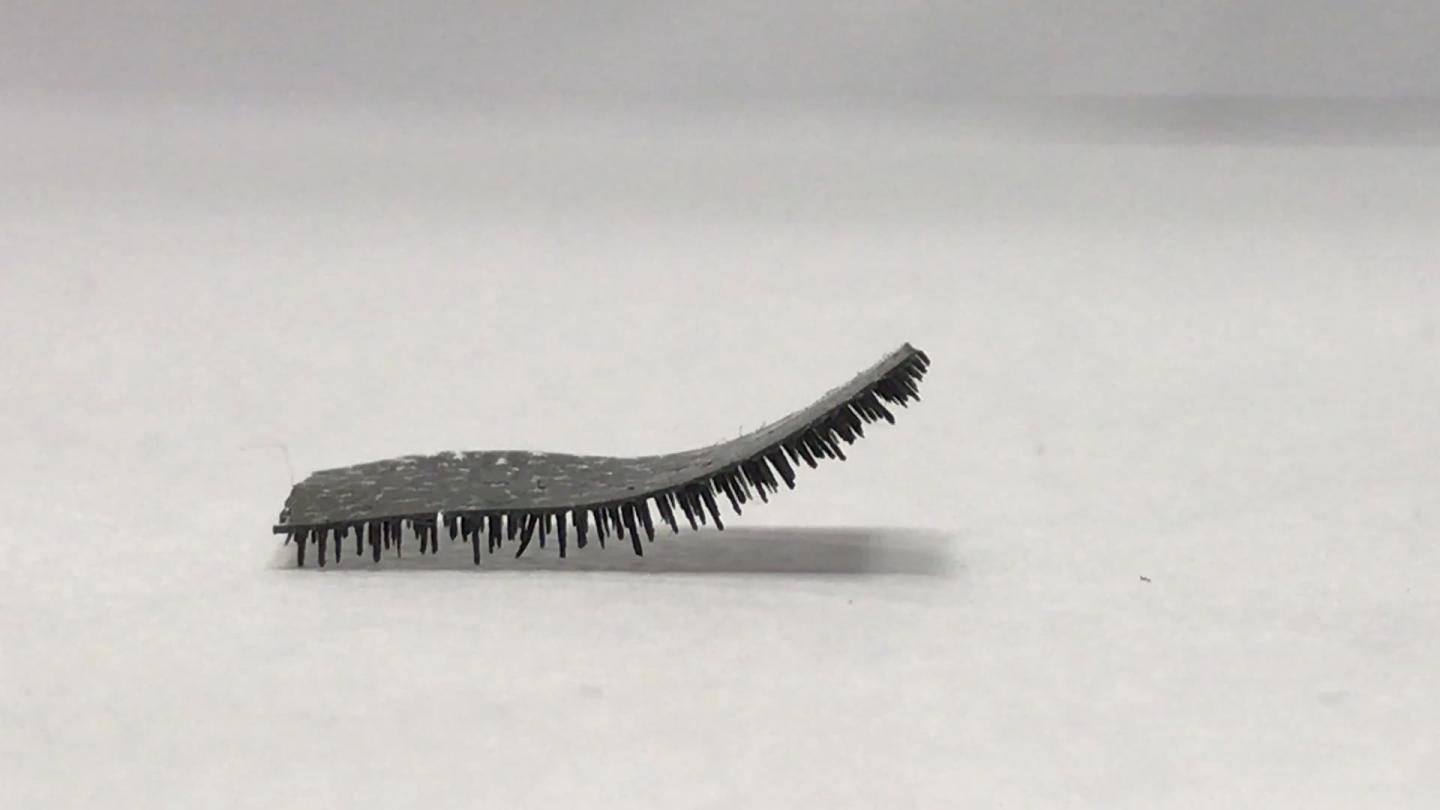
A novel tiny, soft robot with soft caterpillar-like legs which is adaptable to adverse environment and can carry heavy load was developed. Credit: City University of Hong Kong
A novel tiny, soft robot with caterpillar-like legs capable of carrying heavy loads and adaptable to adverse environment was developed from a research led by City University of Hong Kong (CityU). This mini delivery-robot could pave way for medical technology advancement such as drugs delivery in human body.
Around the world, there has been research about developing soft milli-robots. But the CityU’s new design with multi-legs helps reduce friction significantly, so that the robot can move efficiently inside surfaces within the body lined with, or entirely immersed in, body fluids such as blood or mucus.
The research findings have been published in the latest issue of the scientific journal Nature Communications, titled “A Bio-inspired Multilegged Soft Millirobot that Functions in Both Dry and Wet Conditions”.
Bio-inspired robot design
What makes this milli-robot stand out is its hundreds of less than 1 mm long pointed legs that looks like short tiny hair. This unique design was not a random choice. The research team has studied the leg structures of hundreds of ground animals including those with 2, 4, 8 or more legs, in particular the ratio between leg-length and the gap between the legs. And from there, they got their inspiration.
“Most animals have a leg-length to leg-gap ratio of 2:1 to 1:1. So we decided to create our robot using 1:1 proportion,” explains Dr Shen Yajing, Assistant Professor at CityU’s Department of Biomedical Engineering (BME), who led the research.
The robot’s body thickness measures approximately 0.15 mm, with each conical leg measuring 0.65 mm long and the gap between the legs measuring approximately 0.6 mm, making the leg-length-to-gap ratio around 1:1. Moreover, the robot’s pointed legs have greatly reduced their contact area and hence the friction with the surface. Laboratory tests showed that the multi-legged robot has 40 times less friction than a limbless robot in both wet and dry environment.
Apart from the multi-leg design, the materials also matter. The robot is fabricated with a silicon material called polydimethylsiloxane (PDMS) embedded with magnetic particles which enables it to be remotely controlled by applying electromagnetic force. “Both the materials and the mutli-leg design greatly improve the robot’s hydrophobic property. Besides, the rubbery piece is soft and can be cut easily to form robots of various shapes and sizes for different applications,” says Professor Wang Zuankai at CityU’s Department of Mechanical Engineering (MNE) who conceived this research idea and initiated the collaboration among the researchers.
Moving at ease in harsh environment
Controlled by a magnetic manipulator used in experiments, the robot can move in both a flap propulsion pattern and an inverted pendulum pattern, meaning that it can use its front feet to flap forward as well as swinging the body by standing on the left and right feet alternately to advance respectively.
“The rugged surface and changing texture of different tissues inside the human body make transportation challenging. Our multi-legged robot shows an impressive performance in various terrains and hence open wide applications for drug delivery inside the body,” says Professor Wang.
The research team further proved that when facing an obstacle ten times higher than its leg length, the robot, with its deformable soft legs, is capable to lift up one end of its body to form an angle of up to 90-degree and cross the obstacle easily. And the robot can increase its speed by increasing the electromagnetic frequency applied.
The robot also shows a remarkable loading ability. Laboratory tests showed that the robot was capable of carrying a load 100 times heavier than itself, a strength comparable to an ant, one of the strongest Hercules in nature, or to a human being able to easily lift a 26-seated mini-bus.
The amazingly strong carrying capability, efficient locomotion and good obstacle-crossing ability make this milli-robot extremely suitable for applications in a harsh environment, for example delivering a drug to a designated spot through the digestive system, or carrying out medical inspection,” adds Dr Shen.
Before conducting further tests in animals and eventually in humans, the research teams are further developing and refining their research in three aspects, namely finding a biodegradable material, studying new shapes, and adding extra features.
“We are hoping to create a biodegradable robot in the next two to three years so it will decompose naturally after its meds delivery mission,” says Dr Shen.