Research & Development World

  • R&D World Home
  • Topics
    • Aerospace
    • Automotive
    • Biotech
    • Careers
    • Chemistry
    • Environment
    • Energy
    • Life Science
    • Material Science
    • R&D Management
    • Physics
  • Technology
    • 3D Printing
    • A.I./Robotics
    • Software
    • Battery Technology
    • Controlled Environments
      • Cleanrooms
      • Graphene
      • Lasers
      • Regulations/Standards
      • Sensors
    • Imaging
    • Nanotechnology
    • Scientific Computing
      • Big Data
      • HPC/Supercomputing
      • Informatics
      • Security
    • Semiconductors
  • R&D Market Pulse
  • R&D 100
    • 2025 R&D 100 Award Winners
    • 2025 Professional Award Winners
    • 2025 Special Recognition Winners
    • R&D 100 Awards Event
    • R&D 100 Submissions
    • Winner Archive
  • Resources
    • Research Reports
    • Digital Issues
    • Educational Assets
    • R&D Index
    • Subscribe
    • Video
    • Webinars
    • Content submission guidelines for R&D World
  • Global Funding Forecast
  • Top Labs
  • Advertise
  • SUBSCRIBE

Unique Communication Strategy Discovered in Stem Cell Pathway Controlling Plant Growth

By Cold Spring Harbor Laboratory | March 23, 2018

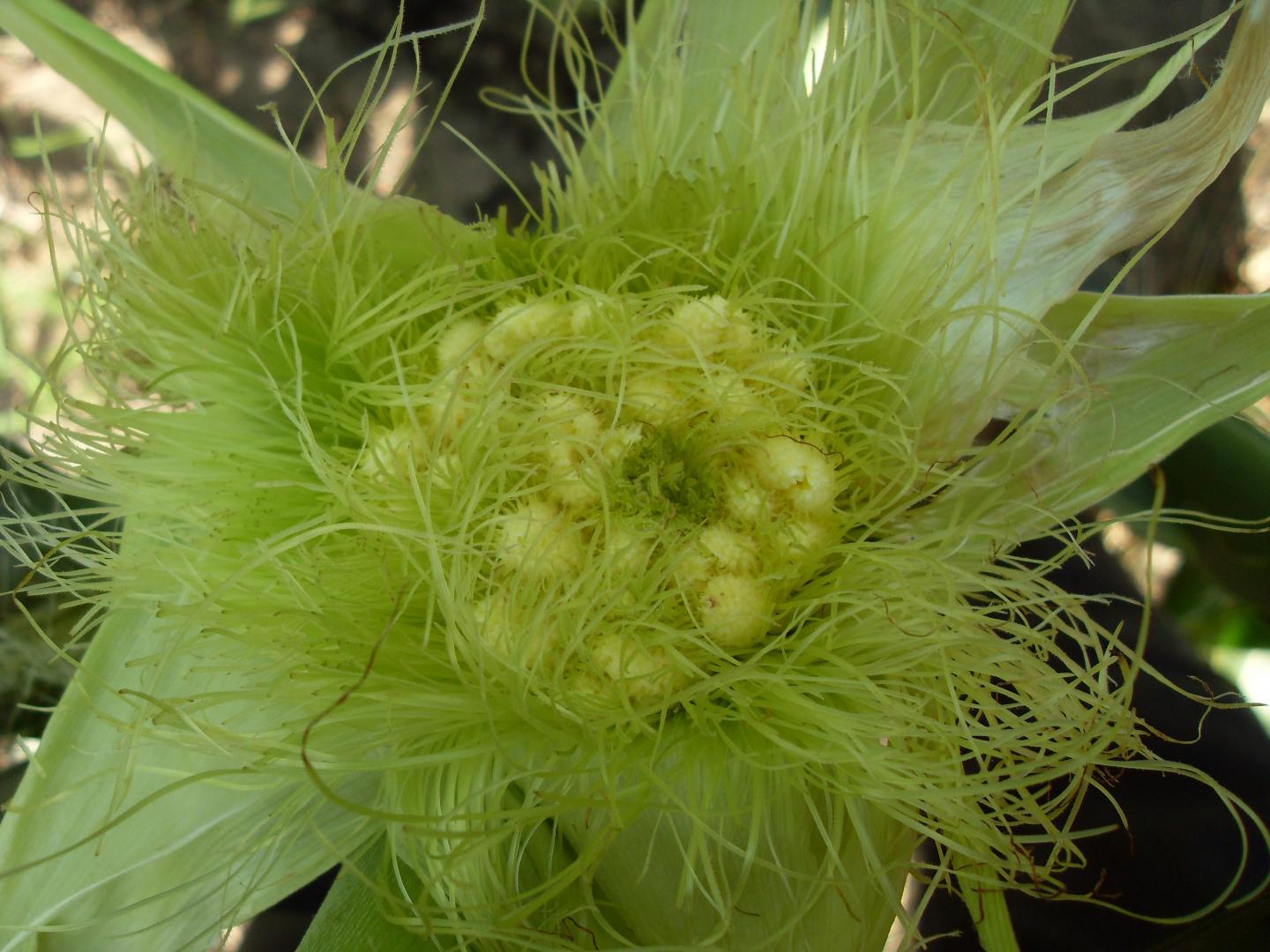
Pathways that control plant stem cells can be modified to make plants generate bigger fruits or more seeds. The tip of this ear of corn is growing abnormally, but provided scientists with information about how to tweak expression of a key gene to boost yield. Credit: Jackson Lab, CSHL

A team of plant geneticists at Cold Spring Harbor Laboratory (CSHL) has identified a protein receptor on stem cells involved in plant development that can issue different instructions about how to grow depending on what peptide (protein fragment) activates it.

This is the first such multi-functional receptor found to work in this way to control plant development. The new findings obtained by CSHL Professor David Jackson and colleagues may have important implications for efforts to boost yields of essential food crops such as corn and rice.

Plant growth and development depend on structures called meristems – reservoirs in plants that contain stem cells. When prompted by peptide signals, stem cells in the meristem develop into any of the plant’s organs – roots, leaves, or flowers, for example. These signals generally work like a key (the peptide) fitting into a lock on the surface of a cell (the protein receptor). The lock opens momentarily, triggering the release of a chemical messenger inside the cell. The messenger carries instructions for the cell to do something, such as grow into a root or flower cell or even stop growing altogether. Conventionally, one or more peptides fit into a receptor to release a single type of chemical messenger.

Jackson and colleagues, however, recently discovered that a protein receptor they first identified in 2001, called FEA2, can can trigger the release of one of two distinct chemical messengers, CT2 or ZmCRN, depending on which of two peptides, ZmCLE7 or ZmFCP1, switches it on. Receptors that release more than one messenger are rare. Jackson says this is the first one discovered that plays a role in crop production.

FEA2 is an important receptor in the CLAVATA signaling pathway, which is known to activate stem cells. Jackson, as well as his CSHL colleague Professor Zachary Lippmann, have previously tweaked this pathway to manipulate the meristem to boost the yield of prominent crop species including tomato, corn, and mustard.

Jackson and his team believe that FEA2 is bound to two different co-receptors, each of which acts as the “lock” for one of the two peptide “keys.” Future research will explore how the two different peptide signals are translated by FEA2 into distinct chemical messages.

“We think the way this stem cell signaling pathway works is fundamental to all plants,” Jackson says. “We have shown that, in theory, the pathways that control stem cells can be modified to make bigger fruits or more seeds. With this study we’ve learned something new about how these pathways work, giving plant scientists another tool for improving crop yields.”


Related Articles Read More >

JLL: 2026 could be a realignment year for life science labs
How Prelude and QDX are using quantum chemistry to discover cancer treatments
US political drama is pushing life sciences talent toward Switzerland, Basel leader says
Thermo Fisher targets early-stage CGT bottlenecks with new Philadelphia hub
rd newsletter
EXPAND YOUR KNOWLEDGE AND STAY CONNECTED
Get the latest info on technologies, trends, and strategies in Research & Development.
RD 25 Power Index

R&D World Digital Issues

Fall 2025 issue

Browse the most current issue of R&D World and back issues in an easy to use high quality format. Clip, share and download with the leading R&D magazine today.

Research & Development World
  • Subscribe to R&D World Magazine
  • Sign up for R&D World’s newsletter
  • Contact Us
  • About Us
  • Drug Discovery & Development
  • Pharmaceutical Processing
  • Global Funding Forecast

Copyright © 2025 WTWH Media LLC. All Rights Reserved. The material on this site may not be reproduced, distributed, transmitted, cached or otherwise used, except with the prior written permission of WTWH Media
Privacy Policy | Advertising | About Us

Search R&D World

  • R&D World Home
  • Topics
    • Aerospace
    • Automotive
    • Biotech
    • Careers
    • Chemistry
    • Environment
    • Energy
    • Life Science
    • Material Science
    • R&D Management
    • Physics
  • Technology
    • 3D Printing
    • A.I./Robotics
    • Software
    • Battery Technology
    • Controlled Environments
      • Cleanrooms
      • Graphene
      • Lasers
      • Regulations/Standards
      • Sensors
    • Imaging
    • Nanotechnology
    • Scientific Computing
      • Big Data
      • HPC/Supercomputing
      • Informatics
      • Security
    • Semiconductors
  • R&D Market Pulse
  • R&D 100
    • 2025 R&D 100 Award Winners
    • 2025 Professional Award Winners
    • 2025 Special Recognition Winners
    • R&D 100 Awards Event
    • R&D 100 Submissions
    • Winner Archive
  • Resources
    • Research Reports
    • Digital Issues
    • Educational Assets
    • R&D Index
    • Subscribe
    • Video
    • Webinars
    • Content submission guidelines for R&D World
  • Global Funding Forecast
  • Top Labs
  • Advertise
  • SUBSCRIBE