Research & Development World

  • R&D World Home
  • Topics
    • Aerospace
    • Automotive
    • Biotech
    • Careers
    • Chemistry
    • Environment
    • Energy
    • Life Science
    • Material Science
    • R&D Management
    • Physics
  • Technology
    • 3D Printing
    • A.I./Robotics
    • Software
    • Battery Technology
    • Controlled Environments
      • Cleanrooms
      • Graphene
      • Lasers
      • Regulations/Standards
      • Sensors
    • Imaging
    • Nanotechnology
    • Scientific Computing
      • Big Data
      • HPC/Supercomputing
      • Informatics
      • Security
    • Semiconductors
  • R&D Market Pulse
  • R&D 100
    • 2025 R&D 100 Award Winners
    • 2025 Professional Award Winners
    • 2025 Special Recognition Winners
    • R&D 100 Awards Event
    • R&D 100 Submissions
    • Winner Archive
  • Resources
    • Research Reports
    • Digital Issues
    • Educational Assets
    • R&D Index
    • Subscribe
    • Video
    • Webinars
    • Content submission guidelines for R&D World
  • Global Funding Forecast
  • Top Labs
  • Advertise
  • SUBSCRIBE

What could make MXene a key to ultra-precise, additive-free 3D microprinting?

By Brian Buntz | April 5, 2025

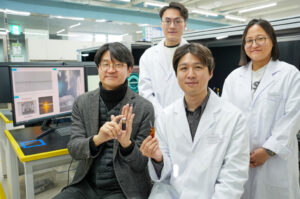
Seol Seung-kwon, Ph.D., (front row, left) and his team at the Korea Electrotechnology Research Institute (KERI) showcase their MXene-based 3D printing ink and nozzle.

Seol Seung-kwon, Ph.D., (front row, left) and his team at the Korea Electrotechnology Research Institute (KERI) showcase their MXene-based 3D printing ink and nozzle.

Binders and viscosity hurdles have plagued micro-scale 3D printing in the past, often limiting results to “2D patterns or required diverse additives to produce 3D architectures,” as noted by researchers. But now, a team in South Korea has pioneered an additive-free method using the 2D nanomaterial MXene, achieving a 1.3-micrometer resolution—reportedly 270 times higher than existing techniques. This reserach, detailed in the journal Small, taps a ‘Meniscus’ printing approach and could help drive progress in manufacturing for next-generation batteries, sensors, and miniaturized electronic devices.

Developing the ‘Meniscus’ printing method
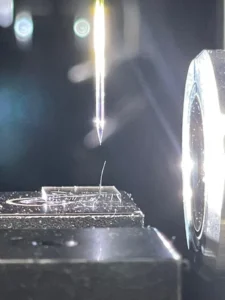
KERI's meniscus 3D printer creating pure MXene microstructures

KERI’s 3D printer creating microstructures with MXene ink

Seol Seung-kwon’s team at the Korea Electrotechnology Research Institute (KERI) addressed specific processing hurdles with MXene. Conventional 3D printing approaches demanded binders, which unfortunately compromised MXene’s vital electrical conductivity and other characteristics. Achieving the correct ink consistency also proved challenging: high MXene concentrations clogged print nozzles, but low concentrations failed to produce stable structures.

To deal with such hurdles, KERI developed a ‘Meniscus’ printing method that controls the ejection of binder-free, water-based MXene ink. This method uses the meniscus—the curved surface of the liquid droplet—as a channel. Rapid solvent evaporation at this interface, combined with strong Van der Waals forces, allows MXene nanoparticles to self-assemble into solid structures without additives.

We put a lot of effort into optimizing the concentration conditions of MXene ink and precisely analyzing the various parameters that could arise during the printing process

Seol Seung-kwon

High-resolution results

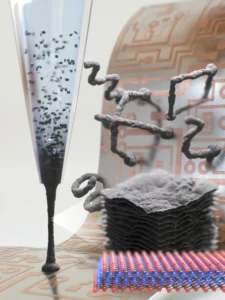
KERI's 3D printing research results selected as the cover article in the journal Small.

KERI’s 3D printing research results selected as the cover article in the journal Small.

This additive-free approach preserves pure MXene’s properties while enabling precisedesigns. The resulting 1.3 µm resolution enhances microfabrication capabilities. Seol noted, “”Our technology is the world’s first achievement that allows the creation of high-strength, high-precision 3D microstructures by leveraging the advantages of MXene without the need for any additives or post-processing.” This capability can enhance various applications: increasing energy density in batteries through greater surface area, improving electromagnetic shielding through absorption effects, and enhancing miniaturized sensors’ sensitivity and efficiency.

The KERI team plans to collaborate with industry partners to develop commercial applications. This pursuit meets a growing need for smaller, more flexible electronic devices. The research’s significance earned it a cover feature in Small. Support for this work came from KERI’s internal programs and a national project by the Ministry of Science and ICT focused on advanced manufacturing technologies.


Related Articles Read More >

Caltech team 3D-prints drug depots deep inside living tissue
Industry 4.0 Modern Factory: Facility Operator Controls Workshop Production Line, Uses Computer with Screens Showing Complex UI of Machine Operation Processes, Controllers, Machinery Blueprints
Building the thinking factory: An additive exec on AI, automation, and the skills crisis
Red Bull and Mercedes F1 cars 3D illustration, 30 Aug, 2022, Texas, EUA
6 technologies pushing Formula 1’s engineering frontier
Pusan National University researchers develop one-step 3D microelectrode technique for neural interfaces
rd newsletter
EXPAND YOUR KNOWLEDGE AND STAY CONNECTED
Get the latest info on technologies, trends, and strategies in Research & Development.
RD 25 Power Index

R&D World Digital Issues

Fall 2025 issue

Browse the most current issue of R&D World and back issues in an easy to use high quality format. Clip, share and download with the leading R&D magazine today.

Research & Development World
  • Subscribe to R&D World Magazine
  • Sign up for R&D World’s newsletter
  • Contact Us
  • About Us
  • Drug Discovery & Development
  • Pharmaceutical Processing
  • Global Funding Forecast

Copyright © 2025 WTWH Media LLC. All Rights Reserved. The material on this site may not be reproduced, distributed, transmitted, cached or otherwise used, except with the prior written permission of WTWH Media
Privacy Policy | Advertising | About Us

Search R&D World

  • R&D World Home
  • Topics
    • Aerospace
    • Automotive
    • Biotech
    • Careers
    • Chemistry
    • Environment
    • Energy
    • Life Science
    • Material Science
    • R&D Management
    • Physics
  • Technology
    • 3D Printing
    • A.I./Robotics
    • Software
    • Battery Technology
    • Controlled Environments
      • Cleanrooms
      • Graphene
      • Lasers
      • Regulations/Standards
      • Sensors
    • Imaging
    • Nanotechnology
    • Scientific Computing
      • Big Data
      • HPC/Supercomputing
      • Informatics
      • Security
    • Semiconductors
  • R&D Market Pulse
  • R&D 100
    • 2025 R&D 100 Award Winners
    • 2025 Professional Award Winners
    • 2025 Special Recognition Winners
    • R&D 100 Awards Event
    • R&D 100 Submissions
    • Winner Archive
  • Resources
    • Research Reports
    • Digital Issues
    • Educational Assets
    • R&D Index
    • Subscribe
    • Video
    • Webinars
    • Content submission guidelines for R&D World
  • Global Funding Forecast
  • Top Labs
  • Advertise
  • SUBSCRIBE