Research & Development World

  • R&D World Home
  • Topics
    • Aerospace
    • Automotive
    • Biotech
    • Careers
    • Chemistry
    • Environment
    • Energy
    • Life Science
    • Material Science
    • R&D Management
    • Physics
  • Technology
    • 3D Printing
    • A.I./Robotics
    • Software
    • Battery Technology
    • Controlled Environments
      • Cleanrooms
      • Graphene
      • Lasers
      • Regulations/Standards
      • Sensors
    • Imaging
    • Nanotechnology
    • Scientific Computing
      • Big Data
      • HPC/Supercomputing
      • Informatics
      • Security
    • Semiconductors
  • R&D Market Pulse
  • R&D 100
    • 2026 R&D 100 Award Winners
    • 2026 Professional Award Winners
    • 2026 Special Recognition Winners
    • R&D 100 Awards Event
    • R&D 100 Submissions
    • Winner Archive
  • Resources
    • Research Reports
    • Digital Issues
    • Educational Assets
    • Subscribe
    • Video
    • Webinars
    • PharmSci360
    • Content submission guidelines for R&D World
  • Global Funding Forecast
  • Top Labs
  • Advertise
  • SUBSCRIBE

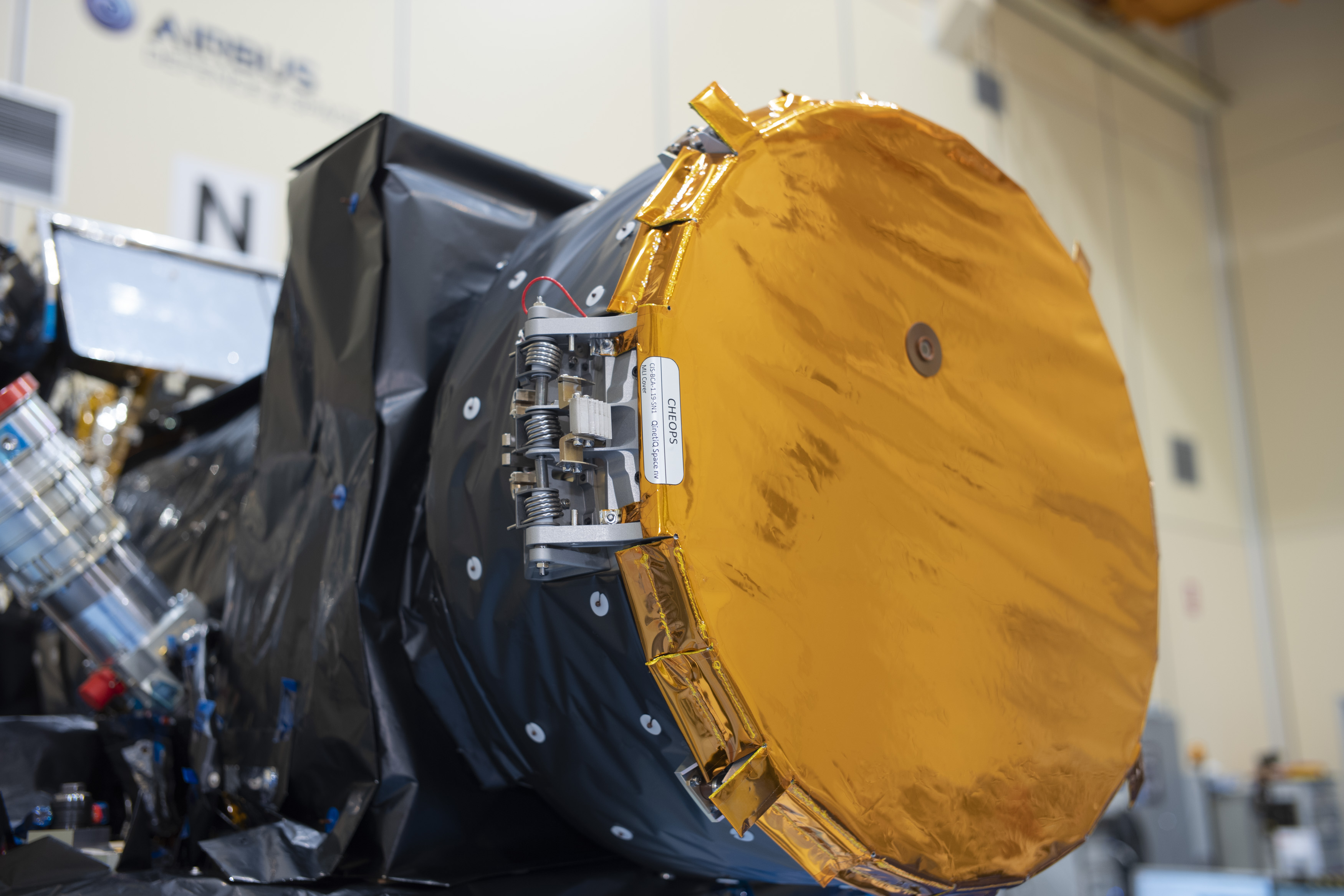
Cleanroom Snapshot: Cheops in the Cleanroom

By European Space Agency | March 13, 2019

Image: European Space Agency

The copper-colored baffle cover of the European Space Agency’s Characterising Exoplanet Satellite, Cheops, in the cleanroom at Airbus Defence and Space Spain, Madrid.

After completing spacecraft testing, the satellite has passed a very important review that determined it is ready to fly. Cheops will be stored in Madrid for a few months before being shipped to the launch site in Kourou, French Guiana; launch is scheduled in the time slot between Oct. 15 and Nov. 14, 2019. The baffle cover pictured in this image is designed to protect the satellite’s scientific instrument—a powerful camera, or photometer—during assembly and launch. Once in space, the cover will open, allowing light from stars to enter the telescope.

Cheops will make observations of exoplanet-hosting stars to measure small changes in their brightness due to the transit of a planet across the star’s disc, targeting in particular stars hosting planets in the Earth-to-Neptune size range. The information will enable precise measurements of the sizes of the orbiting planets to be made: combined with measurements of the planet masses, this will provide an estimate of their mean density—a first step to characterizing planets outside our Solar System.

Cheops paves the way for the next generation of ESA’s exoplanet satellites, with two further missions— Plato and Ariel—planned for the next decade to tackle different aspects of the evolving field of exoplanet science.
Related Articles Read More >

As AI floods drug discovery with designs, Twist uses DNA chips to tackle the wet-lab bottleneck
Interphex 2026 awards honor technologies focused on flexibility, automated workflows and ease of use
What every regulated lab should plan before building a cleanroom
6 essentials for seismic rated cleanrooms
rd newsletter
EXPAND YOUR KNOWLEDGE AND STAY CONNECTED
Get the latest info on technologies, trends, and strategies in Research & Development.

R&D World Digital Issues

Fall 2025 issue

Browse the most current issue of R&D World and back issues in an easy to use high quality format. Clip, share and download with the leading R&D magazine today.

R&D 100 Awards
Research & Development World
  • Subscribe to R&D World Magazine
  • Sign up for R&D World’s newsletter
  • Contact Us
  • About Us
  • Drug Discovery & Development
  • Pharmaceutical Processing
  • Global Funding Forecast

Copyright © 2026 Arrowfly LLC. All Rights Reserved. The material on this site may not be reproduced, distributed, transmitted, cached or otherwise used, except with the prior written permission of Arrowfly
Privacy Policy | Advertising | About Us

Search R&D World

  • R&D World Home
  • Topics
    • Aerospace
    • Automotive
    • Biotech
    • Careers
    • Chemistry
    • Environment
    • Energy
    • Life Science
    • Material Science
    • R&D Management
    • Physics
  • Technology
    • 3D Printing
    • A.I./Robotics
    • Software
    • Battery Technology
    • Controlled Environments
      • Cleanrooms
      • Graphene
      • Lasers
      • Regulations/Standards
      • Sensors
    • Imaging
    • Nanotechnology
    • Scientific Computing
      • Big Data
      • HPC/Supercomputing
      • Informatics
      • Security
    • Semiconductors
  • R&D Market Pulse
  • R&D 100
    • 2026 R&D 100 Award Winners
    • 2026 Professional Award Winners
    • 2026 Special Recognition Winners
    • R&D 100 Awards Event
    • R&D 100 Submissions
    • Winner Archive
  • Resources
    • Research Reports
    • Digital Issues
    • Educational Assets
    • Subscribe
    • Video
    • Webinars
    • PharmSci360
    • Content submission guidelines for R&D World
  • Global Funding Forecast
  • Top Labs
  • Advertise
  • SUBSCRIBE