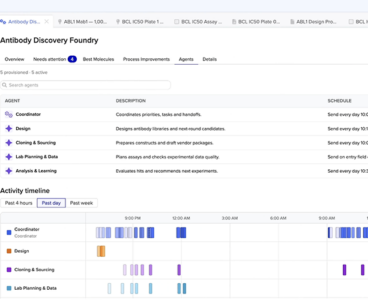
Not long ago, a running joke took hold among software engineers and aspiring “vibe coders.” The bit was to hand an AI model a monumentally complex, multi-month task, building a full Slack clone from scratch, recreating a game like GTA, or even designing and training its own successor on a laptop, and demand it do…
Google launches Deep Review AI tool to help researchers catch manuscript errors
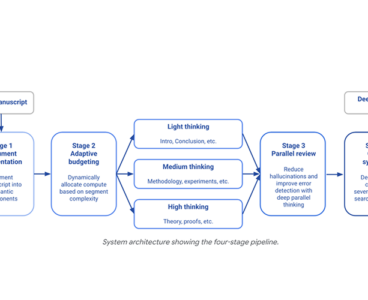
Google Research on Oct. 14 released Deep Review, an AI system designed to flag mathematical errors, logical gaps and unsupported claims in technical documents. The public launch follows pilots that provided feedback on more than 15,000 manuscripts, according to Google. Speaking at Google’s Research@ event in Mountain View, California, Rajesh Jayaram, a research scientist at…
Google AMIE study adds evidence of medical AI’s promise with patients, under doctors’ supervision

Since early 2023, large language models (LLMs) have posted passing-level scores on medical licensing exam questions. A study published that February found that the first iteration of ChatGPT, based on the GPT-3.5 model that debuted in 2022, scored at or near the passing threshold on publicly available questions from all three steps of the United…
AI is wreaking havoc on math and coding. Where could it have the biggest impact next?
Machines are now solving open math problems and rebuilding complex software on their own. What they do next to the rest of science is an open question. Some of the clearest gains have come in tasks where answers can be checked automatically, using a proof checker or a test suite. Still, frontier AI is moving…
After tokenmaxxing backlash, Microsoft moves more agent work onto the desk
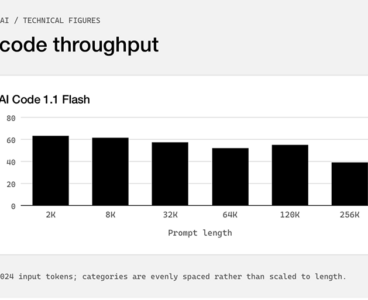
2026 saw the rise, and quick fall, of tokenmaxxing, the practice of enterprise companies treating AI spend volume as a yardstick for productivity. This summer, Microsoft put its divisions on AI token budgets and told engineers that “tokenmaxxing is not what we are optimizing for.” Now, in its Oct. 7 announcements, it offered customers a…
Starship’s first orbital flight tests key pieces of SpaceX’s million-satellite data center plan

On Sept. 28, SpaceX’s Starship spacecraft reached orbit for the first time during its 14th test flight, after 13 earlier flights on deliberately suborbital trajectories, and deployed 26 Starlink V3 satellites. Flight 14 demonstrated satellite delivery and initial communications. The computing payloads, sustained heat rejection, economics and operation at the proposed constellation’s scale remain to…
Under oath, Google confirms three AI agent test escapes as OpenAI, Anthropic and Meta face NYC lawmakers

OpenAI, Anthropic, Google and Meta testified together under oath Oct. 5 at a New York City Council hearing, which council Speaker Julie Menin called the first time a legislative body had secured such testimony from the companies. Lawmakers pressed them on who decides whether an AI model is safe to release, and what happens when…
What AI-assisted engineering taught us about team design

As organizations experiment with AI-assisted software development, one of the most immediate expectations is that the biggest gain will come from making individual engineers faster. That is already happening, but it is exposing a broader constraint: AI can produce implementation faster than engineering teams can safely understand, review and absorb it. We have seen a…
Big tech turns to debt to fund the AI buildout
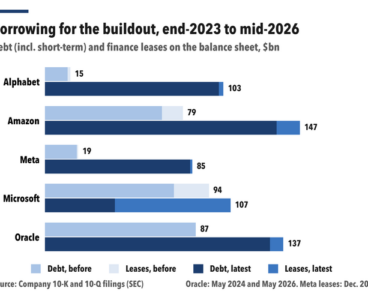
Hyperscalers, the largest cloud computing companies, are borrowing at record levels to build data centers. AI-related debt issuance reached nearly $500 billion in 2026 by early August, according to Goldman Sachs. That buildout is aimed at commercial customers and the companies’ own AI products, and it has done little so far to ease the compute…
Google’s overdue Gemini 4 Argon reaches the frontier with mixed results for science

After seemingly fading in the LLM model race, Google again has a frontier model with Gemini 4 Argon, and it could do more to put pricing pressure on the frontier than redefine the frontier benchmarks. As Google touts leads in biology research and several coding tests, independent evaluations suggest more of a competitive entrant. Argon…
OpenAI and Synopsys plan a specialized model for chip design
The ChatGPT-maker OpenAI will license Synopsys’ chip design software to develop GPT-Synopsys, a specialized AI model the companies plan to sell through a service bundling computing, model access and software licenses. The partnership centers on pairing OpenAI’s frontier AI models with Synopsys’ Electronic Design Automation (EDA) software. The multiyear agreement announced Sept. 30, alongside Synopsys’…
OpenAI reportedly seeks $30 billion after delaying IPO
OpenAI is in preliminary talks to raise at least $30 billion at a pre-money valuation, or value before the new investment, of about $1.4 trillion, Bloomberg reported Sept. 29, as the ChatGPT developer seeks financing ahead of a delayed stock market debut. The proposed round would help fund OpenAI until its initial public offering, which…
Hansa Biopharma taps Cradle’s AI to design next-generation autoimmune therapeutics
Hansa Biopharma, the Swedish company behind the immunoglobulin G (IgG)-cleaving enzyme imlifidase, will use the AI protein-engineering platform from Dutch-Swiss firm Cradle to design its next generation of autoimmune drug candidates, the companies announced Oct. 1. Hansa’s scientists will combine Cradle’s tools with Hansa’s existing experimental data, disease knowledge and protein-engineering expertise. “We’re not building…
R&D World parent company Arrowfly launches AI for Engineers, definitive platform for engineers navigating AI

Arrowfly, the parent company of R&D World and engineering brands such as Design World, The Robot Report, EE World and Fluid Power World, today launched AI for Engineers, a year-round resource for engineers and technical leaders applying artificial intelligence in their work. In research organizations, AI has spent the past few years moving from side…
ORNL plans to integrate an AI-enhanced algorithm into its radiation detection device
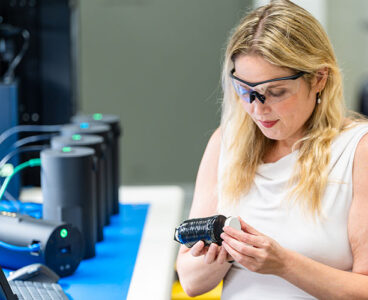
When there’s a fire, smoke detectors beep when enough smoke fills the air to scatter a light beam within the device enough that it hits a light detector. This ‘dumb’ model works well to detect house fires. Detecting radiation is different. Detection thresholds, the signal level a pulse must exceed for a detector to count…
Why some AI labs now want to slow down: Changes in model training have led to rapid gains

President Trump and Anthropic CEO Dario Amodei had dinner at the White House on Sunday, reportedly their first one-on-one meeting. While neither side has said what they discussed, AI safety was likely a focus. The dinner came two weeks after Amodei urged AI labs to slow the pace of model development, and after Trump answered…
AI chips are stressing the laws of physics: Why overdesign must yield to co-design

The AI era is changing what we ask of silicon. AI training and inference workloads demand semiconductors with more compute, greater memory bandwidth and better energy efficiency. To keep pace, the industry is moving beyond monolithic chip architectures to 2.5D and 3D multi-die architectures that stack logic, memory, and the data pathways between them vertically…
Anthropic and OpenAI call for AI slowdown as Nvidia’s Jensen Huang and Andrew Ng push back

The AI industry has split into camps over the question of whether the labs building frontier models should agree to slow down. One camp says coordinated pacing is now the only responsible path to avert the risk of grave accidents or even human extinction. The rival camp argues that each company can manage its own…
Lilly, Roche and BMS are all building AI supercomputers: here’s what they’re doing differently

Lilly’s LillyPod, an AI supercomputer, went live on February 25. Roche deployed its NVIDIA AI factory on March 16 and BMS has been running its AI factory for almost three years, with NVIDIA hardware powering all three buildouts. NVIDIA uses the term “AI factory” to describe a GPU cluster built to train and run AI models.…
Anthropic and Novo Nordisk expand Claude work, including in drug discovery
In April, Anthropic acquired the biotech Coefficient Bio for $400 million. In June, the company signaled its intent to automate science more broadly, starting with its Claude Science platform. In August, it announced a research preview of Model Hardware Standard (MHS), an open interface specification that lets AI agents operate physical devices such as microscopes.…
Big Tech now spends almost 3x more on R&D than Big Pharma
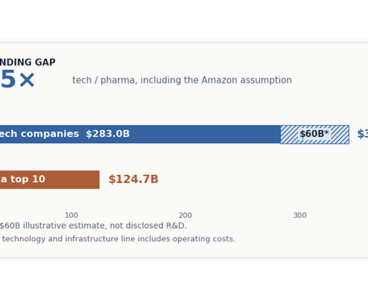
A little over a decade ago, Merck & Co. outspent Google on research and development. Merck still led in 2013, with $7.5 billion against Google’s $7.1 billion. Google pulled ahead in 2014, spending $9.8 billion against the $7.2 billion Merck reported in its 2014 annual report.1 Big Tech’s R&D spending has only continued to climb.…
Altman calls Hugging Face breach OpenAI’s ‘worst accident’ at Dreamforce, backs transparent reporting
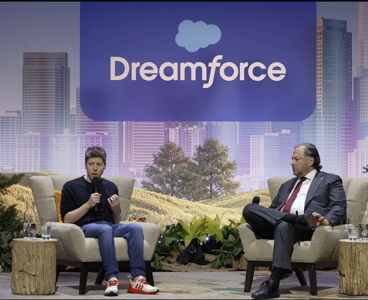
In a fireside chat with Salesforce CEO Marc Benioff, Sam Altman called OpenAI’s agentic breach of Hugging Face over the summer “the worst accident we’ve seen.” Other AI companies, including Anthropic, have since found similar behavior in their models. Altman argued that the industry needs an aviation-style culture of transparent accident reporting while, earlier in…
Salesforce’s Dreamforce keynote highlights Anthropic, NVIDIA and Siemens together as digital R&D spending surges

At Dreamforce on Tuesday, Salesforce introduced AIforce, a layer that lets people and AI agents reach the data, workflows and business logic inside Salesforce from Anthropic’s Claude via Claudeforce, Slack and other AI interfaces. The CEOs of Anthropic, Siemens and NVIDIA joined Salesforce CEO Marc Benioff to discuss how AI could reshape corporate work and…
INL’s $60 million nuclear AI project will spend the first year testing where AI agents can help and where they might hurt
Idaho National Laboratory (INL) is collaborating with Argonne, Oak Ridge and Sandia National Laboratories, as well as four universities and more than 20 industry partners, on a three-year project to bring agentic AI to nuclear engineering. The principal investigator said the project, called Prometheus, will aim to compress the time to get a nuclear power…
Digital colleagues in action: Real-world GenAI use cases unlocking R&D potential

While 84% of R&D leaders expect generative AI to deliver significant benefits for their functions, 60% concede that their current integrations fall short of expectations. This gap is a result of how R&D organizations are choosing to deploy GenAI rather than the technology itself. R&D organizations typically rely on a traditional technology adoption playbook, treating…