Research & Development World

  • R&D World Home
  • Topics
    • Aerospace
    • Automotive
    • Biotech
    • Careers
    • Chemistry
    • Environment
    • Energy
    • Life Science
    • Material Science
    • R&D Management
    • Physics
  • Technology
    • 3D Printing
    • A.I./Robotics
    • Software
    • Battery Technology
    • Controlled Environments
      • Cleanrooms
      • Graphene
      • Lasers
      • Regulations/Standards
      • Sensors
    • Imaging
    • Nanotechnology
    • Scientific Computing
      • Big Data
      • HPC/Supercomputing
      • Informatics
      • Security
    • Semiconductors
  • R&D Market Pulse
  • R&D 100
    • 2025 R&D 100 Award Winners
    • 2025 Professional Award Winners
    • 2025 Special Recognition Winners
    • R&D 100 Awards Event
    • R&D 100 Submissions
    • Winner Archive
  • Resources
    • Research Reports
    • Digital Issues
    • Educational Assets
    • Subscribe
    • Video
    • Webinars
    • Content submission guidelines for R&D World
  • Global Funding Forecast
  • Top Labs
  • Advertise
  • SUBSCRIBE

ETH Zurich researchers created an AI robot that beats humans at labyrith

By Rachael Pasini | December 20, 2023

It has long been recognized that AI can achieve a higher level of performance than humans in various games, but until now, physical skill remained the ultimate human prerogative. This is no longer the case. An AI technique known as deep reinforcement learning has pushed the limits of what can be achieved with autonomous systems and AI, achieving superhuman performance in a variety of different games such as chess and Go, video games, and navigating virtual mazes. Today, artificial intelligence is beginning to push the boundaries and gain ground on man’s prerogative: physical skill.
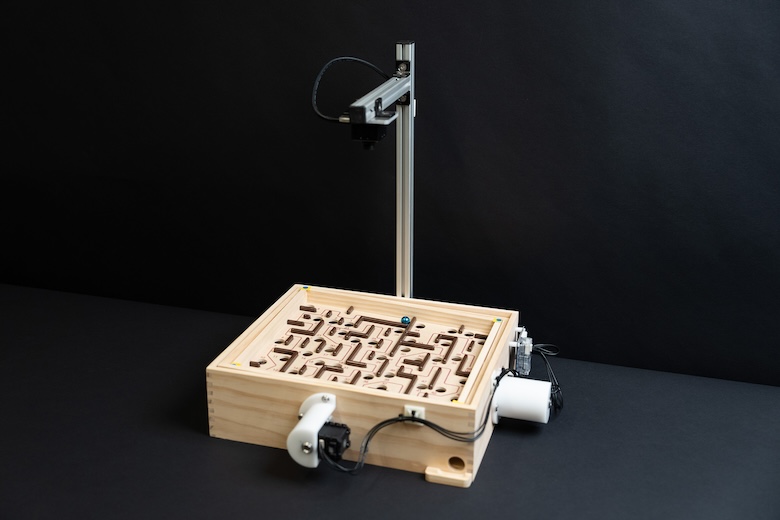
ETH Zurich researchers have created an AI robot that learns, in only 6 hours, to execute a popular game of physical skill in record time.

Researchers at ETH Zurich have created an AI robot named CyberRunner whose task is to learn how to play the popular and widely accessible labyrinth marble game. The labyrinth is a game of physical skill whose goal is to steer a marble from a given start point to the endpoint. In doing so, the player must prevent the ball from falling into any of the holes that are present on the labyrinth board.

The movement of the ball can be indirectly controlled by two knobs that change the orientation of the board. While it is a relatively straightforward game, it requires fine motor skills and spatial reasoning abilities, and, from experience, humans require a great amount of practice to become proficient at the game.

CyberRunner applies recent advances in model-based reinforcement learning to the physical world and exploits its ability to make informed decisions about potentially successful behaviors by planning real-world decisions and actions into the future.

Just like us humans, the robot learns through experience. While playing the game, it captures observations and receives rewards based on its performance, all through the “eyes” of a camera looking down at the labyrinth. A memory is kept of the collected experience. Using this memory, the model-based reinforcement learning algorithm learns how the system behaves, and based on its understanding of the game, it recognizes which strategies and behaviors are more promising (the “critic”). Consequently, the way the robot uses the two motors (its “hands”) to play the game is continuously improved (the “actor”). Importantly, the robot does not stop playing to learn; the algorithm runs concurrently with the robot playing the game. As a result, the robot keeps getting better, run after run.
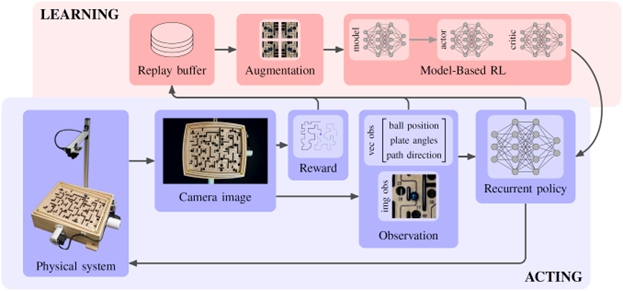
The learning on the real-world labyrinth is conducted in 6.06 hours, comprising 1.2 million time steps at a control rate of 55 samples per second. The AI robot outperforms the previously fastest recorded time, achieved by an extremely skilled human player, by over 6%.

Interestingly, during the learning process, CyberRunner naturally discovered shortcuts. It found ways to “cheat” by skipping certain parts of the maze. The lead researchers, Thomas Bi and Prof. Raffaello D’Andrea of ETH Zurich, had to step in and explicitly instruct it not to take any of those shortcuts.

A preprint of the research paper is available on the project website, where Bi and D’Andrea will open source the project.

“We believe that this is the ideal testbed for research in real-world machine learning and AI. Prior to CyberRunner, only organizations with large budgets and custom-made experimental infrastructure could perform research in this area,” said D’Andrea. “Now, for less than 200 dollars, anyone can engage in cutting-edge AI research. Furthermore, once thousands of CyberRunners are out in the real-world, it will be possible to engage in large-scale experiments, where learning happens in parallel, on a global scale. The ultimate in Citizen Science!”

Watch ETH Zurich’s video:

Related Articles Read More >

Big data technology Data science analysing artificial intelligence generative AI deep learning machine learning algorithm Neural flow network analytics innovation abstract futuristic. 3d rendering.
This week in AI research: Fields medalist says GPT-5.5 Pro did PhD-level math in an hour, Anthropic teaches Claude to ‘dream’
Elsevier joins suit against Meta over use of copyrighted research in LLM training
Alphabet-spinoff Isomorphic Labs raises $2.1 billion in quest to ‘solve all disease’ with AI-based drug discovery tools
AI agent mines 3,000+ papers to create comprehensive lithium metal battery database
rd newsletter
EXPAND YOUR KNOWLEDGE AND STAY CONNECTED
Get the latest info on technologies, trends, and strategies in Research & Development.

R&D World Digital Issues

Fall 2025 issue

Browse the most current issue of R&D World and back issues in an easy to use high quality format. Clip, share and download with the leading R&D magazine today.

R&D 100 Awards
Research & Development World
  • Subscribe to R&D World Magazine
  • Sign up for R&D World’s newsletter
  • Contact Us
  • About Us
  • Drug Discovery & Development
  • Pharmaceutical Processing
  • Global Funding Forecast

Copyright © 2026 WTWH Media LLC. All Rights Reserved. The material on this site may not be reproduced, distributed, transmitted, cached or otherwise used, except with the prior written permission of WTWH Media
Privacy Policy | Advertising | About Us

Search R&D World

  • R&D World Home
  • Topics
    • Aerospace
    • Automotive
    • Biotech
    • Careers
    • Chemistry
    • Environment
    • Energy
    • Life Science
    • Material Science
    • R&D Management
    • Physics
  • Technology
    • 3D Printing
    • A.I./Robotics
    • Software
    • Battery Technology
    • Controlled Environments
      • Cleanrooms
      • Graphene
      • Lasers
      • Regulations/Standards
      • Sensors
    • Imaging
    • Nanotechnology
    • Scientific Computing
      • Big Data
      • HPC/Supercomputing
      • Informatics
      • Security
    • Semiconductors
  • R&D Market Pulse
  • R&D 100
    • 2025 R&D 100 Award Winners
    • 2025 Professional Award Winners
    • 2025 Special Recognition Winners
    • R&D 100 Awards Event
    • R&D 100 Submissions
    • Winner Archive
  • Resources
    • Research Reports
    • Digital Issues
    • Educational Assets
    • Subscribe
    • Video
    • Webinars
    • Content submission guidelines for R&D World
  • Global Funding Forecast
  • Top Labs
  • Advertise
  • SUBSCRIBE