Research & Development World

  • R&D World Home
  • Topics
    • Aerospace
    • Automotive
    • Biotech
    • Careers
    • Chemistry
    • Environment
    • Energy
    • Life Science
    • Material Science
    • R&D Management
    • Physics
  • Technology
    • 3D Printing
    • A.I./Robotics
    • Software
    • Battery Technology
    • Controlled Environments
      • Cleanrooms
      • Graphene
      • Lasers
      • Regulations/Standards
      • Sensors
    • Imaging
    • Nanotechnology
    • Scientific Computing
      • Big Data
      • HPC/Supercomputing
      • Informatics
      • Security
    • Semiconductors
  • R&D Market Pulse
  • R&D 100
    • 2026 R&D 100 Award Winners
    • 2026 Professional Award Winners
    • 2026 Special Recognition Winners
    • R&D 100 Awards Event
    • R&D 100 Submissions
    • Winner Archive
  • Resources
    • Research Reports
    • Digital Issues
    • Educational Assets
    • Subscribe
    • Video
    • Webinars
    • PharmSci360
    • Content submission guidelines for R&D World
  • Global Funding Forecast
  • Top Labs
  • Advertise
  • SUBSCRIBE

New ‘ultrasound tornado’ device breaks down blood clots

By Sean Whooley | February 7, 2023

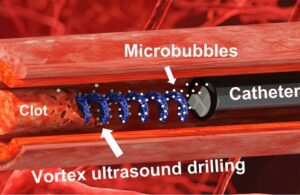
Jiang vortex ultrasound blood clot

[Image courtesy of North Carolina State University]

Researchers at say a new tool and technique using “vortex ultrasound” could potentially break down blood clots in the brain.

This sort of ultrasonic tornado eliminated clots formed in an in vitro model of cerebral venous sinus thrombosis (CVST). The researchers, based at North Carolina State University, say it worked more quickly than existing techniques.

“Our previous work looked at various techniques that use ultrasound to eliminate blood clots using what are essentially forward-facing waves,” said Xiaoning Jiang, co-corresponding author of a paper on the work. “Our new work uses vortex ultrasound, where the ultrasound waves have a helical wavefront.

Jiang, the Dean F. Duncan Professor of Mechanical and Aerospace Engineering at N.C. State, said the ultrasound “is swirling as it moves forward.” Because of the shear stress induced by the vortex wave, he said, this technique eliminates blood clots more quickly than others.

Co-corresponding author Chengzhi Shi, an assistant professor of mechanical engineering at Georgia Tech, said it’s vital that the technique works quickly to prevent CVST. CVST occurs when a blood clot forms in the veins responsible for draining blood from the brain. Jiang said current treatments for CVST fail in 20% to 40% of cases.

“CVST clots increase pressure on blood vessels in the brain,” said Shi. “This increases the risk of a hemorrhage in the brain, which can be catastrophic for patients. Existing techniques rely in large part on interventions that dissolve the blood clot. But this is a time-consuming process. Our approach has the potential to address these clots more quickly, reducing risk for patients.”

How the researchers tested the vortex ultrasound

This tool includes a single transducer for producing the swirling vortex effect. Researchers designed the transducer at a small enough size for incorporation into a catheter. That then feeds through the circulatory system to the site of the blood clot.

The researchers tested their technology using cow blood in a 3D-printed model of the cerebral venous sinus. Testing found no damage to the walls of blood vessels, something that can happen during catheterization or surgical intervention. They also found no substantial damage to red blood cells.

Shi said the clinical application of the vortex ultrasound “would likely be comparable in cost” to other CVST treatments. Jiang said the next step involves testing in an animal model. If successful, the researchers hope to pursue clinical trials.


Related Articles Read More >

UK research grant backs Alphawave Semi’s AI network efficiency project
CHIPS Act monies to be finally distributed in this week’s R&D power index
ZFP: Fast, Accurate Data Compression for Modern Supercomputing Applications is today’s R&D 100 of the day
Bio-inspired Silicone Sealant for Wet Surface Adhesion is the R&D 100 winner of the day
rd newsletter
EXPAND YOUR KNOWLEDGE AND STAY CONNECTED
Get the latest info on technologies, trends, and strategies in Research & Development.

R&D World Digital Issues

Fall 2026 issue

Browse the most current issue of R&D World and back issues in an easy to use high quality format. Clip, share and download with the leading R&D magazine today.

R&D 100 Awards
Research & Development World
  • Subscribe to R&D World Magazine
  • Sign up for R&D World’s newsletter
  • Contact Us
  • About Us
  • Drug Discovery & Development
  • Pharmaceutical Processing
  • Global Funding Forecast

Copyright © 2026 Arrowfly LLC. All Rights Reserved. The material on this site may not be reproduced, distributed, transmitted, cached or otherwise used, except with the prior written permission of Arrowfly
Privacy Policy | Advertising | About Us

Search R&D World

  • R&D World Home
  • Topics
    • Aerospace
    • Automotive
    • Biotech
    • Careers
    • Chemistry
    • Environment
    • Energy
    • Life Science
    • Material Science
    • R&D Management
    • Physics
  • Technology
    • 3D Printing
    • A.I./Robotics
    • Software
    • Battery Technology
    • Controlled Environments
      • Cleanrooms
      • Graphene
      • Lasers
      • Regulations/Standards
      • Sensors
    • Imaging
    • Nanotechnology
    • Scientific Computing
      • Big Data
      • HPC/Supercomputing
      • Informatics
      • Security
    • Semiconductors
  • R&D Market Pulse
  • R&D 100
    • 2026 R&D 100 Award Winners
    • 2026 Professional Award Winners
    • 2026 Special Recognition Winners
    • R&D 100 Awards Event
    • R&D 100 Submissions
    • Winner Archive
  • Resources
    • Research Reports
    • Digital Issues
    • Educational Assets
    • Subscribe
    • Video
    • Webinars
    • PharmSci360
    • Content submission guidelines for R&D World
  • Global Funding Forecast
  • Top Labs
  • Advertise
  • SUBSCRIBE