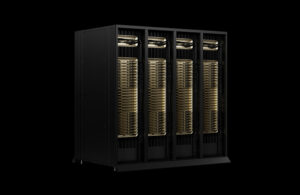
NVIDIA’s DGX SuperPOD supercomputer package. Image courtesy of NVIDIA.
Lilly’s LillyPod, an AI supercomputer, went live on February 25. Roche deployed its NVIDIA AI factory on March 16 and BMS has been running its AI factory for almost three years, with NVIDIA hardware powering all three buildouts. NVIDIA uses the term “AI factory” to describe a GPU cluster built to train and run AI models.
Blackwell Ultra GPUs, which offer 50% more memory and compute than standard Blackwell, power Lilly’s single, centralized supercomputer. Roche is also using Blackwell GPUs for its distributed hybrid-cloud model while BMS is expanding its existing infrastructure with Vera Rubin, which roughly triples Blackwell Ultra’s inference performance per GPU. Both Lilly and BMS use NVIDIA’s DGX SuperPOD, NVIDIA’s prepackaged supercomputer design. Roche has not disclosed which server platform underlies its GPU deployment.
On the 2026 innovators list
Eli Lilly, Roche and BMS are among R&D World’s 100 most innovative companies of 2026. The list examines what each company built, who is using it and the results it has reported. R&D World will publish the full comparison in the 2026 Global R&D Funding Forecast.
Eli Lilly’s LillyPod
A DGX SuperPOD with 1,016 NVIDIA Blackwell Ultra GPUs powers LillyPod, which delivers more than 9,000 petaflops of AI performance. Roche’s system also uses Blackwell GPUs, though the company’s materials do not specify which model.

NVIDIA’s Blackwell Ultra GPU. Image Courtesy of NVIDIA.
Lilly said it assembled the Indiana-based supercomputer in just four months.
The factory can harness 700 terabytes of data using over 290 terabytes of high-bandwidth GPU memory, capacity Lilly says will support training protein diffusion, small-molecule graph neural network, and genomics foundation models. That scale of computation lets scientists test billions of molecular ideas at once, Lilly says, compared with the roughly 2,000 per target a wet lab team can typically manage in a year.
Six months in, Lilly reported that LillyPod was running large open-weight language models on-premises and making them available across the company with no token or budget limits. Chief AI Officer Thomas Fuchs posted on LinkedIn, saying Lilly is the first in pharma to deploy NVIDIA’s Nemotron 3 Ultra, an approximately 550-billion-parameter open-weight model, on-premises, optimized for B300 GPUs at FP4 precision.
Roche’s NVIDIA AI factory
Roche’s NVIDIA AI factory, a distributed, hybrid-cloud architecture spanning several sites across the U.S. and Europe, features 2,176 NVIDIA Blackwell GPUs, more than double Lilly’s factory. The company’s total on-premise and cloud infrastructure exceeds 3,500 Blackwell GPUs.

NVIDIA’s Blackwell GPU. Image courtesy of NVIDIA.
The factory combines NVIDIA’s BioNeMo platform, an open development platform for AI-driven biology and drug discovery, with Roche’s Lab-in-the-Loop to test hypotheses and accelerate progress. NVIDIA’s Omniverse libraries power digital twins that engineers use to optimize processes and factory designs.
BMS’s DGX SuperPOD-powered AI factory
BMS has had a multi-year alliance with NVIDIA, saying it first deployed NVIDIA DGX SuperPOD infrastructure nearly three years ago. BMS deployed the DGX SuperPOD-powered factory to support its R&D activities as part of an AI Center of Excellence. The factory uses the DGX SuperPOD to accelerate oncology research, train models on clinical trial images and use NVIDIA MONAI and self-supervised learning for lesion segmentation.
BMS announced an expansion of the AI factory two months ago, which the company said will be “the most powerful and energy-efficient single-owned NVIDIA infrastructure in life sciences.”
The factory will support BMS’s next-generation foundation models trained on the company’s proprietary data and drawing on domain-specific capabilities from BioNeMo to power agentic workflows.
How they compare
Roche has a total of over 3,500 GPUs with the on-premise and cloud count combined. It owns 2,176, compared to Lilly’s 1,016. However, Roche has not published a performance figure while Lilly reports 9,000 petaflops.
The three also differ on architecture. LillyPod is a single, centralized supercomputer that sits in one Indianapolis facility. Roche spread its GPUs across multiple sites in the U.S. and Europe, supplementing on-premises hardware with cloud capacity. BMS has one DGX SuperPOD already up and running and one recently announced, which the company will combine into a single environment accessible across sites.
Lilly and Roche are both running on Blackwell-family chips. BMS’s new system will run on Vera Rubin, NVIDIA’s newer architecture, which is approximately three times faster than Blackwell Ultra.
Other pharma AI supercomputers
Lilly, Roche and BMS aren’t the only companies racing to build AI infrastructure. Amgen has deployed a DGX SuperPOD, nicknamed “Freyja”, at its deCODE genetics subsidiary in Reykjavik, Iceland. The system runs on 31 DGX H100 nodes, with 248 H100 GPUs in total. The company built it to mine more than 200 petabytes of de-identified human genetic data for drug targets and disease biomarkers.
AstraZeneca is one of five partners in Sferical AI, a jointly owned Swedish company also backed by Ericsson, Saab, SEB and Wallenberg Investments. Sferical is deploying two DGX SuperPODs built on Grace Blackwell GB300 systems, with 1,152 GPUs combined, in Sweden. AstraZeneca said it will use the shared system to “spearhead the next generation of AI enabled drug discovery and development.”
Novo Nordisk is using Gefion’s supercomputer, with 1,528 H100 GPUs rather than building or co-owning hardware. Gefion is owned and operated by the Danish Centre for AI Innovation, which the Novo Nordisk Foundation, a philanthropic entity distinct from the pharma company, partly funds.




Tell Us What You Think!
You must be logged in to post a comment.