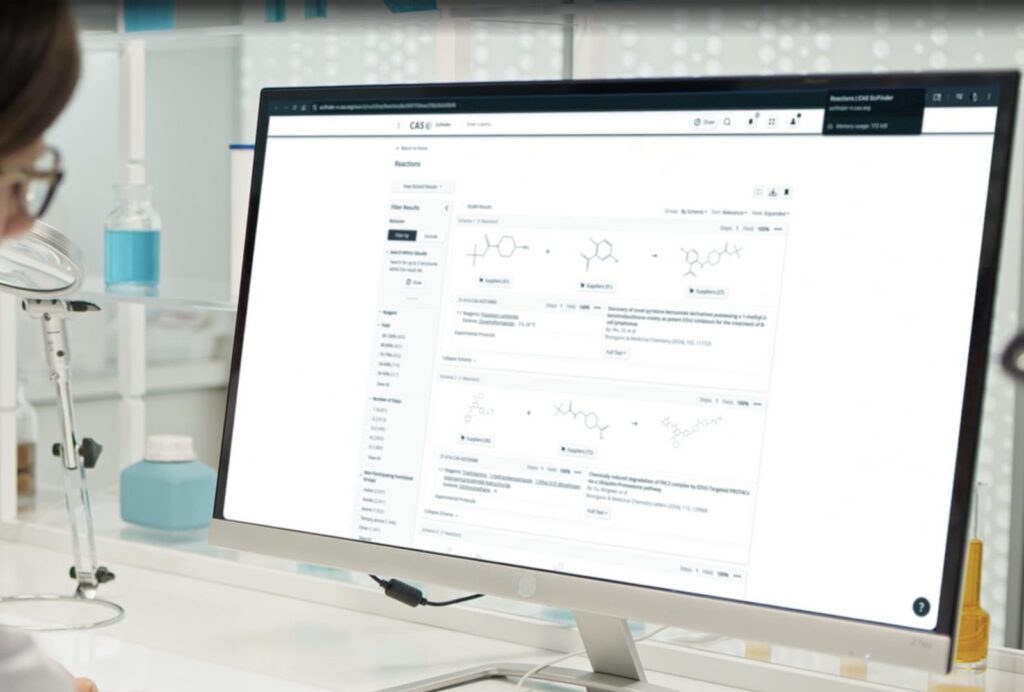
Credit: CAS
Since the term artificial intelligence was coined in the 1950s, the field has been big on promises, centering around a vision of machines that could use language, reason abstractly, solve human problems and improve themselves.
A century of biological progress in a decade. Cures for every disease. AI leaders are setting extraordinary expectations for science: Anthropic’s Dario Amodei has argued that powerful AI could compress 50 to 100 years of biological advances into five to 10, while Google DeepMind CEO Demis Hassabis has said AI could potentially develop revolutionary treatments or even cure all disease. Whether those promises can justify the money pouring into AI will depend in part on how successfully laboratories translate AI-driven discoveries into commercially viable products such as novel medicines and materials.
Among the core ingredients needed to turn AI’s promise into scientific breakthroughs are access to reliable scientific data and integration with the tools scientists already use. Models are already approaching the ceiling on some demanding science tests. Google DeepMind’s Gemini 3 Pro, released in November 2025, scored approximately 93% in Epoch AI’s testing on GPQA Diamond, a set of 198 graduate-level physics, chemistry and biology questions. Epoch’s leaderboard now puts Gemini 4 Argon at 96.4%. Translating that performance into dependable laboratory work presents another challenge.

Andrea Jacobs
“We’re really at the point where raw model capability isn’t the number-one pain point in most AI adoption,” said Andrea Jacobs, who trained in chemistry and computer science and is senior director of AI at scientific information provider CAS, where she has worked since 2010. “How do you build trusted workflows that are increasingly long-running?”
Giving Copilot a scientific reference
One part of CAS’s broader initiative to that end is an integration, announced Oct. 20, with Microsoft Copilot, the AI assistant built into popular Microsoft software ranging from PowerPoint to Word. It gives users access to CAS’s curated scientific content and CAS Newton, an AI agent that draws on CAS data and tools to tackle complex scientific questions, within applications researchers already use. “One of the advantages of Copilot is that it lives on many users’ desktops already,” Jacobs said. “Many users in the world are already subscribers to the Microsoft ecosystem, and much of their work already happens in Microsoft products.”
The CAS Connections listing in Microsoft Marketplace. Credit: Microsoft Marketplace screenshot
CAS supplies scientific information and specialized capabilities through Model Context Protocol (MCP), a standard for connecting AI systems to external tools and data. Copilot can use that connection to retrieve information directly or turn to Newton for questions requiring more extensive analysis.
“Newton knows CAS, our content, and has access to everything that we have,” Jacobs said. “So it can take those complex and multifaceted questions, engage with them at a deeper level within our context, and bring that back to the user’s agent context.”
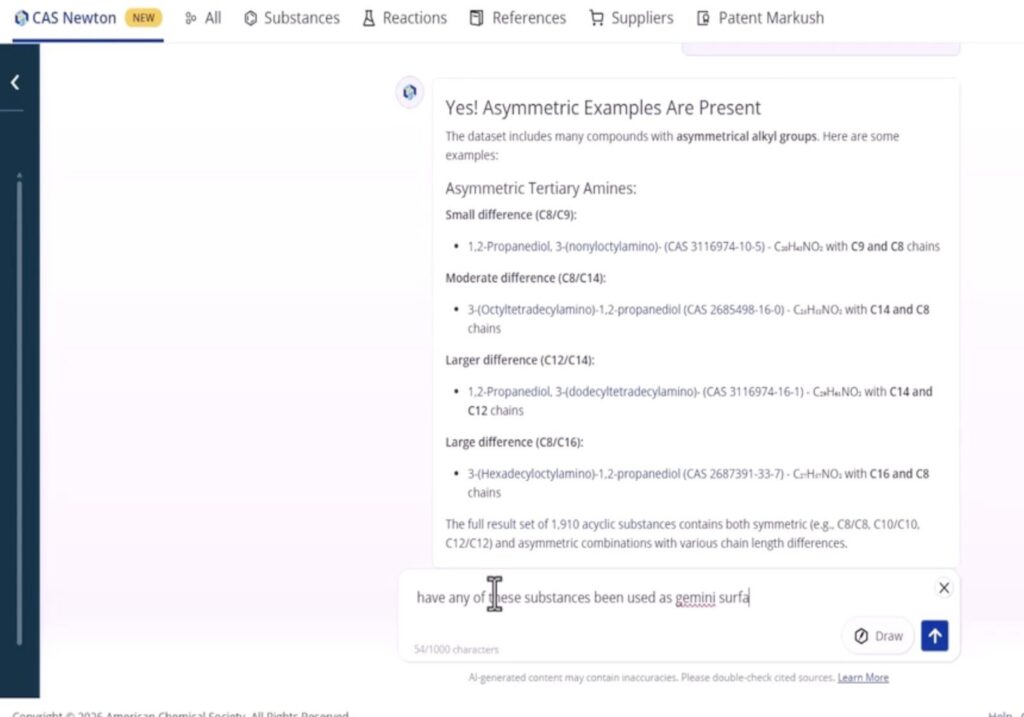
CAS Newton in CAS SciFinder returns compounds with CAS Registry Numbers. Credit: CAS
That context includes knowing when two names describe one substance. The pain reliever acetaminophen is also known as paracetamol; the asthma drug albuterol is also called salbutamol. CAS assigns each substance a unique CAS Registry Number regardless of its names, which gives an agent one identifier to check against. In chemical notation, a single character can separate two molecules. “A one-character difference in science can be a dramatically different chemical compound or a dramatically different chemical concept, and that has meaningful and sometimes dramatic safety implications for a scientist, and accuracy implications for their work,” Jacobs said.
CAS Connections links claims back to CAS source material when that content contributes to an AI-generated answer, Jacobs said. That gives people across a scientific organization a way to check responses, including those whose jobs require working with science outside their own expertise.
“You have deep scientists who know their work really, really well. But you also have business development, project management and other roles that have to deal with scientific information but don’t always have that level of judgment around what is scientifically accurate and what isn’t,” Jacobs said. Validating an answer without that grounding, she said, takes “quite a lot of work and intellectual energy and prior knowledge.”
Connecting scientific data and agents
CAS Connections, launched with several initial collaborators in June 2026, reaches both laboratory software and enterprise AI tools. In electronic laboratory notebooks and laboratory information management systems, the integrations are tailored to specific tasks, such as looking up a compound’s CAS Registry Number or finding reference papers and reactions. For AI platforms such as Copilot, Claude and ChatGPT Enterprise, CAS uses MCP. “That allows us to meet a much more diverse set of use cases through that generalized framework,” Jacobs said.
Through MCP, an AI assistant can draw on two resources: CAS’s curated scientific content and CAS Newton. “Depending on the nature of what someone’s trying to solve, sometimes one or the other of those will be the right tool for the job,” Jacobs said. Direct retrieval serves questions that map to specific information, such as a compound’s properties; Newton works through questions that draw on several kinds of CAS content at once.
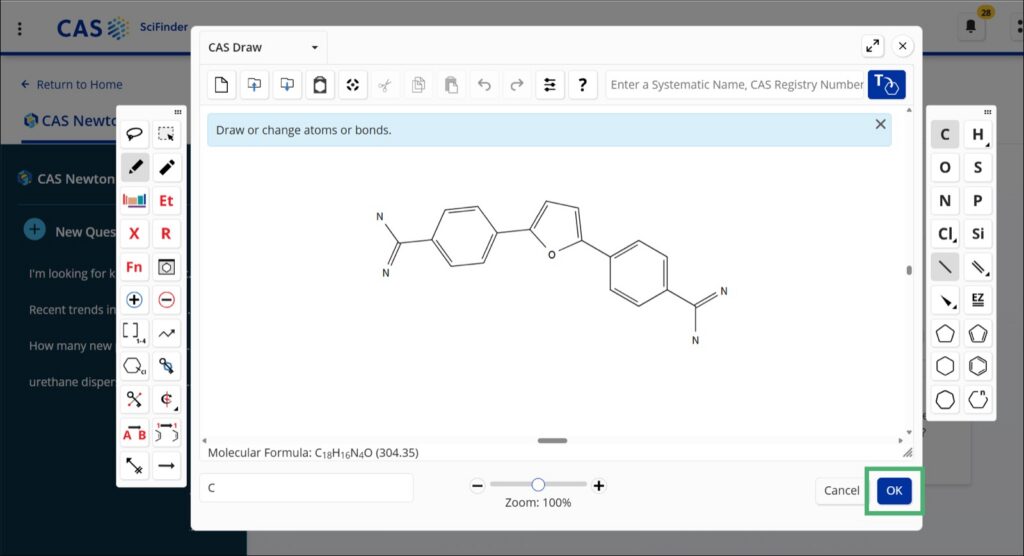
A chemical structure drawn in CAS Draw, ready to send as a question to CAS Newton in CAS SciFinder. Credit: CAS
Bringing AI agents into the physical lab
As agents take on more of that work, Jacobs expects the scientist’s job to change. Planning experiments and anticipating what will happen at the bench give way to directing software. “It becomes much more of a management context. How do I direct the work of a team of AI agents that might be doing things on my behalf? How do I set the right direction?” she said.
Trusted data is one of two problems Jacobs sees between AI capability and laboratory results. The other is physical. “How do you solve the physical-world integration challenges?” she said.
Putting AI agents to work in laboratories also requires connecting them to the instruments that carry out experiments. Jacobs sees early progress toward common standards for those connections. “We are just now starting to see some of the first standard protocols around hardware integration for models,” she said, pointing to Anthropic’s Model Hardware Standard. Anthropic previewed the specification on Aug. 27 to let AI agents operate equipment such as microscopes, liquid handlers and robotic arms. “So, kind of like what we have with the Model Context Protocol, we need to adopt something like that for the physical world,” Jacobs said.
Those connections are one part of the challenge. Instrument makers must also adapt equipment that can remain in service for years, and laboratory automation has physical limits of its own. A system that can dispense liquids, for example, may struggle to handle solid materials. Jacobs said automated chemistry equipment remains limited in the reagents it can accommodate and the reaction conditions it can support. Even when an AI can plan an experiment, carrying it out depends on what the laboratory’s machines can physically do.
For Jacobs, progress in computationally verifiable areas of math and physics offers encouragement for chemistry and biology, where testing ideas usually requires physical experiments. “I think the physics and math examples give us good confidence that what we want to do in chemistry or biology is possible from the AI perspective,” she said. “And then the question becomes how quickly we can overcome both the human challenges and the physical-world challenges to be able to get there.”

Tell Us What You Think!
You must be logged in to post a comment.