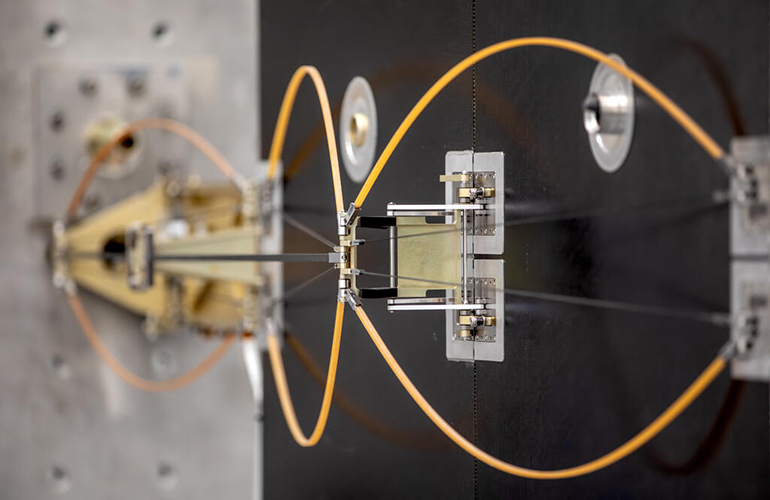
Southwest Research Institute’s Parallelogram Synchronized Truss Assembly (PaSTA) stabilizes deployed solar arrays, enabling spacecraft to use precision-pointing algorithms for attitude control. SwRI is integrating PaSTA into Astroscale U.S.’s in-space refueling spacecraft. Credit: Southwest Research Institute.
Solar arrays have been standard spacecraft hardware for decades, but their tendency to flex can complicate maneuvers needing precision such as docking. To tame the wobble, Southwest Research Institute (SwRI) developed PaSTA, a technology that can bring rigidity to deployable structures on spacecraft, thus enabling autonomous spacecraft docking operations. PaSTA also happens to be one of two 2026 R&D 100-winning entries involving SwRI.
The other winner is ALTRIOS, an open-source digital twin developed through the Advanced Research Projects Agency–Energy’s (ARPA-E’s) LOCOMOTIVES program. ALTRIOS simulates trains, fleets, networks, energy sources and costs over multi-decade rollout scenarios. Its field validation later drew on data from a BNSF battery-electric locomotive demonstration between Stockton and Barstow, California.
PaSTA began with a spacecraft pointing problem
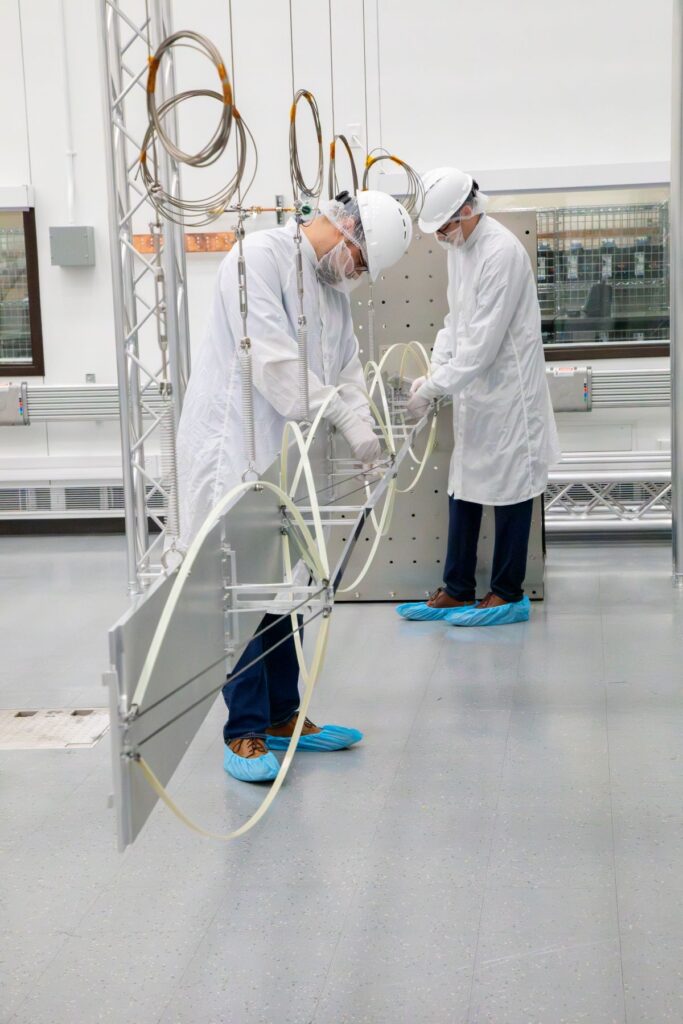
SwRI engineers work on the internally funded Parallelogram Synchronized Truss Assembly (PaSTA), a mechanism designed to stabilize solar arrays on spacecraft performing on-orbit servicing and refueling. Credit: Southwest Research Institute.
Both projects grew from questions about how large, energy-intensive systems behave in motion. PaSTA started as a means to improve the precision maneuvers required for spacecraft docking while supporting a power-hungry electric propulsion system. “I initiated the PaSTA project as a solution related to the fine pointing and high-power requirements of a spacecraft SwRI is currently building,” said Randy Rose, SwRI Institute Engineer. “Its fine pointing requirement is driven by our need to precisely approach, align, and dock with our client spacecraft.”
Rose says the spacecraft’s electric thrusters require 4 kW of power, which called for two four-meter-long solar array wings. “This translates into needing two 4-meter-long solar array wings,” Rose said.
There was a physics challenge. SwRI needed an array large enough to supply the spacecraft while remaining stiff enough for precise pointing and docking. “I challenged our LEXI [Life Extension in Orbit] structures to develop a deployment and support mechanism to stiffen the solar array to a level compatible with the fine pointing requirements,” Rose said. “PaSTA is that solution.”
From there, Ryan Rickerson, manager of SwRI’s Deployable Structures Section, and the rest of the team turned Rose’s concept into a working system.
PaSTA uses buckled S2 fiberglass battens to hold carbon-fiber diagonals in tension. The battens store the strain energy that pushes the array through its deployment motion, locks out the pinned joints and holds the deployed wing in tension.
SwRI evaluated spring steel and carbon-fiber materials including Toray T1000 and T800 before selecting S2 fiberglass. “The S2 fiberglass used in the PaSTA assembly is one of the highest specific resilience materials available,” Rickerson said. “For the battens, SwRI evaluated using spring steel or carbon fiber materials like Toray T1000 or T800, but they cannot take as much mechanical strain as S2 fiberglass and would have made the deployment kinematics more challenging.”
Rickerson said S2 fiberglass can absorb large amounts of energy without permanently deforming. “In fact, S2 fiberglass is used in armor plating because of its ability to absorb energy,” he said.
Rickerson said PaSTA raises the deployed structure’s first natural frequency by roughly an order of magnitude compared with a conventional door-hinge deployment. The official R&D 100 description quantifies the change as below 0.3 Hz to above 1.5 Hz. A higher natural frequency reduces the low-frequency flexible-body motion that can constrain spacecraft pointing and maneuvering. “SwRI’s goal is for this technology to let government and commercial spacecraft developers build vehicles with substantially better pointing and maneuvering capability,” Rickerson said. “Deployed structures normally impose low frequency flexible body modes that constrain how well a spacecraft can point and maneuver. PaSTA raises the deployed first natural frequency by roughly an order of magnitude over conventional door hinge deployments, which gives guidance, navigation, and control designers far more room to work.”
SwRI is open to licensing PaSTA to other prime contractors and is also willing to sell completed assemblies directly, Rickerson said.
How ALTRIOS brings the rail system into one model
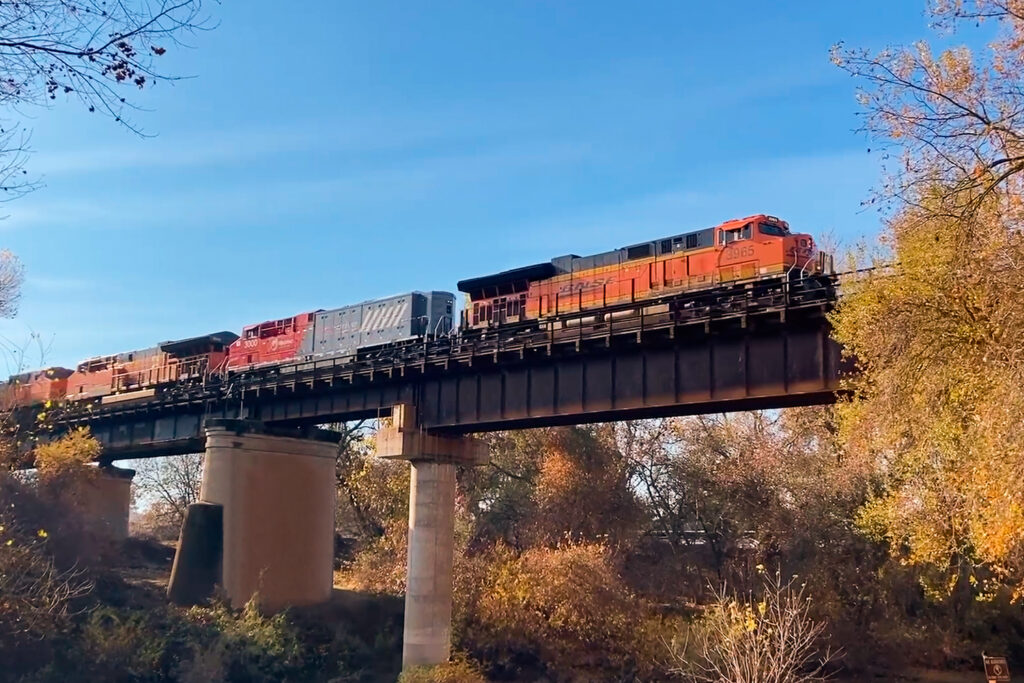
A BNSF freight consist led by diesel locomotive #3965 and featuring Wabtec’s FLXdrive 100% battery-electric locomotive (#3000) situated between conventional Tier 4 diesel units crosses a bridge in California during revenue service pilot testing. Courtesy of BNSF Railway / Wabtec Corporation
Adopting a new locomotive technology sends effects through an entire rail system. Energy use shapes where trains can run, how they are dispatched, where charging or refueling infrastructure must go and what the transition costs over decades. ALTRIOS connects those decisions in an open-source model that can compare rollout strategies across locomotives, trains and networks.
The National Laboratory of the Rockies (NLR), formerly the National Renewable Energy Laboratory, led development and integration. The project team drew on rail-network, dispatch and train-plan models from the RailTEC center at the University of Illinois Urbana-Champaign and researchers at the University of Texas at Austin, locomotive powertrain data and validation from SwRI, and operating data and railroad requirements from BNSF. SwRI’s task was to ground the system-level model in the measured behavior of actual locomotives.
“SwRI provided experimental data on a variety of locomotives covering auxiliary and traction power, fuel consumption, and exhaust emissions,” said Steven Fritz, senior manager of SwRI’s Locomotive Technology Center, in written responses provided by the institute. “These informed the powertrain efficiency maps, component models, and related calibrations in ALTRIOS.”
A roughly 375-mile route between Barstow and Stockton, California, that BNSF operates then became a proving ground for the model. The field data came primarily from the CARB-funded, BNSF-led ZANZEFF battery-electric locomotive demonstration. Additional event-recorder data supplemented the data. The demonstration consist paired one 2.4-MWh Wabtec battery-electric locomotive with two Wabtec Tier 4 ET44C4 diesel-electric locomotives.
CARB reports 18 round trips during the full three-month demonstration. The ALTRIOS validation dataset covered 17 round trips, 6,375 miles and 900 hours of recorded data. “The route’s mix of mountainous terrain (high power demand and regenerative braking opportunities) and long flat sections provided a wide range of operating conditions,” Fritz said.
For the diesel locomotives, the team calibrated idle fuel rate and drivetrain efficiency, with the engine efficiency map drawing on AAR end-of-useful-life test data. The 2023 NREL presentation reports a 3.94% time-averaged fuel-energy error for the example conventional-locomotive validation trip; Fritz put suitable trips in a roughly 3.9% to 4.2% range. On the battery-electric side, the team deliberately avoided reverse-engineering the locomotive’s specific controls and design details. Fritz noted the unit ran air-cooled batteries and unoptimized controls at the time, so validation focused on broader energy-use and state-of-charge trends. Overall train-level agreement remained acceptable given the operational uncertainties, according to Fritz.
Taken together, the test-cell and field data underscores ALTRIOS’s significance. Fritz described it as “the first fully validated, comprehensive open-source model for rail decarbonization simulations.”