SLAC National Accelerator Laboratory and Sandia National Laboratories will lead COMPASS, a new program with funding from the DOE’s Office of Technology Commercialization that aims to facilitate the launch of startups based on national lab technologies.
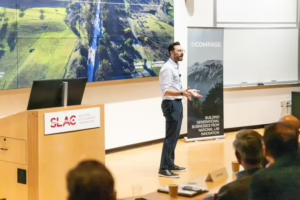
Alex Rousina-Webb speaking at the Waypoints event in July. [Photo: Jacqueline Ramseyer Orrell/SLAC]
“COMPASS is based on the premise that an incredible amount of innovation happens at the Department of Energy national labs, and we firmly believe that not enough of that innovation makes it out into the world and into new startups,” said Alex Rousina-Webb, a technology transfer manager at SLAC and co-lead of COMPASS. A central historical driver of the so-called “valley of death” in technology transfer related to DOE projects and industry is lack of alignment, as the Government Accountability Office noted in 2021 “We haven’t built the right fabric that sits between the labs and new startups to bridge those technologies into the world. That’s what we’re building with COMPASS.”
Connecting investors with researchers
COMPASS has built a network of venture capitalist investors, aiming to engage them with technologies from the very beginning, Rousina-Webb said. The investors help COMPASS identify where there are spaces in the market and problems that can be solved with technologies, then COMPASS goes to the national labs to find the right projects to fill those gaps.
In addition to SLAC and Sandia, COMPASS works with six other national labs. The program works closely with the technology transfer offices at those labs to identify technologies that are at the right stage for COMPASS, Rousina-Webb said.
The program also looks for the right founder for the potential startups. “We’d like to partner with entrepreneurs who have very sector-specific experience or a proven track record of entrepreneurship and exits and that will give us the highest likelihood of success when it comes to launching these new ventures,” Rousina-Webb said.
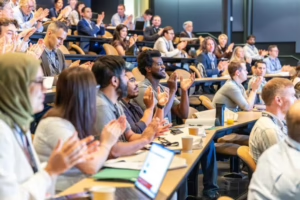
Attendees at the Waypoint COMPASS event, which brought researchers and investors together. [Photo: Jacqueline Ramseyer Orrell/SLAC]
“This was a chance for [the investors] to meet one-on-one with the research team and give us more feedback on where we should spend our time,” Rousina-Webb said. “It also gave the researchers a chance to better understand what venture capital investors tend to look for in new startups.”
Waypoints was different from similar events because the technologies hadn’t begun the process of becoming a company yet, Rousina-Webb said.
“Typically, when an investor meets a company, a lot of the decision-making is already done. They can offer advice on course correction, but not really on fundamental changes to how the startup operates. What we’ve done here is bring people together at a point where that kind of feedback on fundamental direction is still possible, and that’s the feedback we use to determine which ventures we’re going to build and how we’re going to build them,” he said.
The first cohort
COMPASS launched in January of this year as a pilot program. The program is starting with a cohort of five ventures, Rousina-Webb said. Over the program’s three-year life, he expects it to support five teams per cohort across two cohorts and launch six of those ten as startups.
While the structure of the process is very similar for every venture, each one has slightly different needs, so a one-size-fits-all solution won’t work, Rousina-Webb said. That’s part of the reason COMPASS is starting with such a small first cohort.
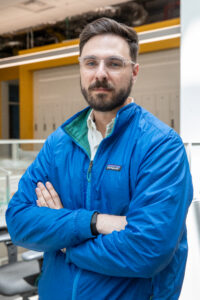
Alex Rousinia-Webb [Photo: Sam Soon/SLAC National Accelerator Laboratory]
COMPASS will announce the first five ventures in the next few weeks, he added. Once the cohort is chosen, the program is aiming to have them ready for their first non-dilutive capital raise within six months.
The program focuses on four areas it believes are best suited to the start-up approach: AI and autonomy, advanced sensing, advanced manufacturing and energy technologies, Rousina-Webb said.
“More than those specific areas, it tends to come down to the level of differentiation and improvement in the technology itself,” he said. “We really only look to work with technologies that offer a step-change improvement in whatever the relevant metric is for that industry or problem. A 10% improvement is still a very valuable innovation, and it will go on to have impact in various industries, but it’s not as well suited for a venture as something that offers a 10x or 100x improvement over the way things are done today.”
Once the startups launch, COMPASS hopes to maintain long-term relationships with the companies.
“Ultimately, we want to be judged on the outcomes of those companies down the line, not just on how many businesses we launched, but on the value those businesses went on to generate in the world,” Rousina-Webb said.