Research & Development World

  • R&D World Home
  • Topics
    • Aerospace
    • Automotive
    • Biotech
    • Careers
    • Chemistry
    • Environment
    • Energy
    • Life Science
    • Material Science
    • R&D Management
    • Physics
  • Technology
    • 3D Printing
    • A.I./Robotics
    • Software
    • Battery Technology
    • Controlled Environments
      • Cleanrooms
      • Graphene
      • Lasers
      • Regulations/Standards
      • Sensors
    • Imaging
    • Nanotechnology
    • Scientific Computing
      • Big Data
      • HPC/Supercomputing
      • Informatics
      • Security
    • Semiconductors
  • R&D Market Pulse
  • R&D 100
    • 2025 R&D 100 Award Winners
    • 2025 Professional Award Winners
    • 2025 Special Recognition Winners
    • R&D 100 Awards Event
    • R&D 100 Submissions
    • Winner Archive
  • Resources
    • Research Reports
    • Digital Issues
    • Educational Assets
    • R&D Index
    • Subscribe
    • Video
    • Webinars
    • Content submission guidelines for R&D World
  • Global Funding Forecast
  • Top Labs
  • Advertise
  • SUBSCRIBE

3D-printed Structures Are Feeling the Pressure

By Lawrence Livermore National Laboratory | June 28, 2016

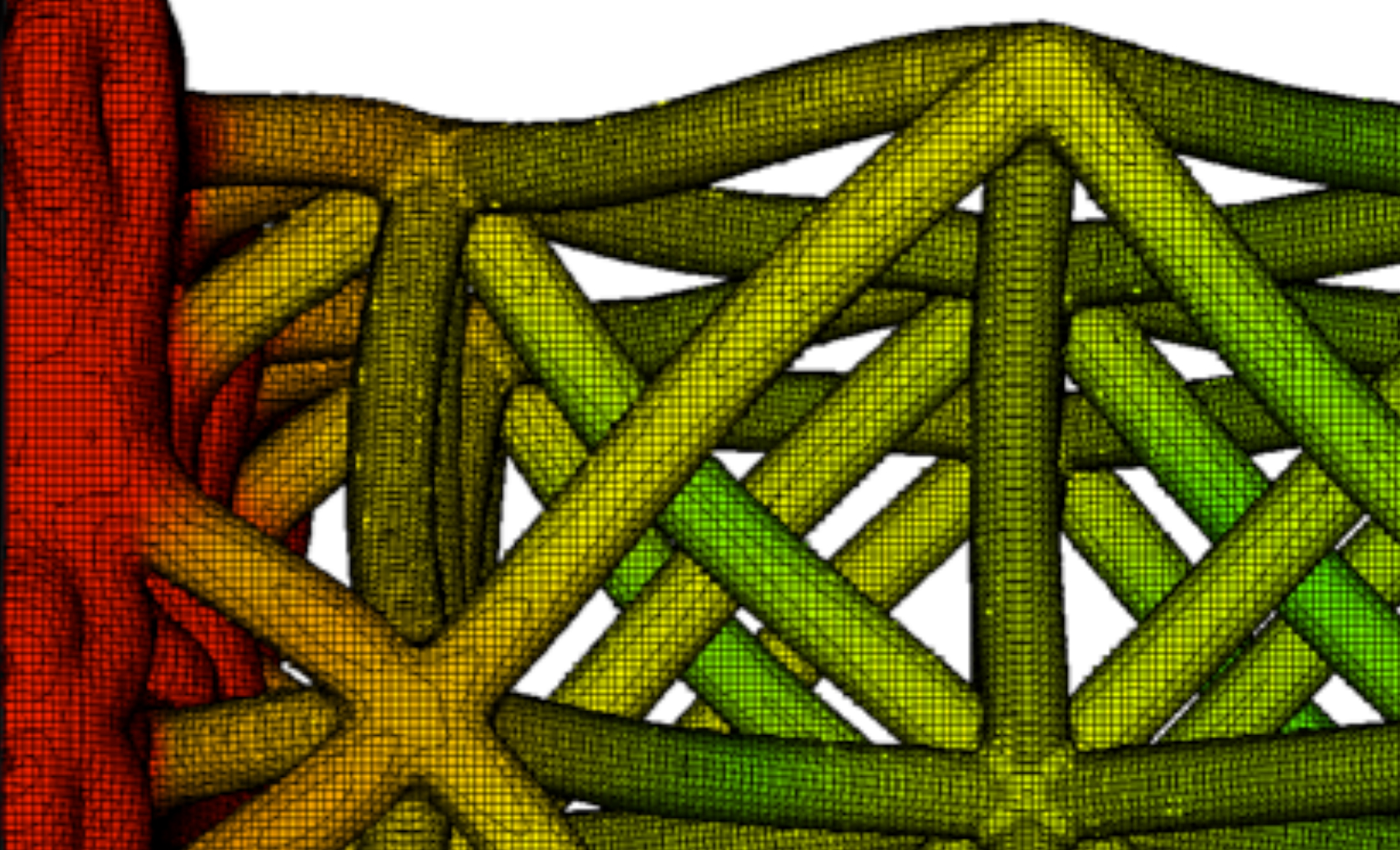
A snapshot from a finite element simulation where the color scale indicates the material velocity and deformation of the lattice as the compression wave travels from left to right.

Through a series of dynamic compression experiments on additively manufactured (AM) structured lattices, a Lawrence Livermore National Laboratory team, supported by colleagues at Los Alamos National Laboratory, has found that the assemblies have unique properties not exhibited by disordered cellular materials.

During the experiment, elastic deflection of the structure occurred ahead of the compaction front and in turn the AM lattice materials supported a precursor wave that has not been seen in disordered materials, such as traditional open-cell stochastic foams, which have a comparable density.

This research allows scientists to build accurate models of AM-structured materials under dynamic loading. The study is published in Scientific Reports (part of the Nature Publishing Group).

The physical world is filled with cellular structures — both manmade, like truss bridges, and natural origin, like porous bone tissue. These entities demonstrate a material response optimized through topology rather than composition. Cellular materials have received significant attention over the last several decades for their thermal, electrical and optical properties as well as for their potential as lighter-weight replacements for bulk materials.

Conventional materials design relies on manipulation of chemistry or microstructural length scales, such as grain size distributions. With the advent of AM — often called 3D printing — scientists are able to manipulate the architecture of the cellular material to impart order and periodicity into materials at the mesoscopic scale.

During the recent experiments — conducted at the NNSA-sponsored Dynamic Compression Sector of the Advanced Photon Source at Argonne National Laboratory — the team found that the elastic and compaction behavior exhibits collective response rapidly under impact loading. Time-resolved phase contrast imaging enabled an unprecedented window in real time into the propagation of a stress wave in the lattice structures.

“The basic approach is to be able to use the collective properties of an engineered structure at the micron scale to influence the macromechanical response,” says LLNL materials scientist Mukul Kumar, and project lead.

The ability to understand and then organize the structure and composition at the mesoscopic scale allows the custom design of materials by applying structural engineering principles, like truss theory, at the micron length scale. This will open up the possibility of designing and engineering material properties to precisely meet the demands of the intended application.

Other Livermore researchers include Jonathan Lind, Brian Maddox, Matthew Barham, Mark Messner, and Nathan Barton, as well as lead author James Hawreliak (formerly at LLNL) of Washington State University, and Brian Jensen of Los Alamos National Laboratory.

Source: Lawrence Livermore National Laboratory

Related Articles Read More >

Caltech team 3D-prints drug depots deep inside living tissue
What could make MXene a key to ultra-precise, additive-free 3D microprinting?
Industry 4.0 Modern Factory: Facility Operator Controls Workshop Production Line, Uses Computer with Screens Showing Complex UI of Machine Operation Processes, Controllers, Machinery Blueprints
Building the thinking factory: An additive exec on AI, automation, and the skills crisis
Red Bull and Mercedes F1 cars 3D illustration, 30 Aug, 2022, Texas, EUA
6 technologies pushing Formula 1’s engineering frontier
rd newsletter
EXPAND YOUR KNOWLEDGE AND STAY CONNECTED
Get the latest info on technologies, trends, and strategies in Research & Development.
RD 25 Power Index

R&D World Digital Issues

Fall 2024 issue

Browse the most current issue of R&D World and back issues in an easy to use high quality format. Clip, share and download with the leading R&D magazine today.

Research & Development World
  • Subscribe to R&D World Magazine
  • Sign up for R&D World’s newsletter
  • Contact Us
  • About Us
  • Drug Discovery & Development
  • Pharmaceutical Processing
  • Global Funding Forecast

Copyright © 2025 WTWH Media LLC. All Rights Reserved. The material on this site may not be reproduced, distributed, transmitted, cached or otherwise used, except with the prior written permission of WTWH Media
Privacy Policy | Advertising | About Us

Search R&D World

  • R&D World Home
  • Topics
    • Aerospace
    • Automotive
    • Biotech
    • Careers
    • Chemistry
    • Environment
    • Energy
    • Life Science
    • Material Science
    • R&D Management
    • Physics
  • Technology
    • 3D Printing
    • A.I./Robotics
    • Software
    • Battery Technology
    • Controlled Environments
      • Cleanrooms
      • Graphene
      • Lasers
      • Regulations/Standards
      • Sensors
    • Imaging
    • Nanotechnology
    • Scientific Computing
      • Big Data
      • HPC/Supercomputing
      • Informatics
      • Security
    • Semiconductors
  • R&D Market Pulse
  • R&D 100
    • 2025 R&D 100 Award Winners
    • 2025 Professional Award Winners
    • 2025 Special Recognition Winners
    • R&D 100 Awards Event
    • R&D 100 Submissions
    • Winner Archive
  • Resources
    • Research Reports
    • Digital Issues
    • Educational Assets
    • R&D Index
    • Subscribe
    • Video
    • Webinars
    • Content submission guidelines for R&D World
  • Global Funding Forecast
  • Top Labs
  • Advertise
  • SUBSCRIBE