Research & Development World

  • R&D World Home
  • Topics
    • Aerospace
    • Automotive
    • Biotech
    • Careers
    • Chemistry
    • Environment
    • Energy
    • Life Science
    • Material Science
    • R&D Management
    • Physics
  • Technology
    • 3D Printing
    • A.I./Robotics
    • Software
    • Battery Technology
    • Controlled Environments
      • Cleanrooms
      • Graphene
      • Lasers
      • Regulations/Standards
      • Sensors
    • Imaging
    • Nanotechnology
    • Scientific Computing
      • Big Data
      • HPC/Supercomputing
      • Informatics
      • Security
    • Semiconductors
  • R&D Market Pulse
  • R&D 100
    • 2025 R&D 100 Award Winners
    • 2025 Professional Award Winners
    • 2025 Special Recognition Winners
    • R&D 100 Awards Event
    • R&D 100 Submissions
    • Winner Archive
  • Resources
    • Research Reports
    • Digital Issues
    • Educational Assets
    • R&D Index
    • Subscribe
    • Video
    • Webinars
    • Content submission guidelines for R&D World
  • Global Funding Forecast
  • Top Labs
  • Advertise
  • SUBSCRIBE

Employing Artificial Intelligence to Predict Suicide Risk

By Joanne Van Zuidam | October 31, 2017

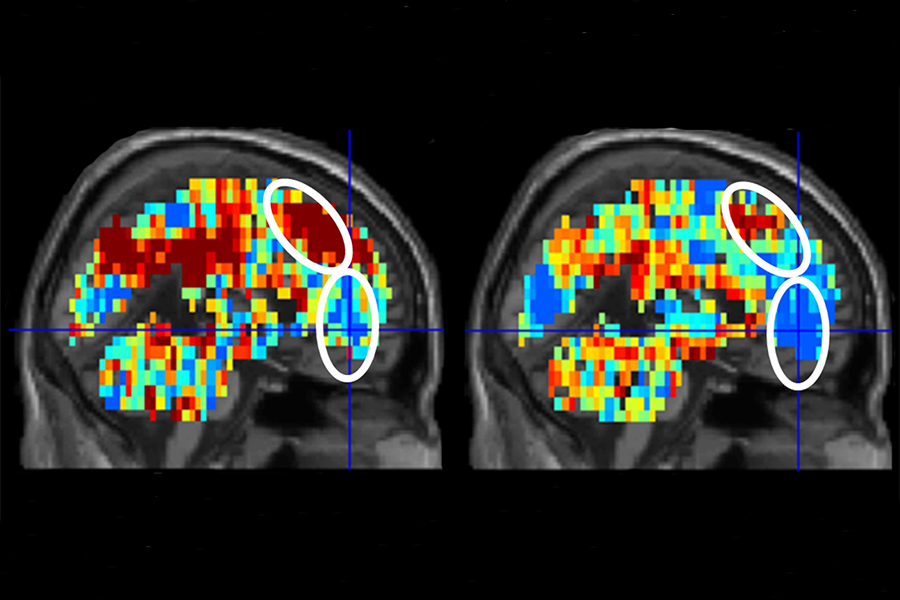
On the left is the brain activation pattern for “death” in participants who had made a suicide attempt. The image in the right depicts the activation pattern for “death” in control participants. Credit: Carnegie Mellon University

Suicide is the second-leading cause of death among young adults in the United States. Equally troubling, suicide risk is hard to assess and predict. But what if you can identify risk by analyzing the alterations in how a patient’s brain represents certain concepts?

A research team from Carnegie Mellon University and the University of Pittsburgh have developed an innovative way to identify suicidal individuals—with the help of brain scans and artificial intelligence.

Their study, published in Nature Human Behavior, found “neural signatures” that can tell whether someone is considering suicide. 

Building on previous work in machine learning to identify what people are thinking, Marcel Just, an author of the paper and the D. O. Hebb professor of cognitive neuroscience at Carnegie Mellon University, theorized that brain patterns may reveal a difference in the way suicidal patients think. 

“Our latest work is unique insofar as it identifies concept alterations that are associated with suicidal ideation and behavior, using machine-learning algorithms to assess the neural representation of specific concepts related to suicide,” says Just, the D.O. Hebb University Professor of Psychology in CMU’s Dietrich College of Humanities and Social Sciences. “This gives us a window into the brain and mind, shedding light on how suicidal individuals think about suicide and emotion related concepts.”

For the study, Just, David Brent, professor of psychiatry, pediatrics, epidemiology and clinical and translational science at Pitt, and their team used the machine-learning algorithms (Gaussian Naïve Bayes) to identify suicidal individuals.

Participants included 17 patients with suicidal ideation and 17 individuals who were neurotypical as a control. Word concepts were presented to the two groups while they were undergoing functional magnetic resonance imaging (fMRI). Participants were asked to think about the word concepts for three seconds while their brain activity was recorded. Words presented as stimuli were categorized into three groups: suicide (e.g., death) positive (e.g., carefree, kindness), or negative (e.g., trouble).

The resulting data was fed to a machine learning program which looked for brain patterns that distinguished between the two groups. The program was able to identify with 91 percent accuracy whether a participant was from the control or suicidal group. What’s more, the program was able to identify those who had previously attempted suicide with 94 percent accuracy.

While the study was small, and more research is needed to validate the findings, the researchers hope their findings will one day save lives.

“Further testing of this approach in a larger sample will determine its generality and its ability to predict future suicidal behavior, and could give clinicians in the future a way to identify, monitor and perhaps intervene with the altered and often distorted thinking that so often characterizes seriously suicidal individuals,” said Brent.  

Related Articles Read More >

How Prelude and QDX are using quantum chemistry to discover cancer treatments
US political drama is pushing life sciences talent toward Switzerland, Basel leader says
Thermo Fisher targets early-stage CGT bottlenecks with new Philadelphia hub
AUTOMA+ 2025 brings global pharma expertise to Austria
rd newsletter
EXPAND YOUR KNOWLEDGE AND STAY CONNECTED
Get the latest info on technologies, trends, and strategies in Research & Development.
RD 25 Power Index

R&D World Digital Issues

Fall 2025 issue

Browse the most current issue of R&D World and back issues in an easy to use high quality format. Clip, share and download with the leading R&D magazine today.

Research & Development World
  • Subscribe to R&D World Magazine
  • Sign up for R&D World’s newsletter
  • Contact Us
  • About Us
  • Drug Discovery & Development
  • Pharmaceutical Processing
  • Global Funding Forecast

Copyright © 2025 WTWH Media LLC. All Rights Reserved. The material on this site may not be reproduced, distributed, transmitted, cached or otherwise used, except with the prior written permission of WTWH Media
Privacy Policy | Advertising | About Us

Search R&D World

  • R&D World Home
  • Topics
    • Aerospace
    • Automotive
    • Biotech
    • Careers
    • Chemistry
    • Environment
    • Energy
    • Life Science
    • Material Science
    • R&D Management
    • Physics
  • Technology
    • 3D Printing
    • A.I./Robotics
    • Software
    • Battery Technology
    • Controlled Environments
      • Cleanrooms
      • Graphene
      • Lasers
      • Regulations/Standards
      • Sensors
    • Imaging
    • Nanotechnology
    • Scientific Computing
      • Big Data
      • HPC/Supercomputing
      • Informatics
      • Security
    • Semiconductors
  • R&D Market Pulse
  • R&D 100
    • 2025 R&D 100 Award Winners
    • 2025 Professional Award Winners
    • 2025 Special Recognition Winners
    • R&D 100 Awards Event
    • R&D 100 Submissions
    • Winner Archive
  • Resources
    • Research Reports
    • Digital Issues
    • Educational Assets
    • R&D Index
    • Subscribe
    • Video
    • Webinars
    • Content submission guidelines for R&D World
  • Global Funding Forecast
  • Top Labs
  • Advertise
  • SUBSCRIBE